
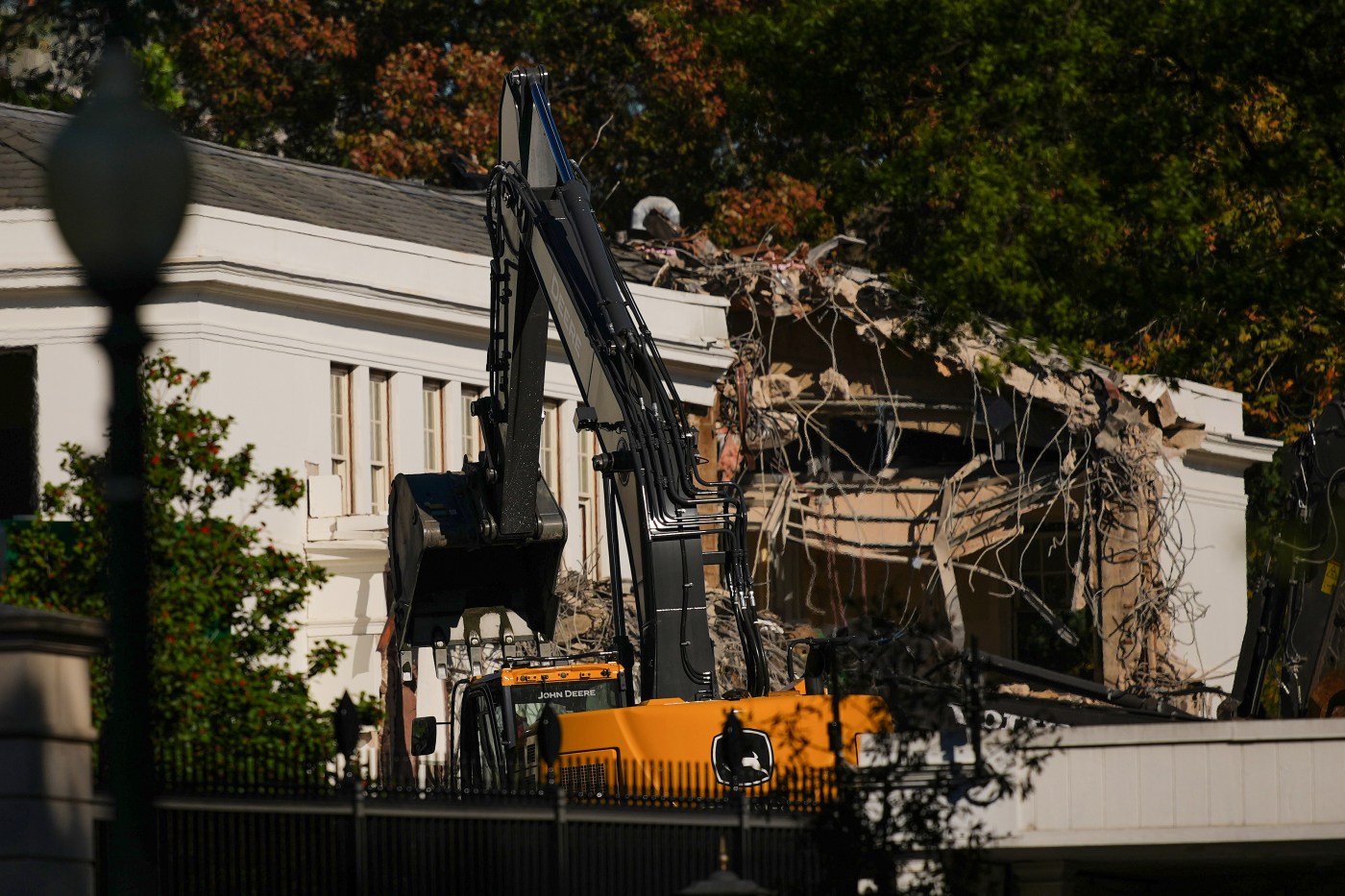
East Wing of White House to be demolished for Trump’s ballroom, official says

The White House is demolishing the entirety of the East Wing to make way for President Donald Trump’s $200 million ballroom, a construction project that is far more extensive than he initially let on, a senior administration official said Wednesday.
The teardown should be finished by this weekend, according to the official, who was not authorized to speak publicly about the plans.
When Trump first announced his plans for the ballroom, he pledged that the East Wing wouldn’t be touched by the construction.
“It’ll be views of the Washington Monument. It won’t interfere with the current building. It’ll be near it but not touching it,” the president said in October. “And pays total respect to the existing building, which I’m the biggest fan of.”
But, upon further evaluation, the White House determined it was cheaper and more structurally sound to demolish the East Wing to construct the ballroom, rather than build an addition, the official said.
The new structure will also have enhanced security features, the official said.
A model is seen as President Donald Trump addresses a dinner for donors who have contributed to build the new ballroom at the White House, Wednesday, Oct. 15, 2025, in Washington. (AP Photo/John McDonnell)
Renderings released by the White House suggest a strong resemblance to the gilded ballroom at Mar-a-Lago, Trump’s private club and home in Palm Beach, Fla.
The project also has grown in size since it was announced, going from accommodating 650 seated guests to holding 999 people, big enough to fit an inauguration if needed, Trump said at a recent White House dinner for donors. Windows will be bulletproof, he said.
The White House has said the ballroom will be ready for use well before Trump’s term ends in January 2029.
Trump is raising tens of millions in private donations to fund the project, the official said. The president plans to contribute some of his own money as well, though the amount has not been determined, the official added.
Architects question plan
Ever since Trump announced plans to build a ballroom in the White House, prominent architecture groups have raised concerns. Just last week, the Society of Architectural Historians urged that “such a significant change to a historic building of this import should follow a rigorous and deliberate design and review process.”
And on Tuesday, demolition crews tore off the facade of the East Wing.
The speed with which the president is moving ahead with building the ballroom caught the architecture profession by surprise. And it raised questions about whether the administration was following the traditional approval process for building on the White House grounds.
Some of the country’s most prominent architecture groups had been calling for careful deliberation, review and planning.
WASHINGTON, DC – OCTOBER 20: The facade of the East Wing of the White House is demolished by work crews on October 20, 2025 in Washington, DC. The demolition is part of U.S. President Donald Trump’s plan to build a ballroom reportedly costing $250 million on the eastern side of the White House. (Photo by Kevin Dietsch/Getty Images)
“While we recognize that the White House is a building with evolving needs, and that it has undergone various exterior and interior modifications since construction began in 1792, the proposed ballroom will be the first major change to its exterior appearance in the last 83 years (since the East Wing in its current form was built in 1942),” the Society of Architectural Historians said in its statement last week.
The American Institute of Architects noted over the summer that although the project would be privately funded, the White House was not a private building. “The historic edifice at 1600 Pennsylvania Avenue is the People’s House, a national treasure and an enduring symbol of our democracy,” it said in a statement in August, after the proposal was revealed. “Any modifications to it — especially modifications of this magnitude — should reflect the importance, scale and symbolic weight of the White House itself.”
The 90,000-square-foot ballroom will dwarf the main White House itself, at nearly double the size, and Trump says it will accommodate 999 people.
The Trump administration brushed off criticisms in a news release that referred to the long history of construction projects at the White House.
“In the latest instance of manufactured outrage, unhinged leftists and their fake news allies are clutching their pearls over President Donald J. Trump’s visionary addition of a grand, privately funded ballroom to the White House — a bold, necessary addition that echoes the storied history of improvements and renovations from commanders-in-chief to keep the executive residence as a beacon of American excellence,” it said in the statement.
Short review process
Some preservation specialists who have worked on White House proposals in the past raised questions about how the ballroom project was being reviewed.
Thomas M. Gallas, who was a member of the National Capital Planning Commission when it reviewed a proposal to build a new tennis pavilion on the White House grounds during Trump’s first term, said that such proposals would typically be submitted for review earlier.
“Usually those reviews happen in the early stages of what we would call concept design or schematic design,” he said in an interview. “Through the review process, if change is needed, you want to make those early before the architects and engineers have drawn the construction documents.”
Joan M. Brierton, a preservation specialist who spent nearly three decades with the General Services Administration overseeing federal building projects before leaving this year, said that changes to the White House typically required review by a number of commissions. She pointed to a series of projects reviewed by the Commission of Fine Arts in recent years, including the construction of the tennis pavilion.
Conservative support
Will Scharf, Trump’s staff secretary and the chair of the National Capital Planning Commission, said at a meeting last month that people have called for years for a large event space at the White House. He questioned reports suggesting that the commission should have been consulted earlier, calling them “deceiving.”
Scharf said that the commission had jurisdiction over construction, not demolition. When a plan is submitted, he said, the commission would review it with other parties to make sure it is “as beautiful as it can be.”
Edward Lengel, who served as chief historian of the White House Historical Association for two years until 2018, said he had been getting questions about the process. “People have asked me if this is illegal. I don’t think this is illegal,” he said. “I think this is a big loophole that has always been there. Previous presidents have observed precedent and not tried to exploit that loophole.”
When officials unveiled plans for the ballroom in late July, some conservatives believed it resembled the president’s vow to make “Federal Architecture Beautiful Again” — as he wrote in August in an executive order about the merits of neoclassical design.
This report includes information from the Associated Press.




More Stories
Beyond the Microphone: British Comedians Who Became Directors and Presenters
Stephen Merchant co-created The Office and went on to write and direct for the cinema. Simon Amstell writes and directs...
Top 10 Best Hair Transplant Doctors in Turkey: A 2026 Guide to Surgeons
This guide names the top 10 best hair transplant doctors in Istanbul for 2026 and explains, in plain terms, how...
How to Choose an HR System for a Growing UK Business
For a while, email and spreadsheets seem good enough. Then managers start asking where the latest file is, staff have...
Top 10 Best Hair Transplant in Turkey
Turkey has become one of the world’s most familiar destinations for hair restoration, with Istanbul attracting patients from Europe, the...
How to Register a Company in Hong Kong in 2026: A Guide for UK SMEs
You can register a company in Hong Kong remotely, but plan tax, banking and compliance before you start. Why UK...
Timur Turlov Takes Freedom SuperApp Beyond Kazakhstan as Digital Expansion Accelerates
The application combines banking, investments and everyday services in one digital environment. Having built its customer base in Kazakhstan, the...