
Penalty kill is vital to Bruins’ success

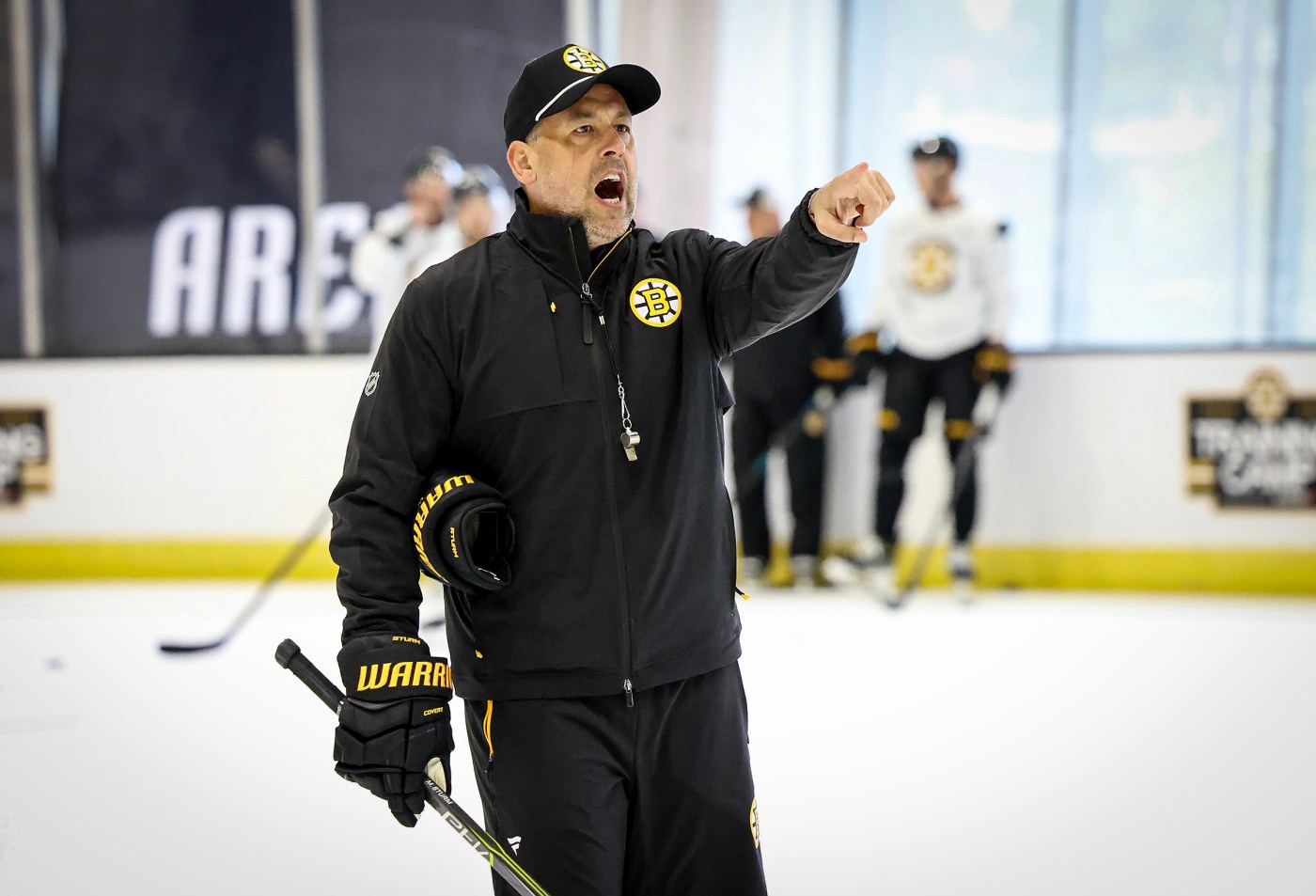
Just as he was as a player, Marco Sturm the coach is quick to smile and give off a positive vibe, at least off the ice.
But if you’re looking to furrow the new Bruins coach’s brow quickly, bring up his team’s penalty kill. It concerned him back in the summer before he ever put whistle to mouth and it concerned just a few days ago as opening night looms.
It’s no secret why. The B’s, once a standard in the PK department, fell to 24th in the NHL. On top of that, they traded away three players who had been stalwarts on the kill – Brad Marchand, Charlie Coyle and Brandon Carlo – in the retool. Considering the edge with which they want to play, coupled with the fact this team will be challenged to score goals beyond David Pastrnak and Morgan Geekie, having a strong PK is paramount to any success they hope to have.
Throughout camp, Sturm has been holding open auditions for the PK.
“We were short a little bit on killers so there’s a few guys – Tanner Jeannot, (Casey) Mittelstadt, those guys, Mikey (Eyssimont) – one of them we need as a killer. We might have to turn him into a killer,” said Sturm, who added on Monday that a big reason why John Beecher made the team was because of his PK prowess. “That’s why we’ve tried things out the last few games and we’re going to continue with that because we’re short on that. Whoever does the best job will get the job, that’s for sure.”
There are a couple of naturals for the job, like Pavel Zacha and Elias Lindholm. But more are needed. Eyssimont showed his prowess in it in the second preseason game at Madison Square Garden when, shorthanded, he stripped Ranger defenseman Adam Fox and scored a goal that spurred a comeback that would erase a three-goal deficit.
Another player who has raised his hand emphatically is Jeannot, who signed a five-year deal worth $3.4 million per season. He has not skated on the penalty kill in a couple of years and he’s eager to get back on it.
“It was a big part of my game in Nashville and it’s something I’m really looking forward to taking pride in,” said the 28-year-old Jeannot. “It’s one of the reasons why I wanted to come here. I thought there was going to be opportunity for me to be doing that again. It’s something that I just take a lot of of pride in and it gives you a lot of purpose on a team if you can have a PK and guys are confident and playing hard and you get a call against you that you can kill it off. Every opportunity I get I want to make the most of it.”
When David Krejci was here, he would often say that whenever he wasn’t feeling the puck like he wanted to, working on the PK would get him back on track. The big, physical Jeannot may be a different kind of player from the silk-mitted Krejci, but the same concept is applicable.
“For sure. It gets you involved in a different way in the game,” said Jeannot. “It’s not necessarily an offensive-minded thing but you’re getting out there and you’re seeing the puck and the pace of play and you’re just feeling into the game. It can definitely spark something. When you’re feeling more in the game then you can be confident in other areas as well.”
Jeannot has been paired a couple of times with Zacha and the duo created a 2-on-1 that Zacha couldn’t convert in the shootout loss to Philadelphia at the Garden.
Zacha, a regular on the PK since he arrived in Boston, has liked the approach so far.
“We’ve had a lot of video sessions and it’s good to have had a couple of reps in the games. It always starts to get better when you get two guys reading off each other and get a couple of reps together so that we can communicate on the ice I think the systems that we’re going to do this year is going to be really good,” said Zacha. “We’ve got some really strong defensemen still. And I noticed we’re going to rotate more guys into it so everybody stays fresh as forwards. But that’s one of the biggest parts of the game. If you get scored on with one or two goals a game in the penalty kill, it’s hard to win. There’s not many goals 5-on-5 anymore so we have to be better than last year. I think we have really good players that we brought on in the offseason who can skate and read the game, so I think we have some good options on the penalty kill.”
One thing the B’s don’t really have yet – or at least he’s not yet been identified – is a scoring threat on the PK. When Marchand left, so did his franchise-record 36 shorthanded goals. The danger of Marchand going the other way for a scoring chance, especially when he was paired with Patrice Bergeron, did wonders to make a power play just a hair tentative.
“It’s a huge help,” said Zacha. “Mentally, it’s a big thing, too. If you have a couple of shorthanded goals in the season, teams are a little more passive trying to pass through guys. It’s a mental game if you can score a couple of goals. Marchie was a big part of that. But I think we have some fast guys who score goals. It’s a big advantage if you can score, even if it’s just once every couple of games. It helps a lot.”
But when asked how important it was for a PK to develop a scoring threat, Sturm pulled the emergency brake, highlighting how much he’s still working on the foundation of this critical area of the game.
“That’s the next step. I’m not there yet. We’ve tweaked a few things on the PK so they have to get comfortable first and then we can talk more about that,” said Sturm. “Those Marchands, the Bergerons, they did it blindly. It was unbelievable. But they’d been together for a long, long time. I feel like that’s almost where we have to start to (create) those pairs again so that we get used to each other in every situation. And we’re just not there yet.”

More Stories
West increasingly vulnerable to energy shocks – IMF
Dwindling oil inventories, low gas stocks and mounting public debt are leaving European economies exposed to further price surges, according...
Best Sites to Buy TikTok Followers, Views and Likes in the UK
Some turn to paid engagement services to increase their follower counts, views and likes. These services can make profiles and...
Tony Buzbee: Why the Buzbee Law Firm Treats Community Work as Part of the Business
The firm takes on personal injury claims, workplace accidents, defective products and medical devices, commercial disputes, and gender discrimination cases,...
The missing space in the hybrid office: a better place for video calls
Video calls have become as routine as email, yet many offices were designed long before the first Teams invite landed...
Best Sites to Buy Instagram Followers, Likes and Views in UK
That is why some users choose to buy Instagram followers, likes and views. These services increase visible numbers, helping profiles...
Midwest Ragdolls: More Than 30 Years in Elburn
Despite that growth, Midwest Ragdolls remains a small, family-run operation, and the same people who built the business over more...