
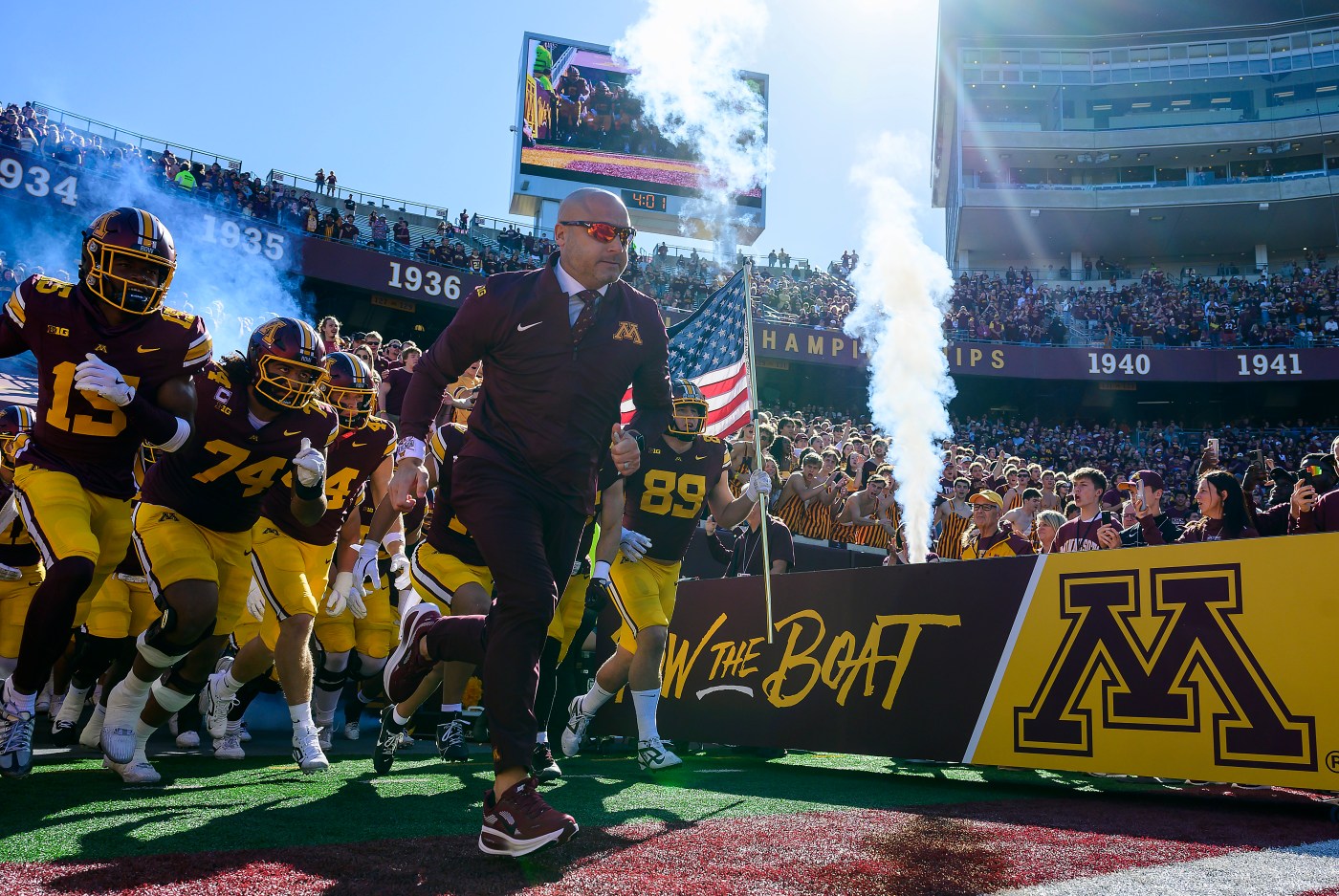
Would Gophers be left out of a college football ‘super league?’

One of the biggest rumors buzzing around college football these days is on the potential creation of a “super league” of top programs nationwide.
An initial step toward this sort of consolidation came when the Big Ten and Southeastern conferences became more hegemonic in 2024, growing to 18 and 16 schools, respectively.
As a result, the Big XII and Atlantic Coast conferences gobbled up other schools, while the Pac-12 turned into a shell of itself.
Instead of a “Power Five” set of conferences; it’s now a “Power Four.” But this gossip is well beyond that.
One industry source told the Pioneer Press in September that one idea is to have a 32- or 48-team division at some point in the future. TV executives are believed to be driving this effort, but a current lack of leadership at the top of the sport might make this a pipe dream.
Hypothetically, would the Gophers football program have enough of a standing to be in that exclusive club? We’ll get into that in a minute.
But first, ESPN reported Wednesday the Big Ten is working to solidify itself with discussions on a private capital investment of at least $2 billion to the league and its members. That deal would include a 10-year extension to the league’s grant of rights until 2046 and would serve as a “distinct blow to the outside entities attempting to form super leagues around college sports.”
This private-capital deal is not considered imminent or certain, and there has not been a league vote on the matter. But it could coallesce within weeks, ESPN said.
The potential of billions of dollars for the Big Ten would result in a huge cash infusion for individual programs running budget deficits given their new line-item expense of direct payments to players via “revenue sharing” after the settlement of the House vs. NCAA court case.
With that added expense hitting athletic departments, the Gophers reported in July a nearly $9 million deficit for the 2026 fiscal year. Athletics Director Mark Coyle has been searching for savings elsewhere in the 23-sport budget and other ways to generate revenue, including a potential naming rights deal for Williams Arena.
This sort of outside capital investment would alleviate the penny pinching at schools such as Minnesota and elsewhere. It would also subdue concerns about the Gophers potentially being left out in the cold and looking in on a “super league.”
Coyle told the Pioneer Press in September he had not yet had meetings with private equity firms and was taking a cautions approach.
“I think the key right now is just to make sure we gather the information,” Coyle said. “We don’t make a quick decision because, again, when they get involved, you’re giving something up. They’re for-profit. They want to make money, right?”
On Saturday in Columbus, Ohio, the Gophers play Ohio State, the type of program that would be, say, a candidate for the first overall pick for any sort of new elite division within the sport.
The Buckeyes are the defending national champions, currently sit 4-0 overall and 1-0 in Big Ten, and are the No. 1-ranked team in the nation. They are a TV ratings juggernaut. The prime-time game against the Gophers (3-1, 1-0) at The Horseshoe is expected to draw a lot of eyeballs for NBC.
But Ohio State has owned Minnesota since the Big Ten foes started playing each other in 1921. The Buckeyes have won 47 of the 54 total games played, including the last 13 matchups played over the last 25 years.
Last year, Ohio State’s AD Ross Bjork said Buckeyes football players received “around $20 million” in NIL (name, image and likeness) money. The Gophers, meanwhile, had an NIL sum in the ballpark of $2.5 million, according to Pioneer Press sources. Both schools are believed to have increased funding this year, but the gap between the two has likely only widened.
If the Big Ten’s private capital deal doesn’t come to fruition and the super league idea gains more traction, the Gophers won’t be concerning themselves with programs such as Ohio State, Michigan, Penn State and Oregon.
If a super league is made up of 32 teams, Minnesota would have a much harder time making its claim. For one, the Gophers have been ranked in the Associated Press for only two weeks since the 2019 season.
A 48-team league would be much more likely to include Minnesota. And the Gophers would likely be focusing on being at the top end of a second tier of sorts, trying to be higher in a pecking order than, say, Wisconsin, Iowa and Michigan State.
Winning is the biggest factor to being included with the big boys, but the Gophers might have other attributes in their favor: the Twin Cities market is ranked 15th in the nation; there no in-state, FBS competition; and the U has big numbers of living alumni (approximately 600,000) and a large student body (more than 50,000).
While the general 32- and 48-team super league concept is shadowy at best, one idea of a super league became public last year. College Sports Tomorrow, a group of business and sports leaders, university presidents and athletics directors, has floated the College Student Football League.
The CSFL would have the top 72 programs — essentially programs within the Power Four conferences — in one conference divided into a dozen, six-team divisions based on geography. The other 64 programs — essentially the Group of Five mid-major conference programs — would compete in the lower level.
The CSFL acknowledges it would run into road blocks with the media rights deals for existing conferences, but its format would not be as exclusive as a 32- or 48-team super league. For instance, the Gophers were pegged for the Midwest conference with Iowa, Iowa State, Nebraska, Ohio State and Wisconsin.
In the meantime, Coyle told the Pioneer Press last month he expects the Big Ten to continue to grow its membership and he pointed to Oregon and Washington being willing to take half shares of the annual Big Ten media revenue to join the top conference last year.
“I think Minnesota is very well positioned,” Coyle said. “We are a charter member of the Big Ten.”
Being on the ground level of the Big Ten Conference’s founding in 1896 might be the golden ticket for the Gophers to stay in the upper echelon of the sport.
Related Articles
Gophers football at Ohio State: Keys to game, how to watch, who has edge
Gophers football: Big Michigan linebacker flips from Central Florida
Get to know Gophers leading tackler Devon Williams
Gophers football: Tall Wisconsin tight end George Rohl commits to UMN
How Gophers’ QB Drake Lindsey won Big Ten freshman of the week


More Stories
Oxfordshire targets 20 unicorns and 30,000 innovation jobs by 2035
Oxfordshire has set out a 10-year plan to create 20 unicorn companies, attract more than £1bn a year in venture...
Start Up Loans names 14 ambassadors as lending passes £1.4bn
Businesses funded by the government-backed Start Up Loans programme have helped create or support more than 249,000 jobs across the...
The 55p Mileage Rate: What Employers and Staff Need to Know About Claiming the Difference
That does not mean every employer must raise its reimbursement rate. It does mean that employers should understand the tax...
When a supplier discontinues a part: how small businesses can protect their fleet from supply gaps
This article explains why discontinued parts hit small fleets harder than large ones, how to spot the warning signs early,...
Dr. Nathan Guerette on Innovation in Women’s Pelvic Health
As a board-certified urogynecologist specialising in Female Pelvic Medicine and Reconstructive Surgery, Guerette has had a close view of that...
A Practical Guide to Pricing Your First Paid Community Tier
Then launch day arrives, a number gets picked more or less on instinct, and six months later nobody can say...