
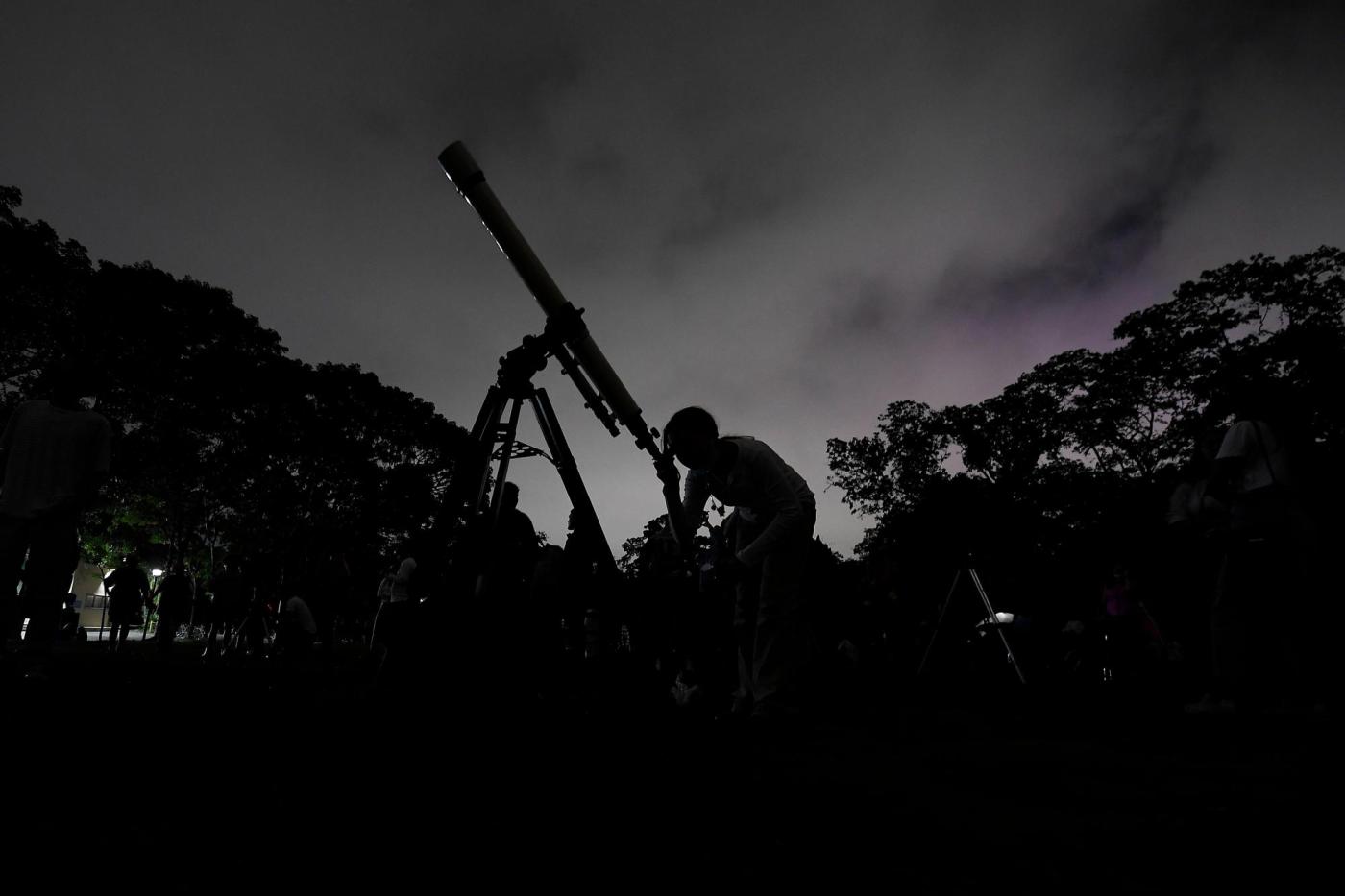
Six planets are hanging out in early morning skies this month. Here’s how to spot them

By ADITHI RAMAKRISHNAN
NEW YORK (AP) — Six planets are hanging out in the sky this month in what’s known as a planetary parade. Catch the spectacle while you can because it’s the last one of the year.
Related Articles
Perseid meteor shower: How and when to watch
Hubble Space Telescope takes best picture yet of the comet visiting from another solar system
Stuck astronaut Butch Wilmore retires from NASA less than 5 months after extended spaceflight
NASA, SpaceX punch through weather threat for Crew-11 launch
Radar satellite launched by India and NASA will track miniscule changes to Earth’s land and ice
These linkups happen when several planets appear to line up in the night sky at once. Such parades are fairly common, happening around every year depending on the number of planets. At least one bright planet can be spotted on most nights, weather permitting, according to NASA.
Six planets were visible in January skies and every planet of our solar system was visible in February, but not all could be spotted with the naked eye.
Venus, Jupiter, Saturn and a faint Mercury are visible this month without any special equipment, and the best chances to spot them are over the next week. Uranus and Neptune can only be glimpsed through binoculars and telescopes.
Jupiter and Venus made a close brush earlier this week and are still near each other in the eastern sky, “close together like cat’s eyes,” said Carolyn Sumners at the Houston Museum of Natural Science.
Mercury will be at its farthest point from the sun on Tuesday morning, making it easier to spot before it disappears into the sun’s glare.
To catch the planets, go out in the morning shortly before sunrise and look east. Try to find Jupiter and Venus clustered together first. Saturn is off to the side and Mercury will be close to the horizon, trying to rise before the sun.
“You’re looking for little tiny pinpoints of light, but they are the brightest ones,” said Justin Bartel with the Science Museum of Virginia. “They don’t really twinkle like the stars do.”
Before heading out, make sure it is a clear, cloudless morning and try to get away from tall buildings that could block the view.
Mercury will hide behind the sun again toward the end of the month, but a crescent moon will then join the parade. The next big planetary hangout is in February.
The Associated Press Health and Science Department receives support from the Howard Hughes Medical Institute’s Department of Science Education and the Robert Wood Johnson Foundation. The AP is solely responsible for all content.

More Stories
A Practical Guide to Pricing Your First Paid Community Tier
Then launch day arrives, a number gets picked more or less on instinct, and six months later nobody can say...
A Complete Guide to IT Support for Small Businesses in Leicester
Even a minor fault can slow employees down and leave customers waiting. This is where professional IT Support Leicester businesses...
A Practical AI Video Workflow for Small-Business Marketing
A polished clip that leaves the offer unclear is unlikely to help. AI image and video tools give teams another...
Michael Aronovici on What the Work at Interaction Restaurants Group Actually Involves
Over more than 30 years, he has owned and operated brands including Pizza Hut in Quebec, the Cultures restaurant chain,...
The Energy Capacity Problem Real Estate Developers Rarely See Coming, According to Ron Yeffet
That gap tends to surface at the worst possible time: after the concrete is poured, after tenants have signed, sometimes...
Four in five new UK jobs taken by foreigners – report
Successive governments have turned to migrant labor while millions of Britons are on welfare, a think tank finds Foreign nationals...