
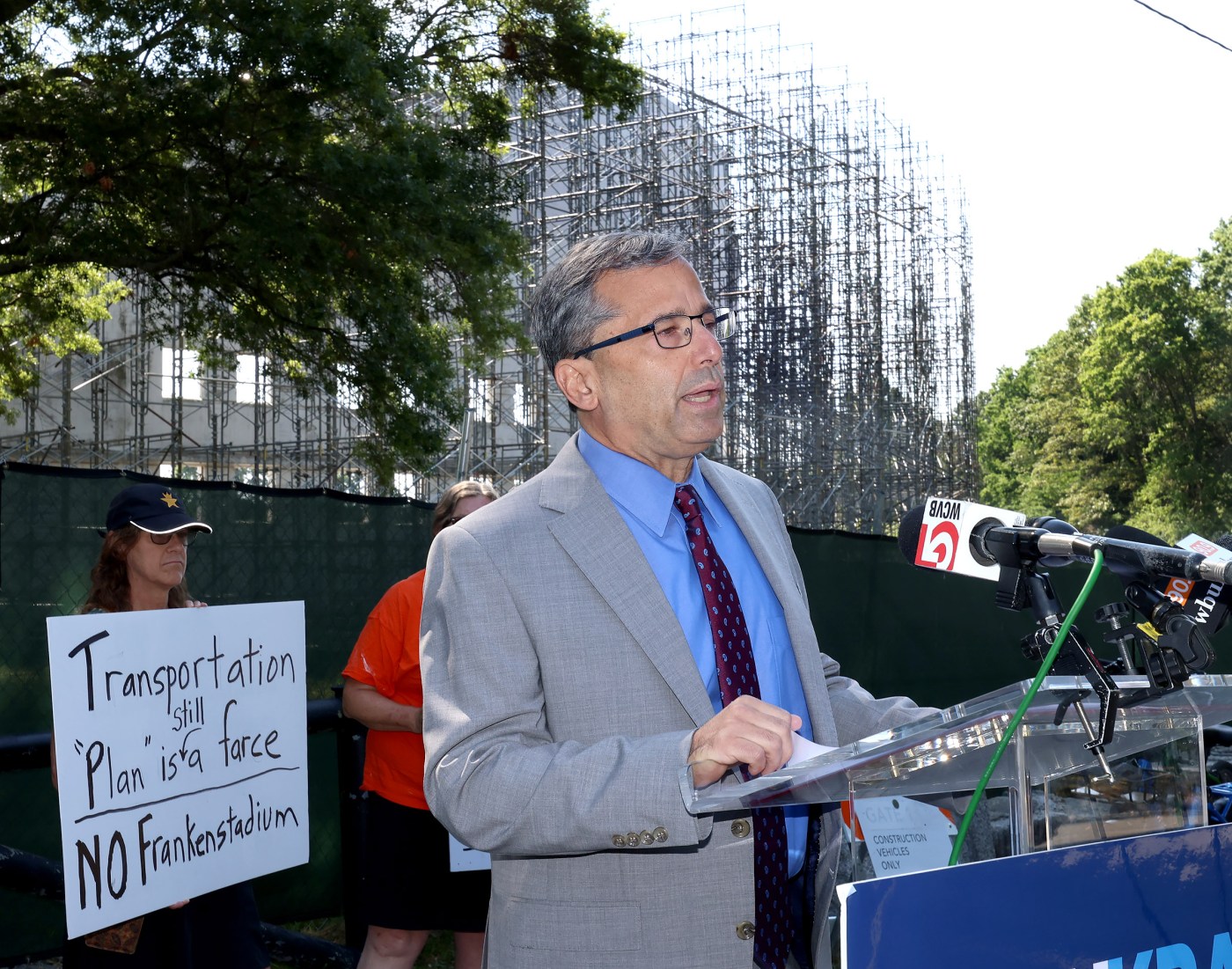
Boston mayoral candidate Josh Kraft says he made $6.3M last year, but short on specifics

Boston mayoral candidate Josh Kraft reported $6.3 million in income last year, per a financial summary provided by his campaign, but the specifics of where his money came from remains unclear given that he declined to release his tax return.
Kraft, son of the billionaire New England Patriots owner Robert Kraft, on Friday provided the first glimpse of his financial information since launching his mayoral campaign — about a week after Mayor Michelle Wu called on him to release his 2024 tax return to reveal any financial interests or business “entanglements.”
“Today, Josh is providing an accurate picture of his personal finances based on the past two years of tax filings, including total annual income and charitable donations, as well as state and federal income tax payments,” Kraft campaign spokesperson Eileen O’Connor said in a statement. “In fact, the information being shared today is far beyond what is legally required for a candidate.
“Josh has been clear with the public that he was born into privilege, and that his family’s success has allowed him to pursue a career of community service and nonprofit work, primarily in the neighborhoods of Boston,” O’Connor added.
The Kraft campaign declined to provide his 2024 tax returns, which are on a six-month extension through the Oct. 15 IRS filing deadline, but did provide a brief summary of his total income, $6.3 million, charitable contributions, $269,000, and estimated federal and state taxes, at $2.06 million and $510,000, respectively.
He paid 41% of his income in state and federal taxes, the Kraft campaign said, adding that Wu paid just 17% in income taxes last year and made no charitable contributions.
A financial summary was also provided for his 2023 tax returns, which he similarly declined to release, despite their completed filings. In 2023, Kraft’s reported income was slightly higher than last year, at $6.495 million.
His charitable contributions, a tax deduction, were higher, at $297,000. He paid less in federal and state income taxes, at $1.83 million and $358,000, respectively.
The Kraft campaign declined to provide specifics about where his income was coming from, only saying in response to Herald inquiries that it “consists of salary, interest, dividends and capital gains.”
“We are not disclosing specific amounts of each,” O’Connor said.
Kraft stepped down from his position as head of his family’s charitable arm, the New England Patriots Foundation, after launching his mayoral campaign this past February.
Publicly available 990 forms show that Kraft was not paid a salary in recent years as head of his family’s charitable foundation. His campaign said he did take in a salary while working as president of the New England Patriots Foundation in 2023 and 2024, but did not say what he was paid.
Kraft served in a similar executive-level role prior to taking the helm of his family’s philanthropic arm. He drew a roughly $350,000 salary as head of the Boys and Girls Clubs of Boston in fiscal year 2020, according to publicly available 990 forms.
Kraft recently dipped into his personal bank account to put $2 million into his mayoral campaign, saying this past May that he needed to do so, given that he is “going against the power of incumbency.” He said he has had just four months to fundraise, while Wu “has had four years to raise money.”
His father, Robert Kraft, chairman and CEO of the Kraft Group, has a net worth of $11.8 billion.
Kraft released his partial financial information amid public pressure that intensified over the past two weeks.
Wu, who in May released her 2024 tax return showing that she made $184,241 in federal adjusted gross income last year, a majority of which came from her $207,000 mayoral salary, publicly called on Kraft to release his tax returns and financial information last week and again on Wednesday.
The mayor accused her opponent of trying to “hide” his business interests and “entanglements” that she sees as potentially impacting his ability to effectively serve as the city’s mayor, while pointing in particular to the Kraft Group’s plan to build a soccer stadium in Everett, amid tense negotiations with the City of Boston.
Kraft has stated that he would recuse himself from the city’s Everett stadium negotiations, but his apparent connection to the New England Revolution, the professional soccer team set to play there may complicate matters for him.
The Wu administration is seeking further mitigation from the Kraft Group over traffic and parking impacts the new stadium could have on the nearby Charlestown neighborhood. The two sides are in mediation after failing to reach an agreement on a prior mitigation package offered by the Krafts.
A 2015 legal filing shows Josh Kraft could be part of a succession plan to inherit ownership of the New England Revolution, which currently shares use of Gillette Stadium with the Patriots. The two teams and stadium are owned by Kraft’s father.
Related Articles
Josh Kraft accuses Boston Mayor Wu of hiding White Stadium taxpayer cost until after election
Boston City Hall staffer embroiled in alleged North End shoe fight
Boston Mayor Wu dismisses calls for National Guard deployment to tackle Mass and Cass spillover
Boston Mayor Wu pushes back timeline for final taxpayer costs for White Stadium
Battenfeld: Michelle Wu ducking summer crime spree in ‘safest city in America’
The Kraft campaign has downplayed Josh Kraft’s connection to the Revolution. It did so again on Friday, saying that the candidate has no operational or decision-making role in any of his family’s businesses, including the Revolution.
The campaign also added that Kraft presently has no financial relationship with the Kraft Group, other than through a blind trust of which he has no control over.
The Kraft campaign, while choosing not to divulge the actual tax returns, defended the day’s partial release as a “significant amount of transparency and far beyond what is required by a candidate.”
Kraft has hammered Wu over what he sees as her lack of financial transparency over the professional women’s soccer stadium plan she’s championed. He held a campaign event on Wednesday, accusing her of trying to hide final taxpayer costs for the roughly $200 million public-private White Stadium rehab until after the election.
More Stories
Getting to know you: Florence Brocklesby, founder, Bellevue Law
Florence Brocklesby is the founder of Bellevue Law, a London boutique law firm specialising in workplace law and commercial disputes...
Canadian Versus British iGaming: Two Markets at Different Stages of Growth
Britain has a mature national regulatory system and an established online gambling culture. In comparison Canada is experiencing faster but...
Getting to know you: Pratham Mittal, founder, Tetr College of Business
Pratham Mittal is the founder of Tetr College of Business, which teaches undergraduates by having them build real ventures as...
Europe’s most valuable company says it cannot build chip kit fast enough
ASML, Europe’s most valuable company, said yesterday that its planned production capacity for both 2027 and 2028 will not fully...
HMRC hands Salesforce 15-year contract to bring AI into tax services
The HMRC Salesforce contract, worth up to £2bn over 15 years, will move legacy tax systems onto one platform with...
Staff at OpenAI’s UK arm cost £2.3m each on average in 2025
Staff at the UK arm of OpenAI cost the business about £2.3m each on average last year, according to newly...