
Boxes in Forest Lake drugstore attic contain treasure trove of history

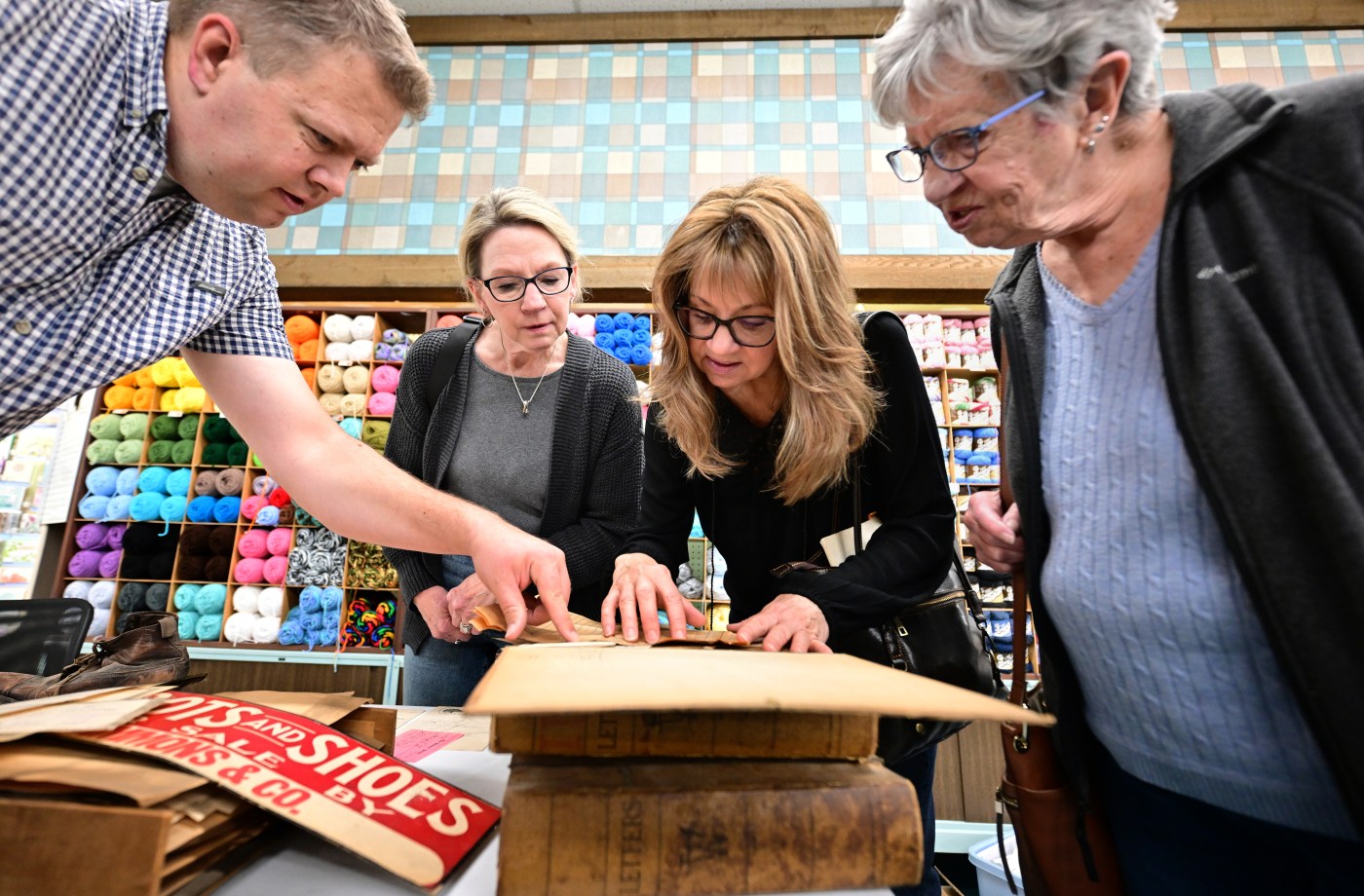
Dana Stachowski and Shelley Trimble reached into a banker’s box at Rolseth Drug in downtown Forest Lake last week and pulled out a yellowed sheath of paper that looked as if it hadn’t been touched since the 19th century.
Inside was an insurance policy that their great-grandfather, J.L. Simmons, purchased in 1899 to cover his store in Forest Lake in the event of any “damage done by tornadoes, wind storms and cyclones.” Simmons paid $5.75 to Continental Insurance of the City of New York to insure J.L. Simmons Dry Goods, Clothing and Shoes – now the site of Rolseth Drug – for up to $1,500 in damages.
“He probably would have used that – if he was still insured – when that devastating tornado came through here in the 1920s,” Trimble said.
The insurance policy is one of hundreds of documents and artifacts belonging to J.L. Simmons that were found this fall in the attic of Rolseth Drug, the oldest commercial building in Forest Lake. Simmons, who also served as Forest Lake’s treasurer, appears to have kept every receipt, invoice and canceled check he ever received.
Among the finds: an original stock certificate for the Forest Lake Cooperative Creamery, a sign advertising “Mayer’s Boots and Shoes” that would have been placed in the store’s front window and a shoe that appears to date to the 1920s. There also were hundreds of letterheads and receipts from area businesses, and an entire box of canceled checks, spanning the years 1897-1920.
Joseph Lincoln Simmons was the son of George Simmons, one of the first settlers of Forest Lake.
Treasure trove of information
Three banker’s boxes of Simmons’ papers, recently donated to the Forest Lake Historical Society, have been a treasure trove of information about the city’s early days, said Justin Brink, the society’s president. Brink has been able to use the documents to pinpoint the date when the Forest Lake Cooperative Creamery was founded (1896) and the date when J.L. Simmons opened his dry-goods store (1895).
“Because he was the treasurer, he had to keep everything,” Brink said.
Simmons family lore has it that J.L. Simmons was a treasurer who “never ever was off one cent,” said Lora Lee Briley, Simmons’ granddaughter and mother of Stachowski and Trimble. “He certainly never threw anything away.”
Family members look over a receipt, dated May 10, 1898, from the store of J.L. Simmons, found during a remodel of Rolseth Drug in Forest Lake, on Thursday, Nov. 16, 2023. Simmons opened the dry-goods store in 1895 and the family ran it, and an associated grocery, until selling out in 1954. (John Autey / Pioneer Press)
The women came to Rolseth Drug earlier this month at Brink’s invitation to sift through the documents and see if they wanted copies of anything. Brink also brought items from his own collection for the women to see, including photos and a cookbook with “From the J.L. Simmons Store” stamped on the cover.
“You found this on eBay?” Stachowski said, flipping through the cookbook and lingering over a recipe for Lightning Layer Cake made with Swan Down cake flour. “You know more about my family than I do. It’s really incredible.”
Many of the items found in Rolseth Drug’s attic will eventually be displayed at the Hopkins Schoolhouse, located on the border of Forest Lake and Hugo. Plans call for the one-room schoolhouse, built in 1928, to be used as a heritage center for both the Forest Lake Historical Society and the Hugo Historical Commission, Brink said.
Brink, who is working with a group to preserve the schoolhouse at 170th Street North and U.S. Highway 61, hopes it will open to the public in time for the 100th anniversary of the building.
All items of historical significance donated to the Forest Lake Historical Society go through an accession process that includes documenting the receipt of each item and creating a record, he said. The items will be stored in a temperature/humidity-controlled room until they are brought out for display.
The Forest Lake Historical Society was formed in 2019, two years after Brink started a Facebook group called “Old Forest Lake.” The Facebook group has more than 6,000 members.
Renovation project
Rolseth Drug will undergo a massive renovation in December that will more than double the pharmacy’s size. As part of the project, insulation was added to the attic in October. That’s when the contractor found the boxes of historical documents and started bringing them down, said Tom Haas, lead pharmacist and store manager at Rolseth Drug.
“Most people would have probably just blown it off, and it would have gone in the Dumpster, but he’s one of these guys who likes history,” said Haas, who has worked at Rolseth Drug for 50 years. “He started looking around for other stuff, and he just kept coming down with more boxes. I think he felt bad after a while because there was so much. He said, ‘Is that OK?’ and I said, ‘Heck, yes. Keep them coming,’ so then he kind of went hunting and pecking. It was really cool. It was an awesome find.”
Related Articles
In the US, Hmong ‘new year’ recalls ancestral spirits while teaching traditions to new generations
50 years sober, Greg Ekbom celebrates the Day by Day Cafe he founded while still in treatment
New Woodbury-Oakdale bridge over I-94 will open Monday
Winter market planned at 21 Roots in Grant
Small Business Saturday: Why and where to support local shops in St. Paul
Haas reached out to Brink and told him what the insulation contractor had found.
“He couldn’t get up here fast enough,” Haas said. “It was funny because I said, ‘Well, stop by if you get a second,’ and he was here in five minutes.”
Brink, the author of “Images of America: Forest Lake,” published in September by Arcadia Publishing, said he always welcomes an opportunity to view potential artifacts for the society’s collections.
The drugstore isn’t keeping any of the artifacts “because I think anything we would keep would get lost in the shuffle,” Haas said. “He’s going to have it where many people can see it, and it’s just better for the public to see it instead of me keeping it.”
Store history
Lora Lee Briley holds a photo of the general store of her grandfather, J.L. Simmons, found during a remodel of Rolseth Drug in Forest Lake. (John Autey / Pioneer Press)
Two of J.L. Simmons’ sons, George and Lawrence, joined their father and expanded the operation by bringing in a cousin, Tom Simmons, in 1929. The cousin converted the north half of the building to serve as a grocery store, while George and Lawrence Simmons ran the dry-goods business.
The Simmons operation lasted 64 years in all, ending in 1954 when the business was bought by Red & White, a chain of small independent grocery stores. The Red & White name continued until 1959 when the Bassett brothers purchased the business and renamed it the Lucky Dollar. Rolseth Drug moved in in 1980.
A number of store artifacts were passed down to the next generations, including the long, wooden bench customers used when trying on shoes. Trimble has the bench at her house. Stachowski has the store’s purple velvet-lined display case that was used for buttons and three of the store’s medicine bottles. Stachowski once bought a framed J.L. Simmons’ “Your Father Christmas” card at an antique store in Lindström, she said.
Brink said he was especially excited to discover the stock certificate for the Forest Lake Cooperative Creamery Association, a multi-county creamery association. “We didn’t know what year it opened until we found this document – 1896,” he said. “If you look at the back of the certificate, there’s a place to sign your name if you wanted to sell or transfer or sell the stock. See, it would have been signed right here, but obviously he kept that.”
The registration papers for the Forest Lake Cooperative Creamery Association are in the Minnesota Historical Society archives in St. Paul. “It lists all the names of the members – they’re all handwritten – and then how many cows they had, because it was a co-op,” Brink said. “A.W. Johnson had the most with 13. J.L. was the only one not to have any cows.”
The mystery of when J.L. Simmons Dry Goods opened was solved with the discovery of a salesman’s order sheet from the W.F. Main Co., a jewelry company based in Iowa City. “He had to fill this form out, and it says on here ‘Simmons & Johnson’ and the kinds of stock they want, and then it says ‘How long in business? Four years.’”
There was no date on the salesman’s order sheet, but the subsequent sheet from the W.F. Main Co. had a date of April 7, 1899, Brink said. “With this one sheet here, we now know that this business started in 1895, which up to this point no one ever knew. This is just neat. There have been lots of mysteries solved.”
Local residents
Brink also found a letter addressed to “J.L. Simmons & Co.,” written by Isaac Banta, “who was a prominent figure around here,” he said. The letter, dated July 3, 1899, asks Simmons to “please let Frank King have what he wants in goods and charge the same to me.”
“So, basically, it was just a letter saying, ‘Here, I’ll pay the bill,’” Brink said. “The King family were early settlers in Forest Lake. He was one of the earliest blacksmiths in town.”
Another great find: a pay slip belonging to Gund Brandt.
“Oh wow. Gund Brandt. I’m so glad I found that,” Brink said. “Why is it important? Because he’s an early Forest Lake person. Matter of fact, I think he was the township’s first health inspector.”
Brandt was hired in 1893 by the township’s board of supervisors to make a thorough sanitary inspection of the entire township. “In the whole township, I failed, much to my pleasure, to discover a single case of sickness among man or beast,” Brandt wrote in a letter to the township board of supervisors on June 12, 1893.
Brink also found a film reel in a back corner of the basement of the drugstore. “It was a reel-to-reel – longer than a Super 8,” he said. “It’s rusted shut, but as far as I can tell, the film is in there, so I’ll get it developed and see what that is. I would guess the film goes back to possibly the ’40s or even in the ’30s.”
Trimble said she couldn’t understand why so many things were left behind.
“When my grandfather (Lawrence Simmons) sold this building, why didn’t they take everything with them?” she said. “It just blows my mind.”
Related Articles
New Woodbury-Oakdale bridge over I-94 will open Monday
Winter market planned at 21 Roots in Grant
Stillwater to host World Snow Sculpting Championship for third time
Lake Elmo city administrator fired at end of council meeting; a member resigns in protest
Appeals court upholds judge’s decision regarding Stillwater Towing permit
Brink said he knows firsthand how many items are left behind after a sale. He and his wife, Jennifer, and their four children live in a house that was the site of Forest Lake’s first hospital. Dr. George Ruggles purchased the old farmhouse in 1946, and the hospital opened two years later. It closed in 1962.
“There was a lot of stuff from the hospital that I found and a lot of stuff from the Ruggles family, too, when we moved in,” he said. “It’s all just tucked away and stuff — you kind of come across. We found a wheelchair in the attic. They probably just didn’t even see it.”
One of the last items Stachowski pulled from a box was a 1901 receipt from the American Hand-Sewed Shoe Co., Agent for The Joseph Bannigan Rubber Company, in Omaha, Neb.
“Twelve pairs of men’s D, F, net price 97 cents, and then it says $11.64,” she said. “They purchased all these shoes for $292.38. That’s a lot of merchandise. I doubt this has been touched in 122 years. That’s really cool. I’m glad he kept all this.”


More Stories
Russia sends three diesel tankers toward US
Deputy PM Alexander Novak has confirmed the first shipments under an agreement with Washington aimed at easing the global fuel...
How small businesses can outsource customer service without losing control of quality
An external team might answer the third message promptly. Unless that team can investigate the order or obtain a decision,...
Going Global Changes the Business: Are Your People Ready?
Attention turns to where to establish a presence, how to form alliances and what the financial rewards might be. But...
When Test Holes Pay Off: Choosing SUE Quality Levels by Risk
Subsurface utility engineering (SUE) exists to bridge that gap: it gives project owners a structured way to decide how much...
HMRC expects £12.9bn of tax debt to go uncollected, NAO says
HMRC expects £12.9bn of tax debt to go uncollected, three times the level recorded before the pandemic, according to a...
Retail sales fall 0.4 per cent as households cut back on food
Retail sales volumes in Great Britain fell by 0.4 per cent in September, according to figures published today by the...