
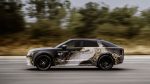
Smaller Land Rover Defender Goes Electric First in 2027 With a Hybrid to Follow

You can already buy a short Defender. It’s called the 90, and it still feels like a big truck from behind the wheel. Jaguar Land Rover is working on something different this time: a smaller SUV of its own, not just another body style for the existing Defender. JLR says the new model will launch in 2027 as a battery-electric vehicle, with a hybrid in development for later. Defender Sport is the name that keeps coming up, but the company hasn’t confirmed what will go on the tailgate.
The new Defender will share JLR’s Electrified Modular Architecture with the upcoming Range Rover GT. The platform is designed to accommodate 800-volt EVs as well as hybrids, but the battery-powered Defender is the only version expected to be ready by the end of 2027. Both SUVs will be built at Halewood in England, the plant that has been turning out the Range Rover Evoque and Discovery Sport. Sharing a factory and a platform makes sense. The more interesting question is how different the two will feel once you leave the pavement.
That’s where the Defender badge carries some obligations. A smaller SUV doesn’t need to match the bigger model obstacle for obstacle, but it needs to offer more than squared-off styling and a convincing set of drive modes. There’s a useful parallel at Ford, where the Bronco Sport and Bronco serve different buyers. The Bronco Sport works on its own terms, but we’d like to see JLR give its smaller Defender enough hardware that the distinction isn’t quite so stark.
Packaging will have a say in how far JLR can go. The electric model’s battery sits under the floor, and Defender and Discovery boss Mark Cameron has acknowledged that the smaller SUV could give up some suspension travel and articulation compared with the full-size Defender. Terrain-management software can help make the most of the grip that’s available, and electric motors can deliver power smoothly at a crawl. Neither can substitute for wheel travel when the trail drops away beneath a tire. Ground clearance and how well the battery is protected will tell us more than any rendering.
There’s an upside to downsizing that doesn’t get enough credit. On a narrow, wooded trail, a vehicle that’s easier to place can be more useful than a bigger one with better numbers on paper. The same goes for threading through a crowded parking garage on Monday morning. We’re still waiting on dimensions, range, and pricing, and the 2027 launch timetable doesn’t tell us when U.S. customers might get one. The later hybrid could also be the more appealing choice for drivers who spend their weekends a long way from a charger.
This is the first real test of whether Defender can work as a family of vehicles rather than one SUV offered in several lengths. We don’t need the smaller model to be a miniature copy of the 110, and going electric first gives it a character of its own. What we do want is a Defender that feels smaller in all the useful ways without making us think twice when the pavement ends.
More Stories
2027 Toyota Prius Plug-in Hybrid Invoice Price, Dealer Cost, and What You Should Pay
The 2027 Toyota Prius Plug-in Hybrid is the PHEV version of Toyota’s fifth-generation hybrid, pairing a 2.0-liter four-cylinder engine with...
EV Home Solar: The Real Costs
Ditching the gas station feels like a massive victory until you get your first winter electric bill. You trade the...
Mercedes-Benz Takes On Tesla With City Driving Assist and Hands-Free Highway Tech
Mercedes-Benz is taking two different approaches to making the daily drive less of a chore. Its new Hands-Free Highway Assist...
Suzuki Compact SUVs for Everyday Driving in South Africa
Compact SUVs give you practical ground clearance, space, and versatility without the bulk of a large SUV. We look at...
China new models October 2026: VW ID.UNYX 09 and BYD Great Han launch
VW ID. UNYX 09 Now that we have covered October 2026 wholesales have been covered, let’s focus on the latest...
Malaysia October 2026: Perodua Axia takes the lead, Proton S70 up to #4
The Proton S70 is up to 4th place in Malaysia in October. 75,004 new light vehicles hit Malaysian roads in...