
Pavegen falls into administration as Iran war stalls contracts

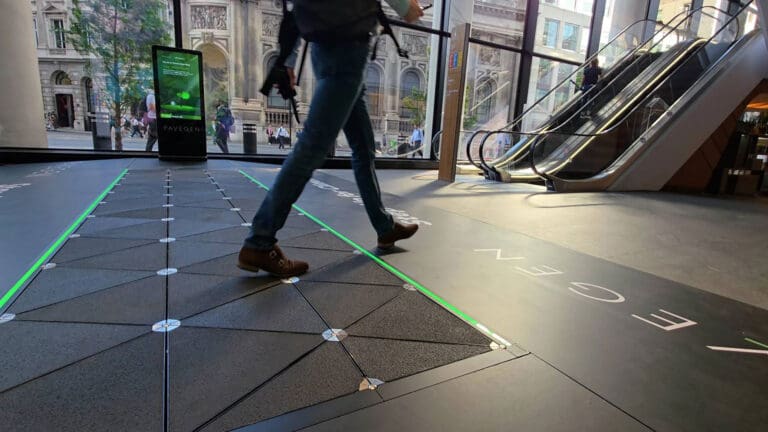
Pavegen, the cleantech company known for floor tiles that generate electricity from footsteps, has collapsed into administration, with its founder blaming the war in the Middle East for stalling contracts and calling on large corporate buyers to bid for its intellectual property.
Laurence Kemball-Cook said the conflict had put a number of significant contracts for the company’s kinetic energy-harvesting tiles on hold and prevented more from being agreed. He described the collapse of the 14-year-old business as “deeply disappointing”.
“After 17 years it is a really deeply disappointing outcome for the team, creditors and shareholders,” he told The Times. “We took this idea for a floor tile that everyone said would not work, where you can generate electricity from footsteps, and we have taken it to over 45 different countries working with some of the world’s biggest brands from the US government, Abu Dhabi airport, Google and Volvo.”
Kemball-Cook said the company had concentrated on building orders in the region before this year’s disruption. “We had put a lot of effort into building pipeline [of orders] in that market and it just did not come through because of the war in Iran,” he said.
That shortfall left Pavegen out of cash, and it called in administrators at the end of September. The company employed 27 people in London, Cambridge and overseas.
The conflict, which began on 28 February, has pushed up energy costs and inflation expectations for UK firms, Business Matters has reported, while the Weil European Distress Index found that UK companies entered the latest energy shock financially weaker than in 2022.
Kemball-Cook, 41, said he was helping Middlebrooks Advice and the administrators at Landwood Group to find potential buyers. The deadline for bids is 20 November, and the administrator is due to send its proposals to the company’s creditors by 25 November. Under government guidance for directors on administration, an administrator has eight weeks to set out proposals to achieve the best return for creditors.
“We are actively looking for an acquirer of Pavegen’s assets, the IP, the technology, the tooling, everything you need to manufacture Pavegen is ready to go,” said Kemball-Cook. “For the right partner it is an incredible opportunity to build on the years of engineering and design and patents that we have created, with these international customer relationships.”
He said the company was in “active conversations with acquirers”. Large overseas infrastructure investors are understood to have shown interest, according to The Times.
Pavegen raised more than £9m from investors after its launch, The Times reported. That included a round in 2025 in which 1,100 individual investors backed the company with £1.3m. Members of the Saudi royal family are understood to have been among them. Last year the company said it expected its revenues to top £5m.
Kemball-Cook studied industrial design and technology at Loughborough University and came up with the idea for power-harvesting paving slabs in his one-bedroom flat in Brixton, south London, in 2009.
The tiles featured in a walkway used by fans on their way to the London 2012 Olympics and in the Morro da Mineira favela in Rio de Janeiro, at an event supported by the late Brazilian footballer Pelé.
Speaking at Web Summit, the technology trade show in Lisbon, Kemball-Cook said he would support the efforts of any new owner to fully commercialise the technology.
“I am the founder of Pavegen and my legacy is to see this company be installed everywhere,” he said. “I feel resilient enough after 17 years … I don’t know if I have another 17 years in me, but I do have another ten years to get this technology to the world.”
He acknowledged that commercialising the green technology idea had been “challenging”.
“You need to take risks, be scared, push the boundaries of what is possible,” he said. “But my words for product designers are that there has never been a better toolkit for you to use, with AI supporting it, to make these ideas real. We need product designers to get stuck in and dig deep to bring their ideas to reality.”

More Stories
Small firms win £3.5m of public sector work through Supply Connect
Small businesses supported by Enterprise Nation’s Supply Connect programme have won more than £3.5m worth of public sector and supplier...
Four female founders named finalists for SCALE Manchester pitch
Four female founders will pitch live to investors at SCALE Manchester on 25 November, competing for a package of scaleup...
EU risks investor exodus over Russian assets – Euroclear chief
Plans to tap Moscow’s frozen funds for Ukraine could drive capital out of Europe, Valerie Urbain has warned The EU...
The Russia-China trade paradox the Western media doesn’t bother to explain
A Bloomberg article notes that the yuan share of Russian exports has dropped but that bilateral trade is surging A...
Christmas branded gift orders: working back from Australia Post’s 21 December cut-off
Parcels staying within the same state get one more day, to Tuesday 22 December. Express Post between metro addresses buys...
Laser Welding Safety: Essential Requirements for Industrial Workshops
As manufacturers such as Dynalasers introduce compact air-cooled laser welders for different fabrication needs, proper laser welding safety becomes an...