
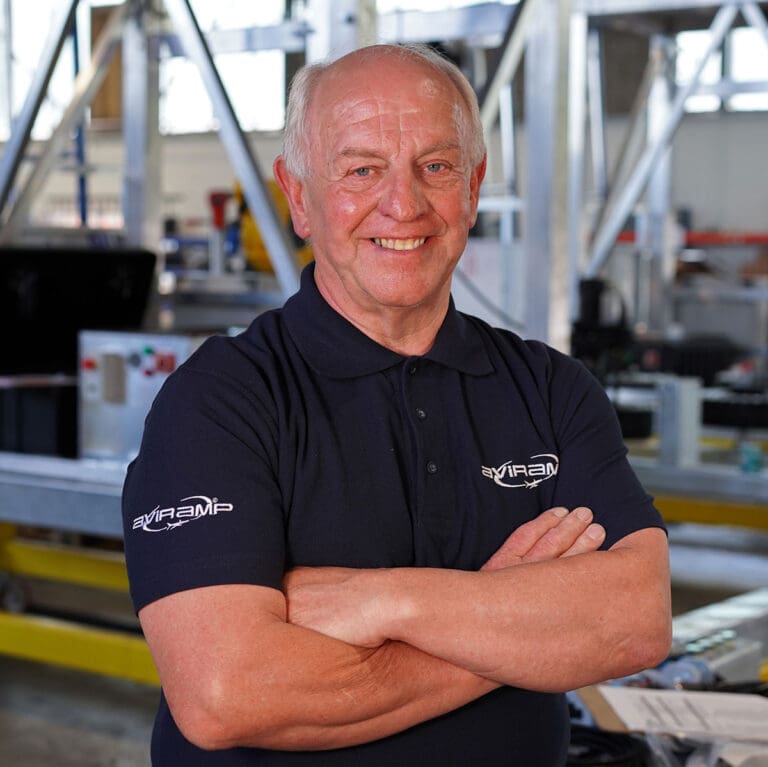
Getting to know you: Graham Corfield, founder and CEO, Aviramp

Graham Corfield is chief executive and founder of Aviramp, the Telford manufacturer of step-free aircraft boarding ramps and bridges, whose ramps have gone into service at airports in around 40 countries since 2010, with customers including Delta Air Lines and Frontier Airlines.
This month Aviramp was ranked 102nd in the Financial Times list of the UK’s 150 fastest-growing companies, after its revenue nearly tripled to more than £9.2m between 2022 and 2025.
The company holds the Queen’s Award for Enterprise in International Trade and was Highly Commended for International Expansion of the Year at the 2026 Lloyds British Business Excellence Awards on Tuesday, while Graham was named one of The Manufacturer’s Top 100 inspiring leaders in 2025. He tells Business Matters how a call about Colonel Gaddafi’s plane changed his life, how he came within a day of losing his home and what Taylor Swift can teach anyone about determination.
What do you currently do at Aviramp?
“I am chief executive and founder, which in practice means I am the one who says yes to things and then works out with the team how we are going to deliver them.
“A lot of my time goes on travelling the world, meeting airlines, airports and ground handlers and showing them what step-free boarding can do. Every one of our ramps and bridges is made here in Telford, so I am also out flying the flag for UK manufacturing and looking for new supply chain partners.
“Back home, I am focused on what comes next. Our strategy has always been built on innovation, so I spend a lot of time with our engineers on new products. Our solar-powered ramps run for a full day on the sun and can be moved by one person, and our ChairLifter takes the strain out of loading heavy electric wheelchairs into the hold.
“And I make time for our people. They are the reason we are where we are, and sharing our success with them matters to me as much as any contract.”
What was the inspiration behind your business?
“It started with a phone call I was convinced was a hoax. In 2009 I was running a small business making truck ramps, disabled access ramps for buildings and aluminium stairs when a pilot rang to ask if we could build a set of stairs for Colonel Gaddafi’s plane. I said yes, agreed a £5,000 fee and thought no more of it, until my wife Lisa rang to ask why £5,000 had just landed in our account from Libya.
“We built the stairs and fitted them at an RAF base, and it got me thinking. If the leader of Libya was struggling to get off his plane, what was it like for everyone else? We have all stood on wet, steep steps waiting to get off a plane, and for disabled passengers it was far worse. Too often they were carried or lifted on board with very little dignity.
“Then Oslo airport got in touch asking for a disabled access ramp for remote stands. I sketched the first Aviramp that same night. The idea was simple: a gentle, step-free slope everyone could use the same way, whether they walk, use a wheelchair or are carrying a toddler and a bag.
“It was safer, it was quicker for the airlines and it gave people their dignity back. I knew straight away I was on to something.”
Who do you admire?
“This might surprise a few people in aviation, but I am a proud Swiftie. I admire Taylor Swift enormously, and not just for the music.
“What I admire most is her determination. She writes her own songs, she has reinvented herself time and again, and when she lost control of her early recordings she did not sit and complain. She went back into the studio, re-recorded the lot and in the end bought her music back. That takes real grit, and it is a lesson for anyone in business: if something is yours and you believe in it, you fight for it.
“She is also a phenomenal businesswoman, a real ‘Mastermind’ when it comes to strategy. The Eras Tour was a masterclass in giving people an experience they will never forget, which is what we try to do for passengers, on a slightly smaller stage.
“And I love the fact that she shared the wealth with her crew. Everyone on that tour got a bonus, and her truck drivers each got $100,000 with a handwritten thank-you note. That is very, very clever. People who feel valued go the extra mile, and it is something I believe in too: when Aviramp does well, the team should share in that success.”
Looking back, is there anything you would have done differently?
“Honestly, no. Everything that happened, good and bad, made Aviramp what it is today, so I would not change any of it. But I would be lying if I said I had not learned some hard lessons along the way.
“After our first contracts we thought the orders would just keep coming. Then in 2012 and 2013 they dried up. We were paying bills on my credit cards and colleagues’ credit cards, and at the lowest point we came within a day of having our house repossessed. Then Dallas Fort Worth International Airport sent a 50 per cent deposit on a £70,000 order and we survived by the skin of our teeth.
“The biggest lesson was about cash. A healthy order book means nothing if the money is not in the bank, so now we watch cashflow closely and build a buffer for the quieter times. The second was not to rely on one market or a handful of customers. Today we sell into the US, Europe, Australasia, Asia, the Middle East and Africa, so a slow spell in one place does not sink us.
“The third was about people. Back then I tried to carry too much myself, and Lisa carried a lot of it with me. I have learned that having the right team around you, and being honest with them when times are tough, is what gets you through.
“Having stared disaster in the face, I make sure I enjoy the success now.”
What defines your way of doing business?
“Say yes. My first instinct is always to say yes to a request and work out how we will deliver it afterwards. If I had said no to that call about Colonel Gaddafi’s stairs, there would be no Aviramp.
“Then innovate. Our strategy has always been about solving real problems for the industry: poor passenger experience, a lack of dignity for disabled passengers, safety on the apron and slow turnarounds. During lockdown, when aviation virtually stopped, we used the time to work out what the industry would need next. That is where our solar-powered ramps came from, and they have driven much of our growth since.
“And look after your people. We are a family business in every sense. Lisa and I make a point of getting to know everyone, we have a recognition programme and a suggestion box, and our curry nights are something to see. People who feel valued take pride in their work and our customers can see it.
“Finally, never rest on your laurels. We have had record years, but I have been in business long enough to know that what got you here will not keep you here.”
What advice would you give to someone starting out?
“Say yes more than you say no and back yourself to work it out. But keep a close eye on your cash, surround yourself with people you trust and do not give up when it gets tough.
“My worst day in business came a day before one of my best. You never know which call is going to change everything.”
More Stories
UK economy grows 0.7 per cent in third quarter as AI lifts output
The UK economy grew by 0.7 per cent in the third quarter, its fastest pace in more than two years,...
ISO 7010 Explained: What UK Businesses Need to Know About Safety Signs
But their importance is easy to overlook until an emergency occurs. A clearly displayed fire exit sign or warning symbol...
Small firms asked to pledge 50,000 work experience places for teens
Small businesses are being asked to pledge 50,000 work experience placements for 14 to 16-year-olds under a government-backed campaign launching...
Life pressures harming 16.3 million workers’ careers, new research finds
Nearly half of UK workers say personal and family responsibilities are harming their careers, according to new research from Bupa....
Tech firms got £39.9m of £50bn UK Export Finance support in five years
Digital and technology companies received £39.9m of the roughly £50bn in support provided by UK Export Finance (UKEF) over the...
Borrowing Against Foreign Shares? The Exchange Rate Counts Too
Over the same three months, what the US owes foreign investors rose US$4.87 trillion to US$69.39 trillion, led by portfolio...