
Founders Relief for just 400 firms as adviser quits over ‘sideshow’

About 400 businesses a year will have founders or investors eligible for the government’s new Founders Relief, according to HMRC estimates published alongside yesterday’s Budget, as the Treasury set out the tests a company must pass before its founders can sell shares at a 10 per cent capital gains tax rate.
The relief applies to gains of up to £10m per person over a lifetime, on disposals made on or after 6 April 2027. In its policy paper on the measure, HMRC estimates that approximately 600 individuals a year will be eligible to claim, and puts the cost to the Exchequer at £260m in 2027-28, rising to £300m by 2031-32. The figures have been certified by the Office for Budget Responsibility.
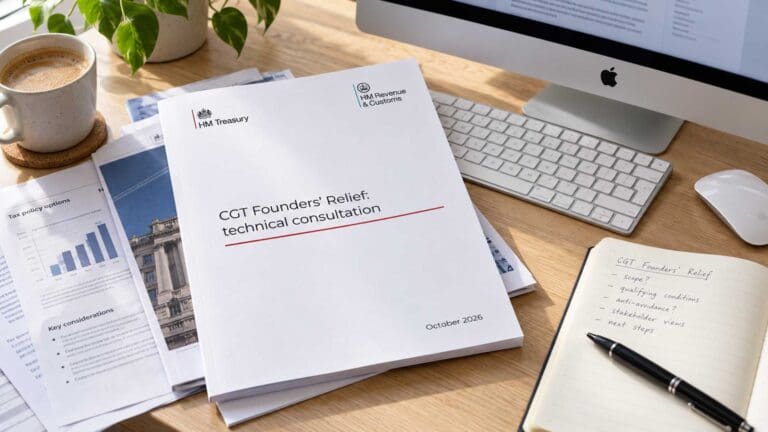
The detail of who qualifies is contained in a technical consultation published by HM Treasury and HMRC, which closes on 30 November 2026.
The publication comes in the week the Treasury’s entrepreneurship adviser, Alex Depledge, leaves her post. She leaves today, having said on Saturday that ministers treat scale-ups “as a bit of a sideshow” while directing taxpayer money towards legacy industries. Before the Budget, Depledge suggested there could be an incentive for founders themselves.
Chancellor John Healey told MPs yesterday that the relief was intended for “the founders of our most successful firms”.
The individual and company tests
To qualify, an individual must have held 25 per cent of the company’s ordinary share capital, with matching voting rights and rights to profits and assets on a winding up, at the point the company’s trade, or preparation for it, began. They must also have held the shares for at least five years before selling and been UK resident under the Statutory Residence Test for at least five continuous tax years.
The consultation says the 25 per cent condition may be met through the holding company of a trading group, and that relief will not be restricted to the original shareholding: all shares sold by a qualifying individual will be covered. Only individuals can claim. Because the £10m limit applies per person, more than one founder can claim in respect of the same company.
The company must be within the scope of UK corporation tax and have had a substantial UK presence for the five accounting periods before the sale. It must be a trading company, or the holding company of a trading group, without substantial non-trading activities. Activities excluded under the Enterprise Investment Scheme, such as dealing in land, financial services and property development, will also be excluded here.
The company must still be carrying on the trade it was set up for when the founder’s shares were issued, with no major change in its nature. In the accounting period before the sale, it must have had turnover of at least £10m and at least 15 qualifying full-time employees.
A qualifying employee is defined as someone working at least 35 hours a week and paid at least the National Minimum Wage. Directors, contract workers and agency workers do not count.
Growth, innovation and paperwork
On top of those conditions, the company must pass at least two of three further tests.
The turnover test requires average compound growth of 25 per cent a year across three consecutive accounting periods within the 10 years before the sale, starting from turnover of at least £10m. On that formula, a company starting at the £10m floor would need turnover of about £19.5m three years later.
The headcount test applies the same 25 per cent compound growth rate to qualifying full-time equivalent staff, from a base of at least 15 employees.
The innovation test requires the company to have spent at least £1.5m on qualifying research and development, and to have claimed R&D tax relief on that spending for accounting periods ending within the three years before the sale.
The government acknowledges in the consultation that innovation can happen without R&D spending that qualifies for tax relief, but says it chose the R&D framework because businesses and advisers are already familiar with it. Requiring two of the three tests means companies that do not claim R&D relief can still qualify if they meet both the turnover and headcount tests.
The £10m lifetime limit will be reduced by any amounts claimed under Business Asset Disposal Relief (BADR) and Investors’ Relief from 6 April 2027. In the same Budget, Healey halved the BADR lifetime limit from £1m to £500,000.
Claims will be made through the individual’s Self Assessment return for the year of the sale, including the periods relied on for each condition. The Treasury is considering requiring a standard supplementary form, and HMRC will treat a claim as “unsatisfactory” without all the specified information.
Because much of the evidence sits with the company, and some may relate to periods beyond statutory record keeping requirements, the government’s preferred approach is a new statutory right for individuals to request information from the company, which would have to supply it within a specified period. HMRC’s policy paper says companies may face one-off familiarisation costs and ongoing costs of responding to such requests.
The government considered asking companies or HMRC to certify that conditions had been met, but said this may be more complex to administer and place additional burdens on companies.
The consultation also states that if HMRC later challenges a company’s R&D tax relief claim and finds a condition the founder relied on was not met, the founder will lose the relief and have to pay the additional tax with interest. It notes this raises questions about how far HMRC can share a company’s tax affairs with an affected individual. Targeted anti-avoidance rules are being considered to counter artificial arrangements, such as company restructuring designed to bring assets into the scope of the relief.
Michael Carter, partner and head of incentives at Osborne Clarke, said: “The key question is who will qualify and how the new relief will work in practice. If it is sufficiently accessible, this could be welcome news for entrepreneurs and help encourage further investment. But as ever with tax changes, the devil will be in the detail.”
The consultation poses seven questions, including whether the individual conditions effectively identify founders and whether there are alternative criteria for identifying innovative companies. Written submissions go to EnterpriseTax@hmtreasury.gov.uk.
The Treasury says the consultation period is shorter than usual because evidence was already gathered in its Tax Support for Entrepreneurs call for evidence, and that it will hold stakeholder meetings before the deadline. Legislation will then be introduced through amendments to Finance Bill 2026-27, with full details in the technical consultation document.


More Stories
An Expert’s risk-first guide to AI in finance
“AI” has become something of a blanket term for a range of different technologies and use cases. In spite of...
Birmingham, Cornwall and North Yorkshire top business rates relief list
More than 2,400 shops, cafés, pubs and salons in Birmingham will stop paying business rates from 1 April 2027 under...
How to Start a Freelance Business in the Creator Economy
If you have a skill that supports that work, you can start a freelance business in the creator economy without...
Why International Perspectives Matter More Than Ever for Modern Businesses
Supply chains span continents, consumer trends cross borders instantly via digital platforms, and geopolitical developments in one region can ripple...
What happens to your business in a divorce? A UK owner’s guide for 2026
In England and Wales, a forced sale is rare and a straight 50/50 split of the shares is rarer still....
Felix Nikolas Prehn: Technology Industries and the US Economy, GDP Data Examined
Their expanding contribution to national output provides context for examining the growth of technology businesses and the performance of their...