
EU Proposes Giving Border Agency Frontex More Powers to Deport Illegal Immigrants

By Victoria Friedman
The European Union has proposed giving the bloc’s border agency more powers, including the ability to take action beyond its territory, carry out deportations between non-EU countries, and deploy rapid-reaction teams in emergencies.
The European Commission said in an Oct. 26 statement that Frontex could organize and carry out returns between third countries before migrants reach EU soil.
Frontex could, for example, deport a Pakistani national directly from Libya—which is one of the main ports of departure for illegal immigrants heading to Europe—directly back to Pakistan.
The EU’s executive branch said these returns would be subject to agreements with those third countries and would comply with international standards and fundamental rights.
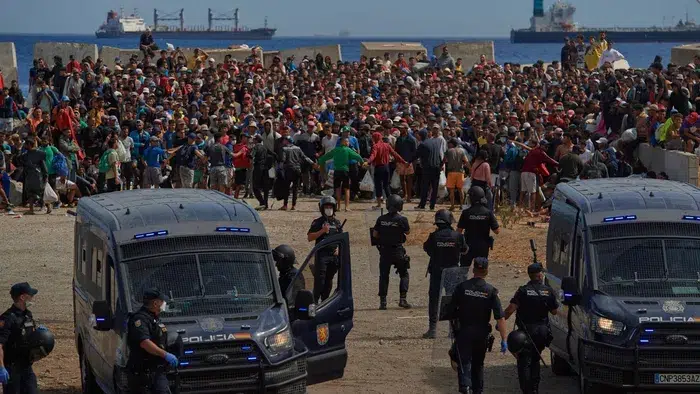
In late July, there was a mass breach of an estimated 72,000 mostly young, male migrants into the Spanish exclave of Ceuta on the North African coast.
The commission said last month that the majority of migrants had been sent back to Morocco, but the incident was cited by several member states as evidence for the bloc needing stronger ways of dealing with illegal immigration.
The EU said that it has made progress on illegal immigration, with crossings more than halved in the past two years and return rates at more than 30 percent. The commission said more needs to be done because of an evolving and challenging geopolitical and security environment.
Magnus Brunner, European commissioner for internal affairs and migration, said in the Oct. 26 statement that the proposed changes to Frontex will make it the “central EU actor on returns.”
“In addition, it will be able to act faster. With a quick reaction force that can deploy within 24 hours and spot risks early, before an event becomes a crisis. ,” Brunner said. “And finally, Frontex will be stronger, better equipped and organised.”
Quick Reaction Force
Under the proposal, Frontex will be able to detect migration trends and intervene in crises or emergencies, reflecting a lesson the commission said it learned from the Ceuta breach.
The Frontex logo at the headquarters of the European Border and Coast Guard Agency in Warsaw on Sept. 17, 2026. Roland Schlager/AFP via Getty Images
The EU’s 27 member states are primarily responsible for protecting their borders and returning those with no right to stay, but Brussels says reinforcing Frontex will better support those countries.
To support member states in these activities, Frontex will increase its standing corps to 30,000 by creating a new reserve of about 17,000 officers. The EU says these officers will be at the disposal of member states and can be deployed when needed.
The EU could also deploy a proposed quick reaction force at the external border on short notice to help member states deal with crises. The decision to deploy that force will be taken by Frontex’s executive director following a request by a member state facing an emergency situation, the commission said.
These proposals will go to the European Parliament, made up of elected representatives from the 27 member states, and the European Council, which consists of the heads of government of those members, for consideration.
‘Weaponized Migration’
Separately, European Commission President Ursula von der Leyen recently said that the EU must strengthen its external border to counter “weaponized migration.”
The head of the EU’s executive branch made the remarks after member states in Eastern Europe have in recent years experienced increased illegal immigration flows from the Middle East and Africa.
European Commission President Ursula von der Leyen at a press conference at the end of a European Union summit at the EU headquarters in Brussels on Oct. 16, 2026. Nicolas Tucat / AFP via Getty Images
“We have seen how Russia and Belarus have weaponized migration,” von der Leyen told the European Council on Oct. 21. “State and non-state actors are deliberately engineering mass movements of people. The goal is clear: to overwhelm authorities, spread fear, and divide us.”
Latvia, Lithuania, and Poland have also blamed Belarus and Russia for orchestrating the migrants flows across their borders to destabilize countries on NATO’s eastern flank. Minsk and Moscow deny the allegations.
Permanent Representative of the Russian Federation to the International Organizations in Vienna Mikhail Ulyanov snaps a picture of journalists as he attends the International Atomic Energy Agency (IAEA) Board of Governors’ meeting at the agency’s headquarters in Vienna, Austria, on Jan. 30, 2026. Joe Klamar/AFP via Getty Images
Mikhail Ulyanov, Russia’s permanent representative to international organizations in Vienna, responded to von der Leyen’s remarks in an Oct. 24 post on X.
“Russians here, Russians there, mighty Russians everywhere,” Ulyanov wrote. “And for her there is no doubt that the migration chaos in Europe is caused by Russia. Bravo! No comment.”


More Stories
Alaska Governor Orders Probe Over Claims Democrats Recruited Senate Spoiler Candidate
By Tom Ozimek Alaska Gov. Mike Dunleavy has ordered the state to investigate whether aides to U.S. Senate hopeful Mary...
DoorDash Agrees to Buy Instacart in $17 Billion Deal to Expand Grocery Delivery
By Evgenia Filimianova DoorDash is offering $17 billion to buy grocery delivery company Instacart, potentially bringing together two of the...
US Economy Gains Momentum as 3rd-Quarter GDP Grows Better-Than-Expected 3.4 Percent
By Andrew Moran The U.S. economy recorded its best quarter in a year as consumer spending and business investment lifted...
The Diplomat Season 5 Renewed! Release Date, Cast, Plot, and More
The Diplomat, an American political thriller series, has captivated viewers since 2023. Four seasons have already aired, and fans are...
175 House Democrats Call for Halt to Ilhan Omar Investigation
By Guy Birchall Scores of House Democrats have called for an end to the federal investigation into Rep. Ilhan Omar...
Gas Prices, Housing, Interest Rates: Inside the US Cost-of-Living Picture Ahead of the Midterms
Andrew Moran, Kevin Stocklin and Emel Akan As voters weigh the economic records of both parties ahead of the midterms,...