
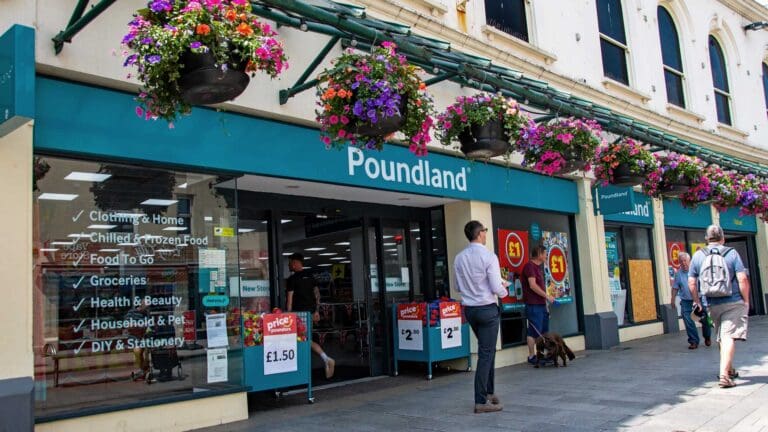
Poundland owner Gordon Brothers pushes for insolvent sale of chain

Poundland’s owner, Gordon Brothers, is pushing for an insolvent deal for the discount chain that could see it broken up and its stores sold to different buyers, putting hundreds of stores and jobs at risk.
The US investment firm is understood to be against accepting a solvent offer from Martin Property Group, the Irish family-owned real estate investment firm that Poundland’s management team had identified as its preferred option.
The dispute centres on a £30m shareholder loan. An analysis of the proposed sale found that Martin Property Group was unwilling to make an upfront repayment on the loan, and suggested this could indicate an intention to restructure or liquidate the company within the next one or two years.
Gordon Brothers, which bought Poundland for £1 last summer, put the business up for sale in September and is in talks with numerous interested parties about buying all or parts of it. Alvarez & Marsal is still working through the bids to evaluate them objectively.
Poundland employs nearly 12,000 people and trades from between 550 and 600 outlets across the UK and Ireland, according to Sky News.
The three independent directors recruited this month to steer Poundland through the sale process are expected to quit after a disagreement with Gordon Brothers.
They are Andrew Kirkpatrick, a former adviser to Steinhoff International when it owned Poundland; Stephen Welch, who is overseeing efforts to revive the British-based fintech FNZ; and Dominic Young, a former director of The Spectator’s owner when it was sold to the hedge fund tycoon Sir Paul Marshall.
Sources told Sky News that the trio had expressed disquiet at what appeared to be attempts by Gordon Brothers to steer Poundland towards an insolvency process.
Martin Property Group’s proposal would involve paying as little as £1 for Poundland’s equity, repaying the balance of existing loans and injecting millions of pounds to fund a turnaround plan, Sky News has previously reported. The firm is said to have committed to retaining the chain’s store footprint and workforce.
Gordon Brothers is now pursuing other potential bids, which would likely take the form of a pre-pack administration or another type of insolvent deal.
Fortress Investment Group, the private equity firm that owns rival Poundstretcher, CDS Superstores, the owner of The Range and Wilko, the German discounters Lidl and Aldi, and Modella, the owner of TG Jones, have all expressed interest in parts of Poundland’s store portfolio.
Fortress amended its offer earlier this month to target between 200 and 250 of Poundland’s roughly 530 UK shops rather than the whole business, according to Sky News, which reported that competition concerns had prompted the change.
The analysis of the bids suggested a break-up could protect staff through a TUPE process, as many of the offers included provisions for such a transfer. TUPE protects UK employees when a business changes ownership or a service contract moves to a new provider. Government guidance on TUPE and insolvent businesses states that the regulations will normally apply when a business is rescued and taken over, but that employees are unlikely to be protected if it is closing down.
Breaking up the business would, however, be likely to result in the Poundland name disappearing from the high street.
Gordon Brothers said: “While Martin Property Group had been identified as the preferred bidder by Poundland’s management team, attention must now turn to other active bids. As well as interest from buyers for the whole business, the sale process has also surfaced a number of formal and indicative offers for significant viable parts of the business from established retail operators. These options will now be objectively evaluated, with a view to minimising uncertainty for Poundland’s people and all relevant stakeholders.”
Poundland was previously part of Pepco Group, the European discount retailer, which sold the chain to Gordon Brothers for a nominal £1 in June last year. The price reflected the challenges facing the business, which has been under pressure from rising costs, intense competition and changing consumer spending habits.

More Stories
Tinned food sales up 40 per cent at Iceland after stock-up call
Iceland has reported a 40 per cent increase in sales of tinned products over the weekend and Maplin a 284...
Microsoft offers voluntary redundancy to up to 60,000 staff
Microsoft has offered voluntary redundancy to up to 60,000 employees, including staff in the UK, as the technology group seeks...
Record 738,144 UK businesses in financial distress ahead of Budget
A record 738,144 UK businesses were in significant financial distress in the third quarter of 2026, according to research published...
British manufacturers urge Healey to cut costs in tomorrow’s Budget
Two British manufacturers have called on Chancellor John Healey to bring down energy and employment costs in his first Budget,...
AI giant eyes record IPO
Claude developer Anthropic is seeking a record valuation while acknowledging potentially catastrophic risks from its own technology US artificial intelligence...
Marcus Orme on building Medialab into a two-time agency of the year
Marcus Orme is the CEO and co-founder of Medialab, the London independent media agency he launched in 2005 with Alex...