
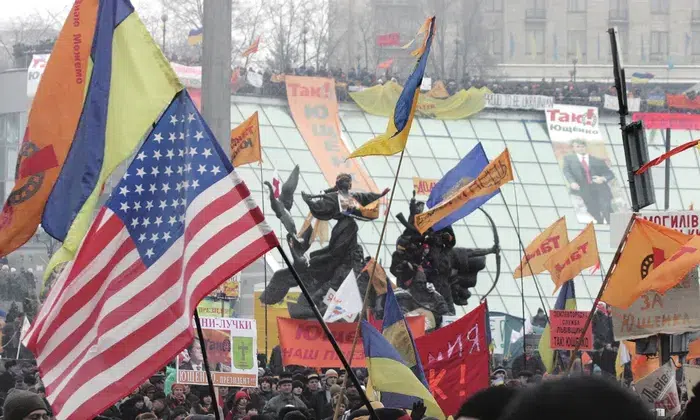
The Color Revolution Comes Home: Ex-USAID Operatives, DSA Networks, and a Playbook Aimed at the American Republic

By Stephen Zogopoulos, USNN World News
In the interview titled “DataRepublican: The Democrat Plan For A Color Revolution: Everything You Need To Know,” the researcher and her interpreter walk through a body of material that, if authentic, maps a familiar foreign-policy toolkit onto domestic American politics.
Former USAID Democracy, Rights and Governance (DRG) personnel—whose office specialized in supporting opposition movements, training activists, funding monitors, and assessing “illegitimacy” abroad—are described as having formed a successor entity after the agency’s restructuring. That group, operating under names such as the Democracy Renewal Group and the Renew American Democracy / RAD project, is alleged to have applied the same playbook to the United States. The stated goal, according to quoted internal language, is to treat a manufactured or opportunistic “breakdown moment” as the opening for “big structural reform” and a “refounding moment.”
Key elements highlighted in the materials and interview include:
Coordination with Democratic Socialists of America (DSA) networks and allied activist organizations (including those linked to “No Kings,” Indivisible, and related protest infrastructure) to generate sustained pressure and confrontations.
Pre-defined “red lines”—actions such as invocation of the Insurrection Act or contested election outcomes—that would trigger declarations of federal illegitimacy.
Contingency planning that shifts perceived legitimacy toward Democratic governors, potential multi-state coordination, and even discussion of broader institutional redesign (including ideas long floated by DSA circles such as structural changes to the Senate).
Involvement of national-security alumni networks and academic frameworks associated with nonviolent resistance research (notably the 3.5% participation threshold popularized by Erica Chenoweth).
The pattern mirrors classic color-revolution doctrine: build parallel legitimacy structures, train and coordinate street and legal pressure, exploit or create a legitimacy crisis, fracture institutional loyalty, and replace the existing order under the banner of “saving democracy.” What makes the current claims striking is that the same professionals who once exported this model are now, according to the documents, running the assessment and contingency planning against their own country’s elected government.
Skeptics will correctly note that political actors of every stripe engage in scenario planning, and that activist networks routinely discuss escalation. The difference here is the combination of institutional pedigree (ex-USAID democracy specialists), the explicit language of “illegitimacy” and “refounding,” the recorded planning sessions left on public or semi-public links, and the operational timeline focused on the period between the 2026 midterms and the seating of a new Congress. DataRepublican’s method—scraping large volumes of documents and using AI-assisted analysis while cross-referencing contacts she had already tracked for years—has produced a volume of material that is difficult to dismiss as mere coincidence or isolated rhetoric.
Whether this constitutes an actionable conspiracy, overheated contingency planning by ideologues, or something in between will require deeper scrutiny of the primary recordings and documents. What cannot be ignored is the open embrace of a foreign-derived regime-change methodology by people who once practiced it professionally abroad and who now appear to be adapting it for use at home. Americans have every right—and every responsibility—to examine these claims carefully, demand transparency, and refuse to treat “democracy promotion” as a license for extra-constitutional redesign of the Republic they inherited.
The video and the accompanying drops are not abstract theory. They are a concrete warning that the techniques once reserved for distant capitals are now being discussed, recorded, and coordinated against the constitutional order of the United States itself.
Disclaimer:
This is an opinion commentary based on publicly available materials released by the independent researcher known as DataRepublican (and discussed in her October 23, 2026 interview with Barry Cunningham), secondary reporting from outlets covering those materials, and the video itself. The claims involve allegations of coordinated political strategy drawn from internal documents, audio, and transcripts. Full independent forensic verification of every recording and document remains incomplete at the time of writing. Readers should examine primary sources for themselves and treat the interpretation below as analysis, not established legal fact.


More Stories
Trump Admin Can Detain Illegal Immigrants Without Bond Hearings: Appeals Court
By Zachary Stieber President Donald Trump’s administration can hold illegal immigrants in detention without bond hearings, a full federal appeals...
Florida Mayor Arrested After Authorities Say She Paid Herself and Family State COVID Funds
By Jill McLaughlin State authorities arrested the mayor of the central Florida city of Kissimmee on Oct. 21, charging her...
American Express Laying Off 5 Percent of Workforce
By Andrew Moran American Express said it is laying off about 5 percent of its workforce. The global payment services...
Typhoon Champi Leaves 1 Dead, 350 Injured in Taiwan; Alters US-Japan Military Exercise
By Arthur Zhang Typhoon Champi left one person dead and 350 injured in Taiwan, disrupting air and rail travel and...
Russian Diesel Expected to Arrive on Nov. 7 After Trump-Putin Deal
By Tom Ozimek A tanker carrying 40,000 metric tons of Russian diesel is heading toward New York following a deal...
Social Security Agency Announces Correction of Tens of Millions of Files
By Zachary Stieber Federal officials announced on Oct. 20 that they corrected tens of millions of Social Security records, including...