
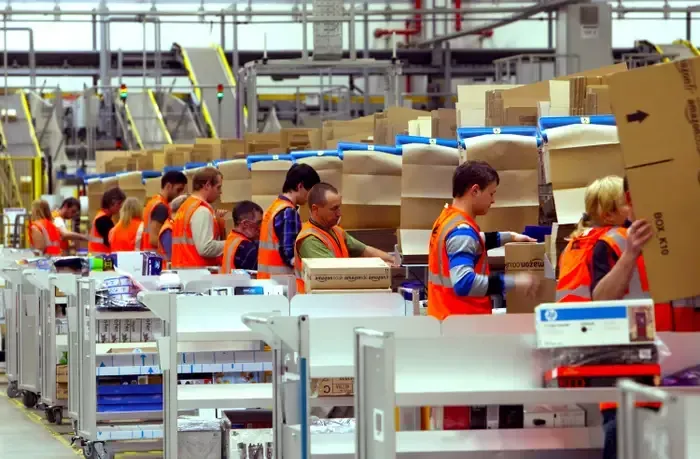
Amazon to Hire 300,000 US Workers for Holiday Season

By Andrew Moran
Amazon has posted a help-wanted sign for this year’s holiday season.
The online retailer said on Oct. 20 that it’s hiring 300,000 people for seasonal, part-time, and full-time jobs during the busy Christmas period, up 20 percent from last year.
This marks Amazon’s first recruitment increase in three years, as the company has hired about 250,000 workers during the season.
Those interested in these seasonal roles can visit amazon.com/localjobs or text NEWJOB to 31432 for local job alerts. Amazon will post new positions every week from October to December.
Additionally, Amazon announced that seasonal employees who log at least 30 hours per week will receive the same healthcare benefits offered to regular full-time staff, beginning Jan. 1.
“That means anyone who joins us in these qualifying seasonal roles now or in the future will have access to healthcare—whether they join us for the holidays or at another point in the year since we hire seasonal employees year-round,” J. Ofori Agboka, vice president of People Experience and Technology at Amazon, said in a news release.
Eligible employees hired before Jan. 1 will gain access to coverage on that date, he added. Those hired on or after Jan. 1 will have access from their first day.
Seasonal hiring has gotten off to a strong start, says Cory Stahle, economist at the Indeed Hiring Lab.
As of Sept. 30, seasonal job postings were up about 10 percent, firmly above 2019 levels. While many large employers are posting fewer seasonal roles, he said, they are offering more part-time jobs, “a potential sign of optimism heading into the final months of 2026.”
“A group of large employers, mostly retailers, are relying less on seasonal postings than they did a year ago, and one of last year’s most active seasonal recruiters has yet to post a meaningful number of seasonal jobs in 2026,” Stahle said in an Oct. 15 note.
So far, however, seasonal hiring announcements have been thin, says Andy Challenger, chief revenue officer at global outplacement firm Challenger, Gray and Christmas.
“Retailers are leaning on automation, existing associates, and on-demand pools before hiring net-new seasonal workers,” Challenger said last month. “It’s more about restocking staffing plans surgically than a return to the 900,000-plus seasonal hiring years we saw in 2020 and 2021.”
To date, only a handful of major retailers have announced their seasonal hiring plans.
Dick’s Sporting Goods plans to hire more than 11,000 seasonal workers. Michael’s aims to hire more than 10,000 seasonal team members.
Bass Pro Shops and Cabela’s recently held national hiring events. UPS is also adding 100,000 seasonal workers for the holiday rush.
Holiday Season Outlook
Despite signs of more cautious consumers, the National Retail Federation expects retail sales in November and December to grow more than 4 percent this year. Overall, holiday sales are forecast to exceed $1.01 trillion, up from $972 billion in 2025.
“We head into the holiday season with strong spending momentum, as consumers remain the bright spot in the economy,” Mark Mathews, the organization’s chief economist and executive director, said in a statement.
People shop at a mall on Black Friday in Bethesda, Md., on Nov. 28, 2025. Madalina Kilroy/The Epoch Times
“At the same time, inflation, rising gas prices and pressure on household spending will affect consumers differently across income groups.”
Stripping out gas and automobile dealerships, retail sales rose just 0.2 percent in September. This comes as the University of Michigan’s October Consumer Sentiment Index sank to the second-lowest level since the series began.
The pain at the pump is weighing on consumer confidence, with the AAA reporting the national average gas price above $4 per gallon.
But economists fear that the war-driven oil price shock will eventually filter through the broader economy.
U.S. companies have tried to avoid passing higher costs on to customers. The Federal Reserve’s Beige Book—a periodic summary of economic conditions across the central bank’s 12 districts—found that businesses face higher input costs from fuel, tariffs, insurance, and other commodities.
“Consumer-facing firms noted tighter profit margins as price-sensitive customers continue to resist price hikes. Contacts are managing their margins with selective price hikes, targeted incentives, and menu changes that reduce their costs,” the report reads.
The retail trade group’s projections, meanwhile, align with other recent estimates.
The Mastercard Economics Institute said in its annual U.S. forecast that spending growth will be 5.5 percent, the best holiday season in four years.
Deloitte’s annual holiday retail report projects holiday retail sales will climb up to 4.8 percent from November to January.
“Retailers are prepared to meet that demand with competitive prices, value and choices for every budget,” Matthew Shay, president and CEO of the National Retail Federation, said in a statement.


More Stories
Pending Home Sales Plunge to Record Low as Mortgage Rates Surge: NAR
By Bill Pan A new report adds to the evidence that rising borrowing costs are weighing heavily on housing demand,...
NY, Feds Raid Programs Suspected of Fraud in New York City
By Zachary Stieber The FBI and state officials launched an operation in New York City on Oct. 20 to crack...
Trump Launches $25 Million Fraud Whistleblower Program, Offering Cash for Tips
By Emel Akan WASHINGTON—President Donald Trump and Vice President JD Vance announced on Tuesday the launch of a $25 million...
US, Partners Seize Nearly 1,500 Pounds of Cocaine in the Caribbean
By Naveen Athrappully A U.S. task force and foreign partners seized nearly 1,500 pounds of cocaine in two operations in...
European Union Unveils Arctic Strategy Aimed at Strengthening Security
By Victoria Friedman The European Union (EU) has unveiled plans to boost security in the Arctic that include better threat...
DOJ Charges 28 Noncitizens in California With Election Crimes
By Tom Gantert The Justice Department announced on Oct. 19 that 28 noncitizens living in California face election-related criminal charges,...