
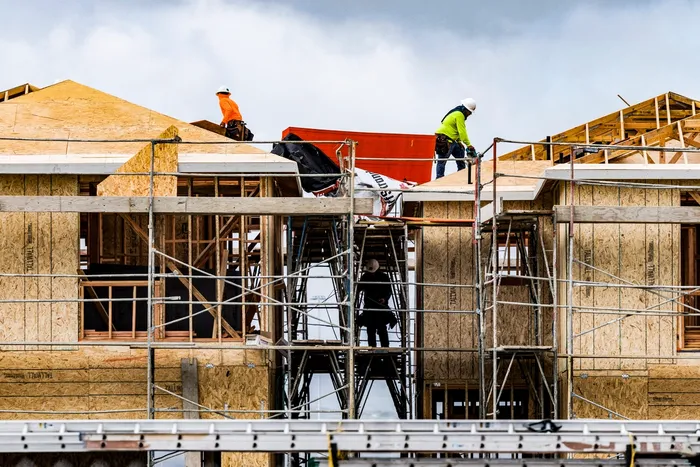
Homebuilder Confidence Drops in October Amid Weak Demand, Rising Costs

By Bill Pan
Confidence among U.S. homebuilders fell in October, as rising mortgage rates discouraged buyers while construction costs and labor disruptions put added pressure on builders.
The National Association of Home Builders (NAHB) and Wells Fargo housing market index dropped by 3 points to 29, the trade group reported on Oct. 19. The reading was the lowest since June 2012.
The index is based on a survey of approximately 400 single-family home builders across the United States. A reading above 50 indicates that more builders view current and near-term market conditions as good than as poor, while a reading below 50 signals the opposite.
The decline affected all three components of the index. Builders’ assessment of current sales fell by 2 points to 33, while expectations for sales over the next six months fell by 5 points to 32. The measure of prospective buyer traffic also declined by 5 points, to 18.
Robert Dietz, NAHB’s chief economist, said buyer traffic was at its weakest level since April 2012, excluding the abrupt downturn at the onset of the COVID-19 pandemic in April 2020.
“Demand persists, but higher mortgage rates, elevated construction costs and weaker consumer confidence are keeping more buyers on the sidelines,” Dietz said.
Mortgage rates have climbed above 7 percent over recent weeks. The average rate on a 30-year fixed mortgage stood at 7.40 percent for the week ending on Oct. 15, unchanged from the previous week but up from 6.27 percent a year earlier, according to Freddie Mac.
With fewer buyers visiting new-home developments, builders have increasingly turned to price reductions and other incentives.
The survey found that 43 percent of builders cut prices in October, the highest share during the 2020–2026 period. However, the average reduction remained at 6 percent for the seventh consecutive month.
Meanwhile, 65 percent offered sales incentives, marking the 19th straight month in which at least 60 percent of builders used them.
Builders are also contending with more expensive construction loans, building materials, and diesel, according to NAHB Chairman Bill Owens.
As of Oct. 12, the average retail diesel price sat at $6.18 per gallon, according to the U.S. Energy Information Administration.
The ongoing war in Iran disrupted global supplies of crude oil needed to produce diesel and regular gasoline. Russia’s war with Ukraine, now well into its fifth year, has also knocked offline some diesel refining capacity.
The Trump administration’s efforts to advance regulatory reform were helping ease some of builders’ cost pressures, Owens said.
Earlier this month, President Donald Trump signed an executive order opening tax-exempt diesel for use on highways through the end of this year. Tax-exempt diesel is standard diesel fuel, but it’s dyed red to indicate that it’s exempt from federal highway taxes.
Labor availability remains another concern. According to Owens, more than one-third of builders reported immigration enforcement activity in their markets during the previous month, which caused construction delays and discouraged workers with legal status from reporting to work.
On a three-month moving-average basis, the Northeast’s index slipped by one point to 38, while the Midwest’s fell by 3 points to 40. The South declined by one point to 30, and the West dropped by 2 points to 26.
Although the Midwest retained the strongest regional reading, all four regions remained below the index’s 50-point threshold, reflecting the broad pressure on the new-home market.
The challenges extend beyond newly built homes.
A separate report by the National Association of Realtors shows that existing-home sales rose by 1.5 percent in September on a monthly basis to a seasonally adjusted annual rate of 3.99 million. This was an increase from August, but both months were the two slowest of the year for home sales.
Meanwhile, the inventory of existing homes increased to 1.6 million, or 4.8 months’ supply, its highest level since November 2019. That leaves buyers with more options while adding competition for builders trying to sell new properties.


More Stories
Elon Musk Pledges to Give ‘Every Kid in America’ 1 SpaceX Share
By Andrew Moran Billionaire Elon Musk said he will give every child in the United States a stake in his...
Vance Says He’ll Wait Until After Midterms to Decide on Presidential Run
By Jack Phillips Vice President JD Vance said he will wait until after the upcoming November midterm elections before making...
Oil Retreats From 5-Month High as Markets Weigh Trump’s Russia Sanctions Waiver
By Tom Ozimek Oil prices fell on Oct. 19, with Brent retreating from a five-month high as investors weighed President...
The Babysitter 3: Renewal Status, Release Date, Cast Members & Plot
Nine years after Netflix’s debut, the horror-comedy film The Babysitter remains one of the biggest hits. What began as a...
Original Games and Familiar Brands: Two Creative Routes in Online Casino Entertainment
A familiar film title can make a game recognisable before anyone opens it. An original character has a different task,...
Weather System Off North Carolina Could Become Nor’Easter or Tropical Storm: What to Know
By T.J. Muscaro The National Weather Service and its National Hurricane Center are tracking a storm system sitting off the...