
Chaos and Violence Grip France as Far-Left Mobs Storm City Halls, Torch Streets

By Etienne Fauchaire
PARIS—Stones and fireworks were already flying across Place de la République before Saturday’s demonstration against rising costs had even started. By 1 p.m., hundreds of black-clad militants, many of them with their faces hidden behind masks, were facing off with riot police in the square. It was the start of an afternoon of violence that spread across the capital.
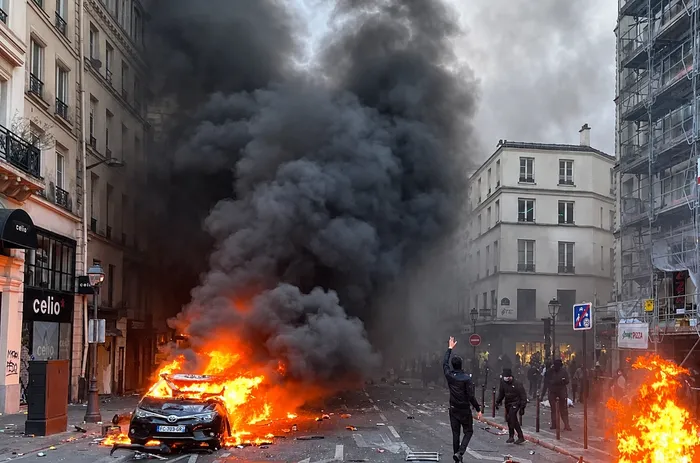
Protesters hurled rocks and fireworks at the police, who fired back with tear gas and water cannons. Shortly after 2 p.m., a car went up in flames in the middle of the square. Bicycles, street furniture and a newspaper kiosk were torched as well, and looters forced their way into a nearby Monoprix supermarket and ransacked it.
Hundreds of demonstrators chanted “Everyone hates the police,” “Revolution,” and “We are all antifascists.” Another chant took aim at the president himself: “Louis XVI: We beheaded him. Macron: We can do it again!”
The trouble soon spilled out of République. Over the course of the afternoon, groups broke away from the authorized march routes and headed for Place de la Madeleine, Place Vendôme, and the Champs-Élysées, where demonstrations had been banned.
According to AFP, police stopped one group a short distance from the Élysée Palace, the official residence of French President Emmanuel Macron. On Boulevard Haussmann, looters broke into the Galeries Lafayette department store, in one of the busiest shopping districts in the city.
Near the Opéra, tourists were caught in clouds of tear gas as police and protesters clashed. Shoppers hurried out of the area, businesses pulled down their metal shutters, and some of the main shopping streets of central Paris came to a standstill.
Masked far-left protesters drag a burning sofa into the offices of French fintech company Qonto in an attempt to set the building on fire during violent demonstrations in Paris on Oct. 17, 2026. Etienne Fauchaire/The Epoch Times
On social media, Saturday’s protests against the rising cost of living had been billed as the comeback of the Yellow Vests, the movement that began in 2018 as a revolt against fuel taxes and grew into a broader uprising against Macron’s government.
Several of the movement’s best-known figures, though, kept their distance. They accused far-left groups of hijacking the Yellow Vest name for their own political ends.
Benjamin Cauchy, one of the most recognizable faces of the 2018 protests, told radio station Europe 1 that the far-left France Unbowed (LFI) party was using the Yellow Vests “as a Trojan horse” to push its own agenda.
Another veteran of the movement told France 24 she saw “a takeover from all sides by the far left, from the Communist Party to France Unbowed.”
Precursor to Presidential Election
The violence drew strong condemnation from France’s political leadership, with Prime Minister Sébastien Lecornu accusing radical left-wing groups of orchestrating attacks across the country.
“Ultra-left groups organized the violence in several cities,” Lecornu wrote on X. He warned those treating the unrest as a rehearsal for the April 2027 presidential election that the government will not back down.
“To those who clearly want to use this violence as a ‘warm-up’ before the presidential election, I say clearly: We will not let ourselves be intimidated,” he said, pledging to move forward with legislation to make rioters pay for the damage they cause.
Macron also promised consequences for those responsible for attacks on government buildings, saying that protesters who had targeted prefectures and looted city halls would be “prosecuted and punished.”
Speaking at an evening press conference, Nuñez said approximately 550,000 people had taken part in 110 demonstrations across France, including 110,000 in Paris. Organizers, led by the CGT trade union and student groups, put the nationwide turnout at about 800,000.
Authorities arrested roughly 1,800 people nationwide.
“We are not dealing with the high school movement,” he said, accusing “the ultra-left and the radical far left” of exploiting the demonstrations to attack police officers, businesses, and public buildings.
Masked far-left protesters use hammers to break up paving stones to throw at police officers during violent far-left demonstrations at Place de la République in Paris on Oct. 17, 2026. Etienne Fauchaire/The Epoch Times
At least 60 police officers and gendarmes were injured during the unrest, including two who were taken to hospital unconscious. More than 10,000 officers had been deployed across the country ahead of demonstrations.
Nuñez said authorities would “do everything to find” those responsible for the looting.
City Halls Attacked, Shops Looted
The scenes in Paris were repeated in cities across the country, where groups of rioters targeted municipal buildings, businesses, and police.
In Marseille, several dozen protesters stormed city hall shortly after 1 p.m., forcing open the doors of the building overlooking the Old Port and pouring into its entrance hall.
“This is the Revolution, we’re taking the Bastille,” they shouted as they entered the building, AFP reported. Earlier, rioters had attacked a municipal police station with smoke bombs, according to the local prefecture.
The violence spread through Marseille’s central shopping streets, where dozens of businesses were looted. Bakeries, jewelry stores, and luxury retailers were among the targets, including an Hermès boutique.
A car burns beneath the Porte Saint-Denis monument as thick black smoke rises above crowds of protesters during violent far-left protests in Paris on Oct. 17, 2026. Etienne Fauchaire/The Epoch Times
In Lyon, masked rioters fired fireworks at police before ransacking and setting fire to an annex of the tourist office on Place Bellecour. The Rhône prefecture said the violence prevented firefighters from reaching the burning building.
In Bordeaux, rioters targeted several public buildings, breaking into the chamber of commerce and ransacking the official residence of the Gironde prefect. Shops in the city center were also looted, prompting authorities to deploy an elite police tactical unit as violence spread.
In Lille, protesters smashed their way through the glass doors of city hall, causing damage inside the building. Several businesses were also ransacked, including the city’s Apple Store, according to the mayor.
In Limoges, an attack on city hall ended in a major fire that spread through one wing of the building and reached the roof. Further incidents of looting were reported in Nantes, Caen, and Valence, underscoring the nationwide reach of the disorder.
On the right, National Rally leaders voiced support for the police and accused the far left of hijacking the demonstrations.
Marine Le Pen, the party’s presidential candidate, said legitimate social grievances had “once again been taken hostage by the far left.” She also accused LFI lawmakers of trying to “precipitate the country into chaos.”
National Rally President Jordan Bardella described Saturday’s unrest as a “convergence of ultra-left terrorism and delinquent populations from the banlieues,” referring to the immigrant suburbs surrounding many French cities.
Masked protesters loot a Monoprix supermarket on Boulevard Saint-Denis in Paris, carrying away merchandise as products lie scattered outside the damaged store during violent demonstrations on Oct. 17, 2026. Etienne Fauchaire/The Epoch Times
Jean-Luc Mélenchon, the leader of LFI and a presidential contender, blamed the police response for the chaos, accusing commanders of allowing the situation to spiral out of control.
“In Paris, the aberrant command opened the door to chaos,” he wrote on X. He also told his supporters they had “no business” taking part in looting.
The Oct. 17 demonstrations marked another escalation in a protest movement that began nearly a month earlier in high schools in the suburbs of Paris.
Protests that began at a handful of schools spread nationwide, fueled by far-left activists.
The toll on security forces and civilians had already been substantial before Saturday’s unrest.
By Oct. 15, Lecornu said 937 police officers and gendarmes had been injured since the movement began, along with 248 students and 149 school staff members.

More Stories
High Gas Prices Could Be the Key Issue That Swings the Senate
By Jeremy Lott Enough voters are fixated on the price of fuel that it could be the deciding issue in...
Treasury Sanctions Iraqi Bank and Iranian Shadow Networks
By Kimberly Hayek The Treasury Department has sanctioned the Iraq-based International Development Bank for Investment and Finance (IDB) and related...
Trump Seeks to Boost Georgia Voters at Rally With Early Voting Underway
By Troy Mters DALTON, Ga.—President Donald Trump, aboard Marine One, flew directly over hundreds of supporters gathered for his rally...
16 Foreign Nationals Charged for Illegal Voting, DOJ Says
By Kimberly Hayek Sixteen foreign nationals in North Carolina, New York, and Idaho, including an illegal immigrant, have been charged...
Renewal Status for Marshals Season 3! Plot, Release Date, and Cast
Luke Grimes is back as everyone’s favourite marshal, Kayce Dutton. The second season of the series is streaming globally, and...
Katie Zacharia Out as Press Secretary, White House Confirms
By Jack Phillips A White House official on Friday told The Epoch Times that new White House press secretary Katie...