
High Gas Prices Could Be the Key Issue That Swings the Senate

By Jeremy Lott
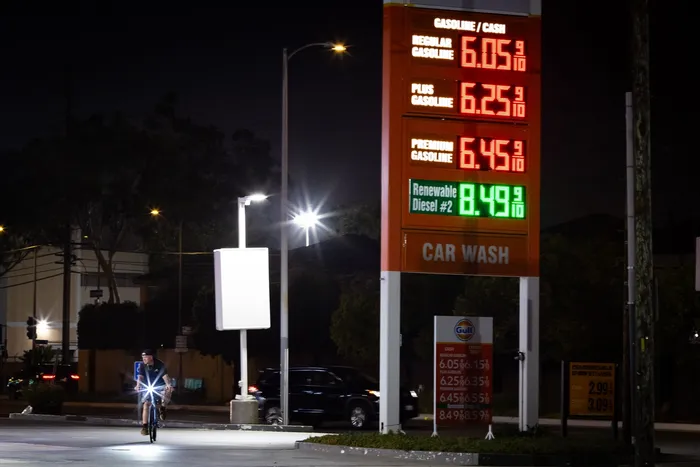
Enough voters are fixated on the price of fuel that it could be the deciding issue in the midterm elections, and especially control of the U.S. Senate.
The GOP’s chances of holding onto either chamber of Congress have slipped as gas and diesel prices have risen this year because of hostilities in Iran, the nearby Strait of Hormuz, and in Ukraine and Russia, analysts say.
The national average prices per gallon for regular gas and diesel were $4.33 and $6.29 on Oct. 14, according to AAA data. One year prior, regular was at $3.07 and diesel was at $3.65.
In midterm debates for congressional offices, Democrats frequently talk about Iran and fuel, putting Republicans on the defensive.
Asked if the Republicans are headed toward an electoral “bloodbath” in November, pollster Robert Cahaly told The Epoch Times in September, “If the election were today and all the undecideds didn’t vote, yes, that’s what would happen.”
Cahaly founded the polling firm Trafalgar Group, which forecast then-candidate Donald Trump’s victory in 2016 when most pollsters were calling it for former Secretary of State Hillary Clinton.
The Trafalgar Group’s September 2026 polling has Democrats leading in Senate contests in North Carolina, Texas, and Ohio, where Republicans are the incumbents.
But Democrats need a net gain of four seats to control the Senate.
The firm also sees very close races for Republican seats in Alaska, Iowa, Kansas, Maine, and South Carolina. Just one of those seats going to the Democrats would, in all likelihood, allow them to take back the Senate.
Cahaly called the rising price of fuel and related costs “the only real factor that’s having an impact.”
“Affordability is hitting people in their pocketbooks and they’re like, ‘Man, I might agree with the Republican versus the Democrat, but I don’t like what’s going on at the gas pump and I want to punish somebody,’” he said.
Other pollsters are finding similar results. For instance, a KFF/AP survey of more than 2,000 rural voters found that concerns about fuel and transportation were huge.
In fact, gasoline and related transportation costs were the single biggest issue with those voters, with 67 percent of them saying they were very or somewhat concerned about how they would pay for the increases.
That 67 percent represented more people than those who expressed concerns about how they would afford healthcare, food, rent, utilities, or keeping a roof over their heads.
One reason for that may be how many people view the price of gas as a proxy for a lot of other things. They follow it as a rough indicator of where the economy is at, and where it’s headed.
“Not everybody in a household goes to the grocery store. Not everybody in the household buys clothes. But most people in the household buy gas. … I bet you could probably tell me right now what the cheapest you ever paid for gas is and roughly what year it was. It’s just a number we know,” Cahaly said.
Britney Boyd, 41, works in the food and beverage industry in Charleston, South Carolina. She recalled the first price of gas that she pumped.
“It’s hard to fathom that when I started driving, gas was 98 cents,” she told The Epoch Times, noting that the situation has changed considerably.
Boyd now has to go out of her way to find gas somewhere in the neighborhood of $3.50 a gallon, often when her car is “on empty.”
Michelle Miller, a small business owner on Florida’s Gulf Coast who is starting to think about retirement in a few years, is affected by the elevated pump price as well.
“I’m definitely feeling the high gas prices,” she told The Epoch Times.
Addressing Gas Prices
Like Boyd and Miller, most Americans currently know that they don’t like the high price of gas.
The Trafalgar Group has conducted private polling on U.S. attacks on Iran and the worldwide slowdown in oil shipments that followed and shared the overall results with The Epoch Times. What the polling firm found was not an anti-war majority but rather an anti-high fuel prices majority.
Cahaly said that if fuel prices could come down significantly before election day, “it would have a massive impact” at the ballot box.
The costs thus far have been significant. Brown University’s Iran War Energy Cost Tracker estimates that Americans paid $134.7 billion in elevated gas and diesel prices at the pump since late February, as of Oct. 14.
Republicans are answering those concerns in a number of ways. One strategy is to argue for short-term costs and long-term benefits. They say that an Iran without the means of developing nuclear weapons, or projecting many other weapons, would be worth some pain at the pump.
The White House’s Senior Director for Counterterrorism Sebastian Gorka made this point bluntly.
“You know what, I really don’t care about the price of gas, because the price of gas will be cheap when we win, which will be soon. And it’s not about the midterms. It’s about dealing death to those who wish to kill Americans. If you think that’s less important than the price of gas, you’re not an American,” he said in September.
Those who have to contest the midterms are more concerned with the immediate price of gas.
John Braun is the Republican minority leader of the Washington state Senate who is trying to unseat Democratic incumbent Marie Gluesenkamp Perez in the state’s Third Congressional District.
Gas prices, affordability and the hostilities in Iran were a notable flashpoint in their Oct. 7 debate.
“People are losing their shirts right now,” Perez said, adding that she had voted against the hostilities through various resolutions six times. She tied the war, rising prices, and instability to Trump and said that a vote for Braun would amount to support for more of the same.
Braun countered that the war presented a “hard problem,” and that he wanted a “good solution” to it, but that he does not support an “open-ended war with no clear objectives to end it.” However, he said that he certainly wasn’t seeing those clear objectives right now from the administration.
Trump himself appears focused on doing whatever he can to bring gas and diesel prices down with the midterm looming.
In September, he voiced support for a diesel export ban, to keep the fuel in the Unites States. He then reversed course when several European countries agreed to release about 100 million barrels of oil from their own strategic reserves, with a significant amount of diesel released in October.
The American president also reversed course on some aspects of the ongoing Ukraine–Russia war.
Trump has criticized Russia recently over the conflict. However, facing record high diesel prices related to his own conflict in Iran and Russia’s diesel export ban, driven by Ukraine’s attack on Russia’s refineries, which took about half of Russia’s diesel refining capacity offline, Trump cut a temporary deal with Russian President Vladimir Putin.
On Oct. 9, Trump announced an “energy ceasefire” and that Russia would be ending its diesel export ban, with Russia releasing about half a million tons of diesel onto the global market.
He faced pushback for the deal from Democrats and members of his own party, and the ceasefire quickly fell apart. Within days, Russia bombed Ukrainian targets and Ukraine resumed drone attacks on Russia’s oil infrastructure.
Consequences of High Prices
The Epoch Times reached out to voters around the country—including Florida’s Miller and South Carolina’s Boyd—about how the lengthy spike in gas prices was affecting them and if it would affect their vote in the midterms.
These voters spelled out some of the problems that high gas prices are creating, for them and for other Americans.
“I have clients in Tampa, which is about a 40-minute drive each way,” Miller said. “That may not seem like much compared to city driving, but with gas this expensive, I have to think about whether the cost of getting there is worth it.”
Boyd thought of gas prices as a larger part of the affordability problem, noting that she “cannot afford to buy a home.”
“I am lucky enough to live close to my place of employment so I don’t have to travel far on a daily basis, but I know many people that have to travel far in busy traffic, daily,” she said.
Another respondent was Jason Vander Kooy, a dairy farmer with 1,400 cows to milk in Washington state’s Skagit Valley region.
Most of the vehicles and other machinery on Vander Kooy’s farm burn diesel, which was making for a very expensive harvest season, he told The Epoch Times.
A normal price for diesel would be about $3 a gallon. Even at a bulk farm rate, the farm is paying closer to $6 a gallon.
“That’s the highest price for diesel we’ve ever paid,” he said.
Total farm operations burn through about 1,000 gallons a day at harvest time, meaning that the daily fuel cost has increased from about $3,000 a day to about $6,000 a day. And they face other mounting, diesel-driven prices.
“Everything that gets trucked into our farm and all the milk that gets trucked out, we’re having fuel surcharges put on us,” he said.
Democratic campaign messaging blames Trump for these high prices and Republicans for abetting them. That is a message that is landing with some voters—but by no means all of them.
Boyd is voting for the Democratic candidate for Senate in South Carolina, pediatrician Annie Andrews, “because I believe she cares about the people of South Carolina and isn’t going to be a puppet, corporate shill,” she said.
Miller is a Republican who doesn’t see high gas prices as a good enough reason to switch.
“Voting just on gas prices seems like jumping out of the frying pan into the fire,” Miller said.
She expressed concerns over the Democrats’ recent “lurch towards socialism,” with Democratic Socialists of America-backed candidates winning many primaries, though she also faulted her own party for letting the federal debt pile up to $40 trillion and counting.
Vander Kooy said that the diesel hike wouldn’t change his vote because he doesn’t especially blame anyone in the United States for the worldwide shortage in refining capacity. At the same time, he worries that the worst may not be over.
“All we need now is for a refinery to go offline, you know with a disaster or something, and things get pretty crazy quickly,” he said.

More Stories
Treasury Sanctions Iraqi Bank and Iranian Shadow Networks
By Kimberly Hayek The Treasury Department has sanctioned the Iraq-based International Development Bank for Investment and Finance (IDB) and related...
Trump Seeks to Boost Georgia Voters at Rally With Early Voting Underway
By Troy Mters DALTON, Ga.—President Donald Trump, aboard Marine One, flew directly over hundreds of supporters gathered for his rally...
16 Foreign Nationals Charged for Illegal Voting, DOJ Says
By Kimberly Hayek Sixteen foreign nationals in North Carolina, New York, and Idaho, including an illegal immigrant, have been charged...
Renewal Status for Marshals Season 3! Plot, Release Date, and Cast
Luke Grimes is back as everyone’s favourite marshal, Kayce Dutton. The second season of the series is streaming globally, and...
Katie Zacharia Out as Press Secretary, White House Confirms
By Jack Phillips A White House official on Friday told The Epoch Times that new White House press secretary Katie...
From AI to Oil: US Import, Export Prices Rise Sharply in September
By Andrew Moran U.S. import and export prices jumped far above economists’ expectations in September, underscoring mounting inflation pressures. Prices...