
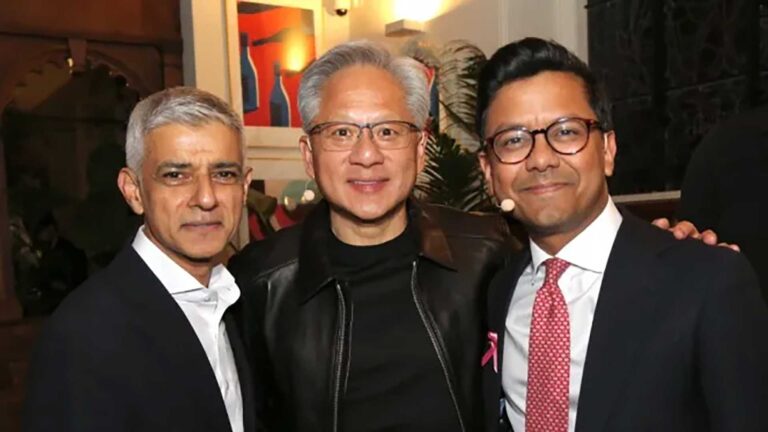
Nvidia’s Jensen Huang warns UK against relying on ‘opaque’ AI models

The chief executive of Nvidia has warned British companies, government agencies and individual users against relying on “opaque” artificial intelligence models built by large American research labs for “mission critical” work.
Jensen Huang, co-founder of the $5trn chipmaker, said on a visit to London on Wednesday that the UK could not depend on proprietary models such as those developed by Anthropic and OpenAI for such tasks, and urged users to adopt open-source models instead.
“There are many things about your country, your company, where you simply cannot have opacity because of either trust of the system, regulatory reasons, sovereignty reasons, control reasons, proprietary reasons. You simply cannot afford to outsource that. In that case, you need to have open models,” Huang said.
“How could you have an opaque agentic system, be contained in an opaque box, run by an opaque company? It’s obviously not sustainable.”
Open models, such as those developed by Meta, Mistral and many Chinese companies, can be downloaded on to a user’s own computer and fine-tuned for specific purposes. Their advocates argue that this gives users greater privacy and control, because data remains on the premises rather than being exported to the cloud.
Models from OpenAI and Anthropic, by contrast, require users to send data to external servers and offer less scope for modification. The large AI labs argue that open models do not have the same safety guardrails as their products.
Governments and heavily regulated industries have shown increasing interest in open models amid a wider push for sovereign AI.
Nvidia, which dominates the supply of the chips underpinning AI, has emerged as a champion of open models, and in September agreed to buy the open model platform Hugging Face for $12.93bn. The strategy comes as OpenAI and Google, among others, have invested heavily in designing their own chips, which could cut their reliance on Nvidia.
Huang said both kinds of model were needed, and that relying on an opaque service was “fine, frankly” for work that was not mission critical.
Huang said he had met Andy Burnham, the prime minister, over a glass of whisky on Wednesday and told him that “economic growth is literally sitting right in front of you” thanks to AI.
“The UK is really at the Goldilocks moment. You have every aspect necessary to take advantage of this new industrial revolution, and you just have to activate it,” he said.
He added that the UK was “phenomenally well-positioned” to act as a mediator between the US and China on AI.
Huang also said Britain needed to improve its “entrepreneurial spirit” to capitalise on AI. “If you tell an entrepreneur there’s one in a million chance they can succeed, that entrepreneur says, ‘So you’re telling me there’s a chance?’ But in the UK, somehow, there’s 999,000 reasons to fail,” he said.
At the event in Mayfair, attended by Lord Khan of Tooting, the mayor of London, and Kanishka Narayan, the AI minister, Nvidia announced that it was taking minority stakes in five start-ups as part of a $1.16bn investment in the UK. According to Dealroom, Nvidia participated in 53 venture rounds worth more than $100m in total in the first eight months of the year, more than venture capital firms including Sequoia and Lightspeed.
The company also donated computing power worth $250m to UK-based AI safety research institutes. In its announcement, Nvidia said the compute would be provided over five years, worth $50m a year, for research into the safety and security of AI agents.
Huang said industry concerns about the existential risks of AI were “not credible in science, and not based on facts”, and argued that safety was an engineering matter rather than one for new laws, as he did at Salesforce’s Dreamforce conference in September.
“Safety and security are not hopes and dreams, it’s technology and engineering. We can engineer safer cars,” he said.
Others have called for legislation. Geoffrey Hinton, the Nobel Prize winner, has backed a private member’s bill that would prohibit the development of superintelligent AI in Britain.
Huang was in the UK to meet start-ups and policymakers ahead of Nvidia’s annual showcase conference in Berlin next week.

More Stories
Bailey says firms are cutting costs and margins to absorb energy bills
British businesses are cutting costs, reducing headcount and absorbing higher energy bills in their profit margins rather than passing them...
Intuit to buy British AI start-up Sequence in reported $200m deal
Intuit, the American software company, has agreed to buy Sequence, a British financial technology business, in a deal estimated to...
More than 200 bosses urge Healey to overhaul business rates
More than 200 employers have written to the Chancellor, John Healey, calling for an overhaul of business rates at his...
Getting to know you: Ross Cafferkey, founder and CEO, Research Clever
Ross Cafferkey is the founder and CEO of Research Clever, a bootstrapped London market research agency that provides survey programming,...
Getting to know you: Alex Postlethwaite, founder, Pebblio
Alex Postlethwaite is the founder of Pebblio, a web app that helps friends and family put interest-free loans in writing,...
Getting to know you: Steve Rowbotham, founder, Navigator
Steve Rowbotham is the founder and CEO of Navigator, a London-based travel commerce media business that aggregates more than 2bn...