
Jellycat owners receive £179m dividend as profits nearly double

The owners of Jellycat have received a £179m dividend after the soft toy maker’s pre-tax profits rose 98 per cent to £240m in the year to December 2025, according to accounts due to be published in the coming days.
The accounts for Jellycat Limited, which are due to appear at Companies House, show revenue rose 43 per cent to £450m over the same period.
The dividend is more than 50 per cent higher than the £116m the company’s owners received the previous year.
Jellycat’s ultimate parent company, Jelly Holdings, is domiciled in Jersey and controlled by the Gatacre family’s trust. It is understood that the funds will be retained within the wider group for future investment in the business.
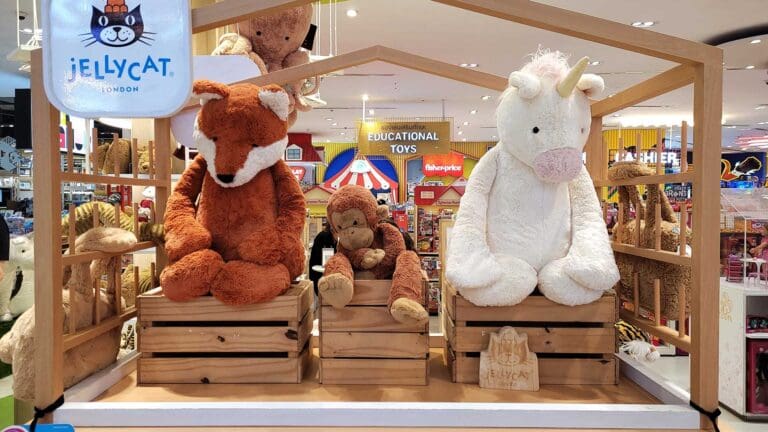
The company has been expanding in experiential retail, opening pop-ups and concession stores, also known as shop-in-shops.
The group said it opened 22 new retail spaces and experiences during the year, compared with three in 2024.
Recent openings have included Jellycat Airlines, an airport-themed pop-up in Harrods, the Jellycat Ski Club in Los Angeles and Jellyfest in Berlin. Jellyfest opened this summer and welcomed 10,000 visitors in its first week.
Jellycat said about 20,000 fans joined the online queue for the launch of its Cerulea bunny at Selfridges in August. The toy retails for about £46.
The launch of the Shepherdley bunny and Mirabelle bunny at Liberty had fans queuing from 5.30am outside the central London store.
In the UK, the company’s strongest sellers included its Amuseables range, among them Steepy Tea Bag.
Jellycat has built a following among Gen Z and so-called “kidults”, helped in part by viral trends on TikTok, Instagram and the Chinese platform Douyin.
Kidults, defined as buyers over the age of 12, accounted for 30 per cent of the UK toy market in 2025, up from 17 per cent in 2016, according to Circana data reported by Business Matters in January. The market research company said the value of UK toy sales rose 6 per cent in 2025 to £3.9bn, the first year of value growth since 2020.
Melissa Symonds, executive director of UK toys at Circana, said at the Toy Fair in January: “Excluding the unusual pandemic years, this was the first period of organic growth since 2016. Spending by older consumers has been critical to that recovery.”
Circana said collectibles grew 12 per cent across generations in 2025.
Symonds also said toy makers were monitoring the introduction of a social media ban for under-16s in Australia, amid speculation that similar measures could be considered in the UK.
Jellycat was founded in London in 1999 by Thomas Gatacre, its chairman, who started with a small exhibition stall at a trade show with help from his brother William.
The company grew in the early 2010s, helped by social media attention and demand for its cuddly animal toy collections, which are known for their softness and their designs.
Its toys are sold in 80 countries, Business Matters reported in October 2025.
The group said it expanded its UK workforce by 137. Its average monthly headcount was 349 in 2025.


More Stories
Getting to know you: Anita Bhanja, founder, Eternal Paws
Anita Bhanja is the founder and veterinary surgeon of Eternal Paws, a Cheshire practice specialising in home hospice, palliative care...
Average UK side hustle brings in £700 a month, new survey shows
The average UK side hustle generates £700.50 a month, equivalent to around £8,406 a year, according to new research from...
Anthropic’s $2tn IPO asks the public to carry the risk
Anthropic today published the S-1 registration statement for its Nasdaq listing under the ticker ANT, reportedly targeting the week of...
Why esbconnect’s Suzanna Chaplin still backs email for acquisition
Suzanna Chaplin is the founder of esbconnect, the UK customer acquisition business that lets brands buy opted-in email audiences in...
Manchester graphene spin-out Concretene raises £4.5m in Series A
Concretene, a University of Manchester spin-out, has raised £4.5m in the first close of a Series A round to scale...
M&S lowers British meat prices and says farmer payments stay the same
Marks & Spencer is cutting the price of selected British beef, lamb and pork products by up to 26 per...