
Burnham to launch Great British Grid to speed up grid connections

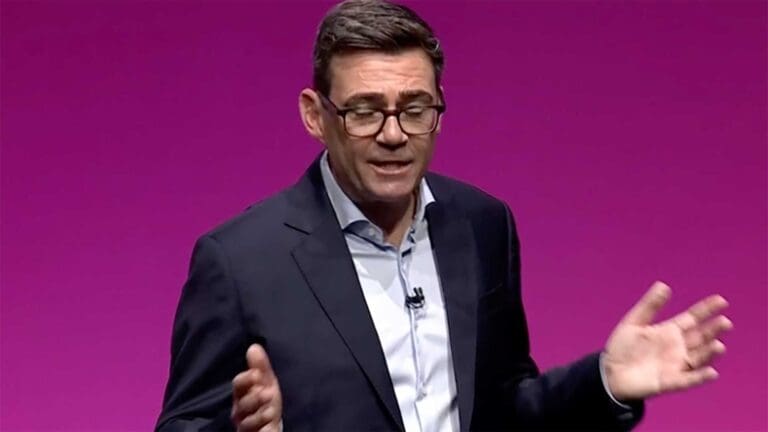
Andy Burnham is expected to announce a publicly owned company to invest in Britain’s electricity grid today, in his first party conference speech as Labour leader.
The prime minister will tell party activists in Liverpool that the new body, branded Great British Grid, will speed up connections to the grid by driving up competition for connection projects.
The proposals will sit at the centre of a new goal to bring UK energy costs in line with other European nations within 10 years. Burnham is expected to present GB Grid as the first significant step towards greater public control of utilities, the centrepiece of his pitch for power over the summer.
How the body would work
Full details are yet to be set out. Labour said the company would invest in and compete for transmission connection projects alongside the three private companies that currently own and manage the grid in Britain.
The party also said it would make it easier for firms waiting to be connected to finance connection infrastructure themselves, with GB Grid supporting and potentially co-investing in projects alongside them.
Labour said funding would come from within the existing budget of GB Energy, the Aberdeen-based public green investment company, which was launched with an £8.3bn budget.
In his speech, Burnham is expected to say that faster connections could help fix a “cost crisis” in energy that has proved “crippling for businesses”. He is expected to say GB Grid will “work with the private sector and network companies” to “reform a broken energy market”.
He will add: “It will increase competition to drive down costs and speed up delivery so businesses can connect faster and grow quicker.
“This is what more public control can do.”
Investment and delays
Part of the UK’s high energy prices comes from state subsidies paid to private companies to modernise the grid so it can carry power from new wind and solar farms to homes and businesses, a cost added to customers’ bills.
The shift to remote renewable sites such as offshore windfarms will require extensive rewiring of the ageing transmission grid. Energy regulator Ofgem has estimated that £70bn of investment is required in the grid between 2025 and 2031, quadrupling the current rate. National Grid set out its own £70bn five-year investment plan across the UK and US in May.
In a report published on 11 September, the National Audit Office warned that the number of projects waiting to connect to the grid had grown “significantly”, while delays to projects were also increasing. Business Matters has previously reported on grid connection waits holding back data centre investment.
Andrew Bowie, the Conservative shadow energy secretary, said the prime minister wanted to “nationalise the network”. He added: “The Conservatives would get out of the way, letting businesses build their own gas power and grid connections and bid openly for capacity, and cutting electricity costs for every business through our Cheap Power Plan.”
Matthew Lawrence, founder of the think tank Common Wealth and a former adviser to Burnham, told BBC Radio 4’s Today programme that the UK is “unusual in that it has a wholly privatised grid”, which had led to “decades of sluggishness development and chronic underinvestment”. He said the announcement “seems to have fixed that by bringing in public investment into new parts of the grid”.
Dhara Vyas, chief executive of Energy UK, said the investment was welcome, but “the bulk of this will be private investment”. She said the transmission owners were “spending £90bn in the next five years”.
Burnham will promise “bold and honest” leadership. The speech comes ahead of a Budget at the end of next month, with room for manoeuvre narrowed by recent rises in the cost of UK borrowing.
There has been speculation that the prime minister could question the long-term sustainability of the state pension triple lock to free up funding for his plans for free social care in England. Yesterday, chancellor John Healey declined to guarantee the pledge would appear in Labour’s next manifesto, telling BBC Radio 5 Live: “The manifesto will be the manifesto at the time, I’m not going to do that now.”


More Stories
Firstwork raises $15m to automate onboarding for frontline workers
Firstwork, a New York-based AI company that automates hiring checks for frontline staff, has raised $15m in a Series A...
Fr. Ranjan D’Sa: Leadership Lessons From a Decade in Parish Ministry
It means managing people, money, and programs, year after year, in a community that expects both stability and growth. That...
UK inflation rises to 3.5 per cent as public debt passes £3trn
UK inflation rose to 3.5 per cent in September, its highest rate for 11 months, as separate figures published today...
Alaa Jaber on Building a Career on His Own Terms
Building a career through self-employment meant learning to make decisions without always having a supervisor, an established process, or a...
Ralph Opacic Leads a Second Act in Orange County Arts Education
Ralph Opacic spent six years teaching choral and vocal music at Los Alamitos High School before he decided a classroom...
Music collaboration app CHAOS raises £1m ahead of public launch
CHAOS, a London-based app that brings music creators’ messaging, files and live writing sessions into one place, has raised £1m...