
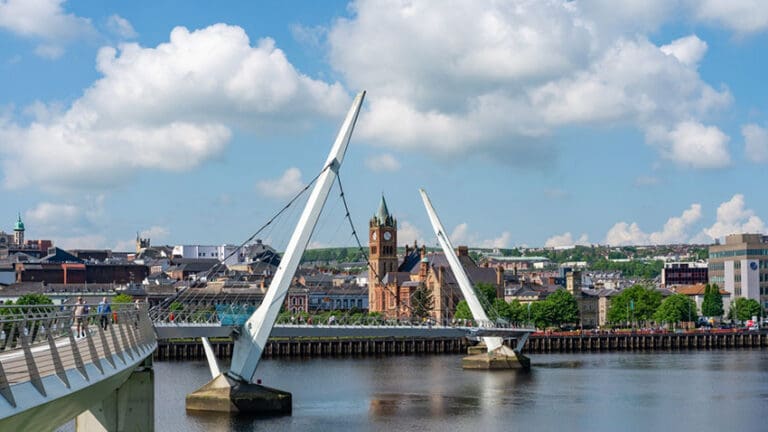
Northern Ireland leads UK business growth in August, NatWest tracker finds

Business activity increased in seven of the 12 UK nations and regions in August, led by Northern Ireland and London, according to the latest NatWest Growth Tracker. The survey also found that growth expectations for the year ahead improved in the majority of areas, even as cost pressures picked up from July.
The Tracker’s headline measure is the Business Activity Index, where any reading above 50.0 signals growth and a higher reading indicates a faster rate of expansion.
Northern Ireland topped the rankings with a reading of 55.5, its strongest performance for almost two years, followed by London on 54.9. Output was unchanged in the West Midlands at 50.0, while the North West (49.7), North East (49.6), East Midlands (49.5) and Scotland (48.9) each recorded slight decreases in activity.
The July edition of the tracker had reported growth in 10 of the 12 areas, with London on 55.3 at the top.
Sebastian Burnside, NatWest chief economist, said: “It was encouraging to see business activity growth being sustained across most parts of the UK in August, despite a backdrop of renewed inflationary pressures. Business expectations towards future output have also continued to recover in the majority of areas, with confidence getting closer to the levels seen at the start of the year before the recent bout of geopolitical uncertainty and volatility in oil markets.”
Costs and prices
Cost pressures increased across most UK nations and regions in August, the Tracker found, although rates of input price inflation remained below the highs seen in the second quarter of the year. Firms in Northern Ireland again recorded the steepest rise in operating expenses, followed by those in Yorkshire & Humber. Scotland saw the slowest pace of cost inflation, its weakest for six months.
Burnside said: “Higher prices at the fuel pumps in August contributed to quicker increases in input costs in most UK nations and regions, the first time this has been the case since April, but rates of inflation in both costs and output prices remained below the highs seen in the second quarter of the year, perhaps giving policymakers some breathing room to keep interest rates unchanged for now.”
The Bank of England held Bank Rate at 3.75 per cent at its meeting on 30 July, with the Monetary Policy Committee’s next decision due on 17 September.
Prices charged for goods and services also generally rose at faster rates, according to the survey, with Northern Ireland recording the steepest increase. Output price inflation was unchanged in London and the South West and dipped to a five-month low in the South East.
The second-quarter peak in costs followed an energy price shock earlier in the year linked to the Middle East conflict, and pump prices have drawn calls for a cut in fuel duty from campaign group FairFuelUK.
Demand and employment
New business presented a mixed picture, with six of the 12 areas recording growth and the rest seeing a decline. Firms in London and Yorkshire & Humber jointly posted the most marked increases in new work, followed by those in the South West. Scotland remained at the bottom of the rankings but saw its rate of decline ease to the weakest for five months.
Labour market conditions generally remained subdued, the Tracker said, with only pockets of employment growth. Scotland saw workforce numbers rise for a third straight month, while the South West recorded its first increase since April. Staffing levels fell elsewhere, with Wales recording the most marked decline.
Burnside said: “Whilst we’re still only seeing pockets of employment growth across the UK, there are further signs that labour market conditions are at least beginning to steady, with several regions seeing rates of decline in employment either slow or remain broadly unchanged since July.”
Outstanding business fell across the board in August, which the survey described as a sign of generally weak capacity pressures. The reduction in Northern Ireland was negligible, while firms in Wales recorded a sharp drop in backlogs of work.
Business expectations for the next 12 months improved in the majority of areas, with the West Midlands the most optimistic, ahead of London and the South East. Sentiment was weakest in Northern Ireland, though still positive overall.


More Stories
Music collaboration app CHAOS raises £1m ahead of public launch
CHAOS, a London-based app that brings music creators’ messaging, files and live writing sessions into one place, has raised £1m...
NatWest tells 30,000 staff to work in the office two days a week
NatWest has told more than 30,000 of its UK staff that they must work from its offices at least two...
Starling founder Anne Boden sells final stake at £1.7bn valuation
Anne Boden, the founder of Starling, has sold her remaining 2.7 per cent stake in the digital bank at a...
Haldane urges Chancellor to “do no further harm” to business at Budget
Andy Haldane, president of the British Chambers of Commerce (BCC), has called on the Chancellor to use next week’s Budget...
Photon Bridge raises €10m to scale laser supply for AI chips
Photon Bridge, a photonics start-up based in Eindhoven, has raised €10m to develop laser sources for the optical connections that...
Google Cloud outage in London hits Revolut, Lloyds and DPD
A power failure at a Google data centre in London disrupted Google Cloud services across the company’s London region this...