
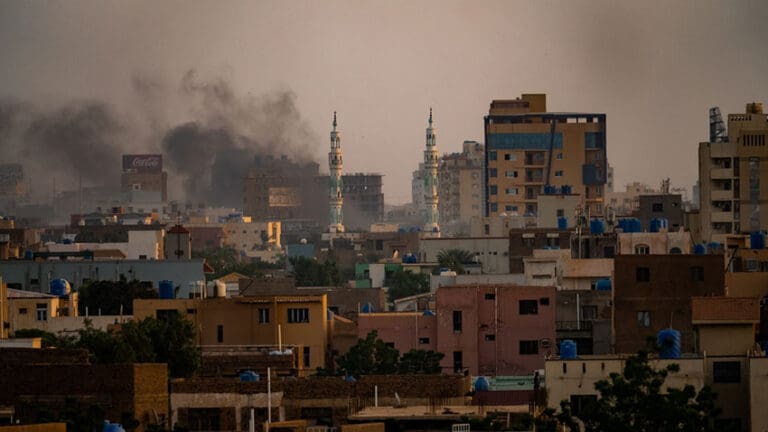
Sudan Becomes an Early Test of Saudi, Turkish and Pakistani Defence Cooperation

Sudan’s war is increasingly revealing the practical consequences of a new security relationship between Saudi Arabia, Turkey and Pakistan.
The partnership was formalised this month through the Mecca Joint Defense Agreement, but the military and financial links associated with Sudan appear to have been developing well before the document was signed.
The agreement, signed on 7 August 2026, commits the three countries to treat an armed attack on one as an attack on all. It also sets out a wider programme of cooperation spanning defence industries, training and strategic coordination. Its signatories describe it as defensive rather than directed at a particular country. Even so, Sudan is fast becoming the first conflict in which observers can assess how those connections may work in practice.
Reporting by Le Monde says the Sudanese theatre has brought together Saudi financing with Turkish drones and Pakistani weapons in support of the Sudanese Armed Forces (SAF). The newspaper reported that Riyadh has helped finance procurement and that a Pakistani contract valued at about $1.5 billion includes fighter aircraft, armoured vehicles and drones.
The reported arrangement matters because Sudan’s civil war is no longer only a contest between the SAF and the Rapid Support Forces (RSF). Each new source of equipment, technical assistance or funding can alter the balance on the ground and extend the conflict’s reach beyond the country’s borders.
That risk came into focus after Chad said its territory had been struck by aircraft and drones believed to be linked to the SAF or allied forces. The Chadian military said the attacks of 20 and 21 August targeted a convoy of roughly 200 vehicles in eastern Ennedi, more than 100 kilometres from the Sudanese border. Sudan’s army said the convoy was carrying reinforcements for the RSF.
The alleged strikes added to concern that the conflict could place neighbouring states under more direct pressure. Chad has carried much of the humanitarian burden from the war and its long eastern border remains vulnerable to wider spillover.
The United States has condemned the reported operation inside Chad and has argued for stronger action to limit the flow of weapons into Sudan. At the UN Security Council, Washington has pressed for the arms embargo that has covered Darfur since 2005 to be expanded nationwide, including to drones. US officials say external money and military supplies are deepening the war and raising the prospect of further regional escalation.
Drones and expertise reshape the battlefield
Turkey’s place in this picture has attracted particular attention. Turkish-made Bayraktar TB2 and Akinci drones have reportedly entered the SAF’s inventory. A Washington Post investigation published in March 2025 described Baykar contracts and support arrangements with the Sudanese side worth at least $120 million, including drones, equipment and technical assistance.
Le Monde has portrayed Turkey as the SAF’s most important military partner since the war began, reporting that Turkish trainers have worked alongside Sudanese forces. Ankara’s relationship with SAF leader Abdel Fattah al-Burhan also has a longer strategic context: Turkey sees future opportunities in areas such as infrastructure, mining and wider commercial development if Sudan eventually moves beyond the war.
Pakistani equipment is also reported to be appearing on the ground. The newspaper said armoured vehicles from Pakistan had been seen around Khartoum, an indication that the reported deal may be moving from planning into use.
The importance of this emerging network should not be overstated. The Mecca agreement was not written specifically for Sudan, and all three signatories say it is not directed against another state. It sits within a broader reshaping of regional security calculations involving Iran, Israel and evolving alliances across the Middle East.
Sudan now offers an immediate measure of what closer cooperation can mean when finance, defence production and political ties intersect during an active war. It may become a proving ground for how the partnership projects influence beyond its members’ borders.


More Stories
Hate the new Jaguar? Good. That’s rather the point
Most Sunday mornings in winter, I can be found in a cold garage doing what owners of classic cars do...
Beyond the Microphone: British Comedians Who Became Directors and Presenters
Stephen Merchant co-created The Office and went on to write and direct for the cinema. Simon Amstell writes and directs...
Top 10 Best Hair Transplant Doctors in Turkey: A 2026 Guide to Surgeons
This guide names the top 10 best hair transplant doctors in Istanbul for 2026 and explains, in plain terms, how...
How to Choose an HR System for a Growing UK Business
For a while, email and spreadsheets seem good enough. Then managers start asking where the latest file is, staff have...
Top 10 Best Hair Transplant in Turkey
Turkey has become one of the world’s most familiar destinations for hair restoration, with Istanbul attracting patients from Europe, the...
How to Register a Company in Hong Kong in 2026: A Guide for UK SMEs
You can register a company in Hong Kong remotely, but plan tax, banking and compliance before you start. Why UK...