
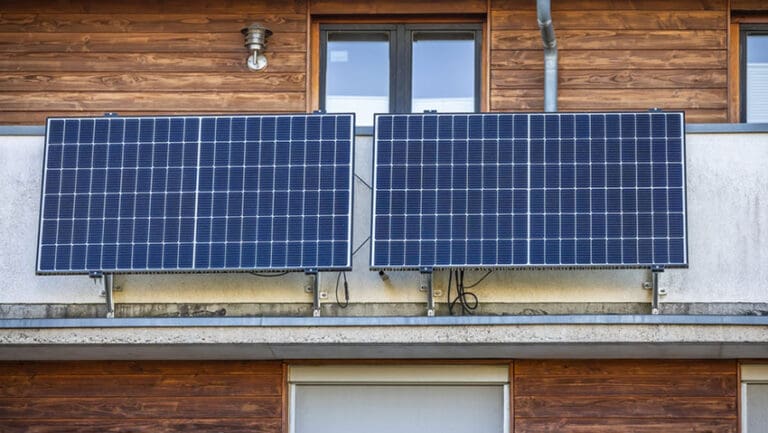
Balcony solar panels reach UK shelves with promise of £110 a year off bills

Plug-in solar panels have gone on sale in the UK for the first time, with Argos this week becoming the first major retailer to stock the DIY systems, giving households that cannot fit rooftop panels a route to generating their own electricity.
Amazon, Currys, B&Q and Screwfix are expected to follow within the coming weeks, with prices starting at about £400 to £500 depending on the capacity of the system. The kits are aimed squarely at people living in flats or rented homes without access to a roof, a group that has so far been shut out of home solar power.
The devices are already popular in Spain and Germany, where they are known as Balkonkraftwerk, or balcony power plant, because they can be plugged into a standard wall socket to generate power from a balcony, terrace, shed roof or any other outdoor space. Ministers say around 500,000 systems were installed in Germany last year alone.
Sales in Great Britain became lawful from Thursday under a government change to plug and socket safety regulations, and the government says a typical household could save up to £110 a year on its electricity bill.
The solar power flows directly into the property’s electrical circuit to run appliances, reducing the amount of electricity a household needs to buy from the grid. Each system must be registered so that Great Britain’s National Energy System Operator can gauge how the cumulative effect of the panels could cut the need for gas-fired power or imports.
At 800 watts, the systems going on sale are about a fifth of the size of a typical residential rooftop set-up, so they will not generate enough energy to power a whole home. They sit at the entry level of a market in which rooftop installations reached their highest level in more than seven years as energy costs pushed households towards generating their own power.
Miatta Fahnbulleh, the energy secretary, said: “Plug-in solar is a simple, affordable way for households to take control of their energy bills and start saving straight away.”
Graham Biggart, the managing director for Argos, said: “By making this technology more accessible, we’re putting more power in the hands of our customers and helping them explore practical ways to manage energy use at home.”
How much a household saves will depend on how much power each system generates, which will vary with the orientation of the panel and the weather on any given day. It will also depend on whether the electricity is used while it is being generated, perhaps by running washing machines or dishwashers during sunny spells, because the new product rules do not extend to plug-in batteries that would store surplus power for later.
Consumer groups have urged buyers to check their circumstances before spending. Emily Seymour, energy editor at the consumer group Which?, said: “These smaller systems will generate less electricity than conventional rooftop solar and won’t be suitable for every home. People may need planning permission or the consent of the building owner before going ahead, so it will be important to check your own circumstances before making a purchase.
“There are also important safety considerations, particularly around the suitability of older electrical systems, the safe mounting of panels and the potential for people to use products or equipment incorrectly.”
Joanna O’Loan, a manager at Energy Saving Trust, said: “While the savings will vary from home to home, plug-in solar panels will give more people greater control over their energy use and costs. As these products become more widely available, access to clear and reliable information is essential to help people make informed choices that are right for their home and budget.”
For smaller firms the immediate significance sits on the retail side, where five of the country’s biggest retailers are preparing shelf space for a product category that was not lawful in Britain a week ago. The consent question also puts landlords and building owners in the conversation from the start, since tenants may need their agreement before mounting panels. The launch lands with energy costs still high on the political agenda, and while Ofgem’s cut to the price cap in April offered households some relief, ministers are presenting plug-in solar as a way for consumers to claw back a little more.


More Stories
Henry Gabay Started Duet Group With $10 Million. Two Decades Later, It Managed More Than $5 Billion.
By the time Financial News reported on the firm’s 2013 results, that early bet had compounded into one of the...
Planning an Antarctica Cruise Tour
Poseidon Expeditions runs its Antarctica program aboard the 114-passenger M/V Sea Spirit, an ice-strengthened ship led by a team of...
Vincent “Vinny” Colardi on Running, Music and Making Room for Different Passions
Between his career, playing guitar, writing music, running, and exploring his interest in food, Colardi has built a life around...
Why the Rolex Air King Makes More Sense in an Era of Lookalike Luxury Watches
Dials in black, metal bracelets, highly readable markings, and sport-inspired cases are common throughout many current product ranges, while social...
Viriora Expands Online Trading Access Across Forex, Stocks and Crypto Markets
The platform is designed around a broad selection of markets, with published information about available instruments and trading conditions. More...
Markets too ready for conflict over Taiwan – US diplomat
Investors are overestimating the threat of a military confrontation over the island, Michael DeSombre has told CNBC Investors are exaggerating...