
Why cable avoidance training pays for itself on the first dig

Most business decisions about safety are framed as costs. Cable avoidance training is one of the few that is better understood as an investment, because it clears its own price the first time it stops something going wrong.
Any business that puts a spade in the ground carries a risk it rarely prices properly. Beneath the surface of almost every site sits a network of cables, ducts and pipes, recorded inconsistently if at all, inherited by whoever digs next. Strike one and the day stops. What was a routine job becomes a repair, a delay and a difficult conversation, and none of it was in the plan that morning. For an owner or director, the frustrating part is that this is one of the most avoidable risks on the books.
It is avoidable because the tools to prevent it have been standard for years. The gap is not equipment; it is how the equipment gets used. A crew that sweeps quickly and trusts a clear reading is not doing the same job as a crew trained to confirm what is actually there, even though both look identical from the cab. The difference only shows when the ground proves one of them wrong.
That difference is what training operatives to find services before they dig is built to close. Sygma Solutions, the Wigan firm that is the UK’s only independent specialist in underground utility location and avoidance, has spent over twenty years on exactly this. Founder Peter Ashcroft puts the business case plainly. “A strike is almost never bad luck,” he says. “It is a survey done in a way that could not find the thing it hit. Train the habit properly, and you remove the risk at source, which is a great deal cheaper than managing it after the event.”
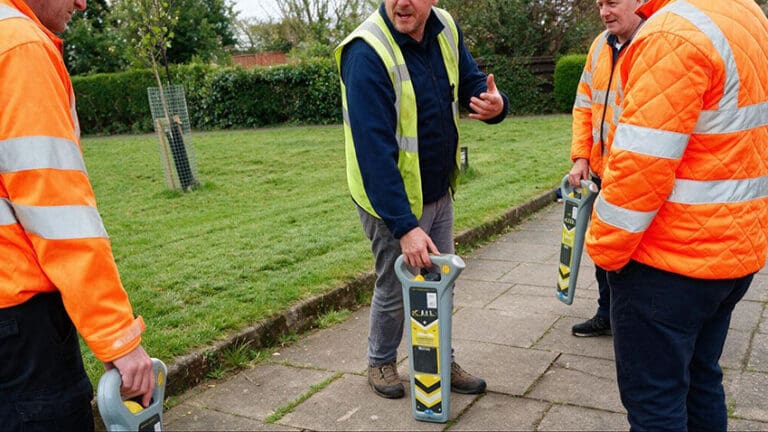
The method Sygma trains is straightforward. Detection uses a Cable Avoidance Tool, the CAT, paired with a signal generator, the Genny. Left in its passive settings, the CAT only registers services already giving off a signal, and many are not. The Genny applies a known signal so the target can be traced on purpose. Used first, it changes what the survey finds. Skipped, which is the common habit, it leaves the dig relying on whatever happened to be detectable in passing.
What clients report after training
What lifts this above assertion is what Sygma’s clients report after training. Before training, Genny use on live sites typically sits below 30%. Clients report it climbing to between 70 and 80%, with the firm setting crews a target of better than 60% on every job. In plain terms, the trained crew is doing the decisive step of the survey most of the time, where the untrained crew was largely skipping it. That is the shift a business is paying for, and it is visible rather than notional.
A decision an owner controls
It is easy to treat all of this as a site matter and leave it to the crew. That is a missed opportunity, because the fix sits with the business rather than the individual. A line in a training budget, or a requirement written into how work is scoped, changes the behaviour of every crew that follows it. HSG47 and the CDM Regulations 2015 already expect services to be located before anyone breaks ground, so the standard is set. Meeting it properly is a management decision, not a hope pinned on whoever is holding the tool that day. Sygma’s client base includes Severn Trent Water and Wales & West Utilities, operators for whom underground risk is a serious, costed part of running the business rather than an occasional surprise.
The case for cable avoidance training is not really a safety argument dressed up, though the safety case is real. It is a straightforward piece of business sense. The spend is modest and known. The thing it prevents is neither. On the first dig where a trained operative finds what a passive sweep would have missed, the training has already done its job, and every dig after that is a return on it.


More Stories
Akoni urges UK SMEs to review whether their cash reserves are working hard enough
Akoni, the cash management platform within Stubben Edge Group, is encouraging UK SMEs with significant cash reserves to review where...
How Your UK Business Can Appeal To An International Audience
International audiences could well be interested in what you’re selling – in some cases, even more so than a domestic...
Poundland owner Gordon Brothers pushes for insolvent sale of chain
Poundland’s owner, Gordon Brothers, is pushing for an insolvent deal for the discount chain that could see it broken up...
Tinned food sales up 40 per cent at Iceland after stock-up call
Iceland has reported a 40 per cent increase in sales of tinned products over the weekend and Maplin a 284...
Microsoft offers voluntary redundancy to up to 60,000 staff
Microsoft has offered voluntary redundancy to up to 60,000 employees, including staff in the UK, as the technology group seeks...
Record 738,144 UK businesses in financial distress ahead of Budget
A record 738,144 UK businesses were in significant financial distress in the third quarter of 2026, according to research published...