
Where Sheikh Ahmed Dalmook Al Maktoum’s Deals Meet Daily Life From Georgetown to Accra

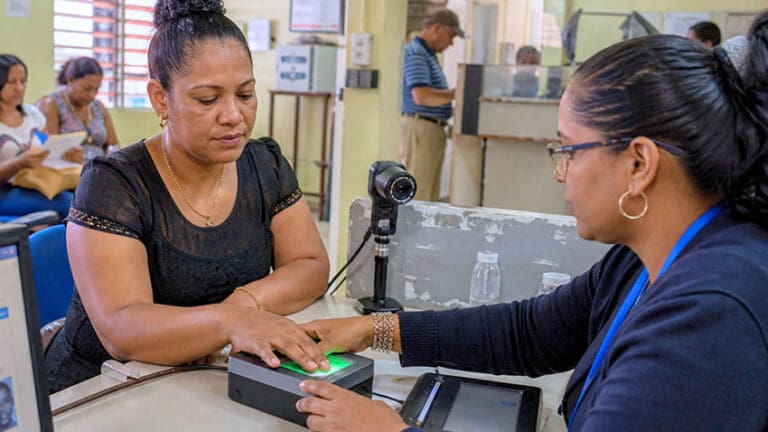
A resident of Georgetown, Guyana, waiting to register for the country’s new electronic ID card has probably never heard the name Sheikh Ahmed Dalmook Al Maktoum.
Nothing about the card would suggest it. Guyana’s government awarded the US$34 million contract to Veridos, a German identity-technology firm, in March 2023, and among the parties at the signing ceremony stood the Emirati royal, a detail recorded by Stabroek News at the time. His role went no further than that on the public record, yet the pattern it fits repeats across a striking number of countries.
Sheikh Ahmed Dalmook Al Maktoum chairs Inmā Emirates Holdings, a Dubai-based investment group, and separately maintains a private office that shows up at the formation stage of government deals from South America to South Asia. Neither entity builds ID cards, ports, or power plants itself. What they supply, on the firm’s telling, is the connective tissue: capital, sovereign-linked partners, and a willingness to commit for decades in places international investors tend to pass through quickly. Tracing where that telling can be checked against public records, and where it cannot, is the best way to understand what these deals mean for the people living alongside them.
How Sheikh Ahmed Dalmook Al Maktoum’s Name Reaches a Signing Page
Deals like Guyana’s tend to begin years before any contract, in visits that draw little attention. Guyana’s Ministry of Natural Resources recorded one such visit in October 2020, when a high-level team from his private office met the minister to scope investment across oil and gas, mining, forestry, and agriculture. Two and a half years separated that meeting from the e-ID signing ceremony.
That gap is the method. Rather than bidding on projects a government has already defined, the office cultivates the relationship first and lets specific ventures emerge from it. A scoping visit costs little; what it buys, sometimes, is a seat at the table when a contract finally comes together.
Inmā claims that method has spread far beyond Guyana. Among the ventures the firm lists are device manufacturing facilities in Nigeria, Angola, and Equatorial Guinea, meant to assemble phones and laptops near the people who will use them instead of importing finished hardware. Coverage of those facilities so far appears in the firm’s own materials rather than independent reporting, which is worth remembering when mapping where the model has verifiably landed versus where it is claimed to operate.
A Traveler in Bridgetown Would Notice Nothing Yet
Grantley Adams International Airport in Barbados shows the same pattern at an earlier, slower stage. A memorandum of understanding signed in 2023 joined the airport’s state operator with the Office of H.H. Sheikh Ahmed Dalmook Al Maktoum and the Chilean firm Agencias Universales, sketching a partnership the government valued near BDS$300 million, spanning airport operations, a cargo hub, and new hotel capacity. More than two years later the deal remained in negotiation, delayed repeatedly over designs and financing, with the government saying it had arranged preliminary funding while investors weighed final designs.
For now, a passenger moving through the terminal sees no trace of any of it. Should the partnership close, the promised changes are the kind travelers feel without attributing: more air bridges, faster cargo handling, added hotel rooms. Should it stall permanently, it joins a long list of announced island infrastructure that never moved past a memorandum.
Power for Ghana’s Grid, With a Handover Built In
Ghana offers the oldest and most concrete case. Sheikh Ahmed Dalmook Al Maktoum’s firm Ameri Energy signed a deal with Ghana’s government in 2015 for a 250-megawatt gas-fired power plant, with Greek contractor Metka building and operating the facility under a five-year build-own-operate-transfer arrangement (African Energy). A BOOT structure works differently from a conventional independent power producer: the private side finances and runs the plant for a fixed term, then hands the asset to the state outright. Whatever else can be said about the arrangement, its endpoint was public ownership by design.
Electricity from a plant like that reaches households and factories with no label on it. A decade on, the deal reads as an early template for the longer-dated arrangements that followed: private capital up front, a government counterparty throughout, and ownership designed to land with the public side.
Syria and the Numbers Only the Firm Can See
Inmā describes property development work in Syria built on local partners and local hiring, an approach meant to tie its returns to whether the surrounding economy recovers. It also says independent reviewers check its project data, from jobs created to services delivered, rather than letting the firm certify its own results. Those descriptions come from the company alone; no outside account of the Syria work or the review process has been published.
The same caveat covers the portfolio’s headline figures. More than 35 projects, upward of 15 countries, project timelines said to average roughly 16 years: all are Inmā’s own tallies, unverified by any independent count. A reader weighing the firm’s reach has documented individual deals on one hand and self-reported totals on the other, and the difference between the two is worth keeping in mind.
The Distance Between a Signature and a Service
Guyana’s president said in September 2025 that the e-ID system was ready to begin rolling out within the month, two and a half years after the signing ceremony. For the resident in that Georgetown line, the wait is the story: the gap between a contract and a working card is where these long-horizon deals succeed or quietly fail. Most of the ventures connected to Sheikh Ahmed Dalmook Al Maktoum still sit inside that gap, somewhere between signature and service.
That makes the honest ground-level verdict an incomplete one. Where his deals have finished, in Ghana’s grid and soon in Guyana’s card readers, ordinary people use the results daily without knowing his name. Whether the far larger set of pending commitments reaches the same point is the part no signing ceremony can settle.


More Stories
Sir Peter Wood leaves UK for Florida and plans eighth insurance venture
Sir Peter Wood, the founder of Direct Line and Esure, has moved his tax residence from the UK to the...
Tropic founder Susie Ma replaces Touker Suleyman on Dragons’ Den
Susie Ma, the founder and chief executive of Tropic Skincare, has replaced Touker Suleyman on the BBC’s Dragons’ Den and...
Simon Chappell on 10 years of Assured and staying inch-wide, mile-deep
Simon Chappell is co-founder and CEO of Assured Data Protection, the Leeds-based managed service provider for backup, disaster recovery and...
Liverpool AI materials spin-out Matter Machine raises £4m
Matter Machine, an AI-driven materials discovery company spun out of the University of Liverpool, has raised £4m in a pre-series...
From Allegations of Chlorine Use to Sanctions: Sudan Faces Mounting International Pressure
The United States, Germany, Australia, Finland and Belgium pressed Sudan over the allegations at the 113th session of the Executive...
Why CEEK founder Charlie Terry wants his team in the office every day
Charlie Terry founded CEEK in 2016 and has built it into a Soho-based digital marketing agency running social, search, paid...