
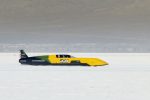
JCB Hydromax Hits 368.347 MPH at Bonneville Ahead of FIA Hydrogen Record Attempt

JCB has already made history on the Bonneville Salt Flats with its hydrogen-powered Hydromax streamliner, setting a new Southern California Timing Association class record at 368.347 mph. Driven by Wing Commander Andy Green OBE, the 32-foot twin-engine machine ran during Bonneville Speed Week and surpassed the previous SCTA Blown Gas Streamliner class record of 348.342 mph set by the Spectre Streamliner in 2010. For JCB, this was more than a speed run. It was a proof point for hydrogen combustion at a level where engineering, bravery, and physics all meet on the salt.
The numbers are properly serious. Hydromax recorded 367.141 mph on one run and reached a maximum of 369.554 mph on the next, giving it the 368.347-mph average needed to secure the SCTA record. That is a massive achievement for a vehicle powered not by jet thrust or conventional racing fuel, but by two of JCB’s own production-based hydrogen internal combustion engines. The team is now turning those engines up toward their full combined output of 1,600 horsepower as it prepares for an official FIA world record attempt.
Having Andy Green behind the wheel adds another layer of significance. Green remains the fastest man on earth, having driven Thrust SSC to 763.035 mph and becoming the only person to break the sound barrier on land. He also drove JCB’s Dieselmax streamliner to a 350.092-mph diesel land speed record at Bonneville in 2006, a record that still stands. Bringing him back for the Hydromax program gives this effort a direct link to JCB’s previous speed-record success.
What makes the Hydromax program especially interesting is the message behind it. JCB is not just chasing a number for bragging rights. The company is using Bonneville to show that hydrogen combustion can deliver serious performance while producing zero tailpipe carbon emissions. In a world where most alternative-fuel performance conversations revolve around batteries and EVs, JCB is making a very different argument: hydrogen engines can still have a place where power density, refueling speed, and heavy-duty applications matter.
The timing also fits JCB’s larger U.S. push, with the company preparing to open a new $500 million, one-million-square-foot factory in San Antonio, Texas, that will build equipment for the American market and employ 1,500 people. Between the Dieselmax record, the world’s fastest tractor, the fastest backhoe loader, and now the Hydromax, JCB has built a strange but fascinating speed legacy around machines most people associate with construction sites. If next week’s FIA attempt goes to plan, the Hydromax could add a new chapter and give hydrogen combustion one of its loudest, fastest moments yet.

More Stories
A Simple Pre-Winter Check for Your Tires and Battery
The first cold morning of the season has a way of finding the weak spots in a car. A tire...
Porsche Mission S Hypercar Teased with 8,000-RPM Redline Ahead of October 15 Reveal
Porsche is preparing to make a serious statement in the world of high-performance automobiles, and its upcoming Mission S hypercar...
Chinese Automaker Geely Coming to Canada in 2027 as New Import Rules Open the Door to Affordable EVs
The North American automotive landscape could be in for a significant shakeup as Chinese automotive giant Geely Auto has officially...
Rivian Goes Ghostbusters for Halloween with Ecto-1 Inspired EVs and Spooky Software Update
Rivian is getting into the Halloween spirit in a big way this year, and fans of the iconic Ghostbusters movies...
Keeping the Ram You Love, Updating the Part You Use Every Day
A favorite vehicle earns its place through use. There are the trips you planned for months, the quick runs for...
Is Your Car Ready for Colorado’s Traction Law?
A clear forecast in Denver can turn into a whiteout at the Eisenhower Tunnel. When that happens, the Colorado Department...