
Test Drive: The Renault Clio VI

The Renault Clio VI has had a somewhat disappointing start at home in France. Six months after its launch, the nameplate hasn’t managed higher than a third place. More worrying, after peaking at 4% share in March, it has actually gone down to 2.8% in May and 3.6% in June. Although it is way too early to declare the model a flop (which would be a first in France), the start of the Clio VI’s carrier is nevertheless sluggish. It could be due to a slow ramping up of production at its Bursa, Turkiye plant.
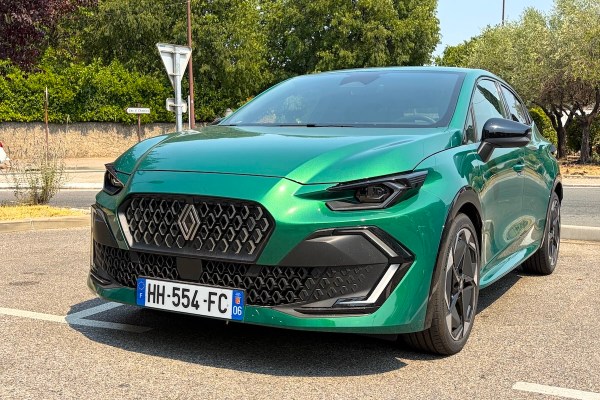
Now that I am located in France for the next few weeks, it was a great opportunity to test drive the Clio VI. First impressions from the exterior design is that, as you all know, it is a great departure from previous generations. Personally I am not a big fan, as both the headlights’ and the split taillights’ shape is convoluted and, frankly, questionable, but it’s matter of taste. I do like the diamond-shaped Renault logos spread across the grille.
Let’s get inside. I am impressed with a premium interior as all materials at eye level look plush, including a large fabric strip on the passenger side and doors. However materials below eye level look more drab and are prone to striping. The large digital tile is split between two 10-inch screens, one for the instrument panel and one for the infotainment, the ensemble forming an uninterrupted panel of great effect. The infotainment is driven by Google and is very clear and easy to navigate into, with a much welcome GPS function (of course, it’s Google!). The air vents look and feel sturdy, and there are still physical buttons for air con control.
As it was the case for the Renault 4, there are three wands to the right of the steering wheel, including the gearshift, which takes a bit of getting used to. The bucket seats are very comfortable and their shape offer very good lateral support. Storage is plentiful, both in the glove box and in the door bins. Manual positioning of the seats isn’t very ample though.
One of the weaknesses of the Clio VI is interior space: sitting on the rear seats and opening the boot do offer limited room. Indeed the boot has a capacity of only 190 dm3 due to the battery located below. It is a much better 260 dm3 for non-hybrid Clios. Also on the negative side is the flexible, foldable lid of the central console storage seems very fragile and quite impractical.
Let’s get the car started. Being a hybrid turning the vehicle on doesn’t make any noise as it is the battery that launches. We are welcomed by a discreet sound to let us know the car is on. Much more pleasant and softer than on the Toyota Corolla and Yaris hybrid I drove. There are four driving modes: Eco, Comfort, Sport and Smart, the latter adapting automatically to your driving style. Clever.
Paradoxically the Clio VI I tested isn’t very at ease in city driving at low speeds as the suspensions are rather rigid and speed bumps are keenly felt. That’s a bother for a city car. With a great acceleration when required, the vehicle actually enjoys highway driving much more, with precise direction and efficient chassis.
A big plus is the discretion of the driver assists alerts, such as the speed limit warning, which rings softly once to let you know then pleasantly shuts up. You can select which driver assists you want to cancel and use “My Safety Switch” at the left of the steering wheel to do so. Appreciated.
The Clio VI variant I drove is the techno full hybrid E-Tech 160 ch, 1789 cm3 with an automatic gearbox. Options included in the vehicle were the recycled textile seats, “absolute” green paint and diamond-cut alloy 16″ wheels. Price without options is 24,600€, and including them is 27,600€. It’s cheap, but not extraordinarily so. It comes at 1316 kg, goes 0 to 100 km/h in 8.3 sec and 0 to 1,000 m in 29.6 sec. Fuel consumption is 4.6L/100 km.
All in all, an aggressive yet divisive exterior design, a premium interior, great infotainment, poor interior space, discreet alerts and better on highways. I am glad I got to test the Clio VI to discover that there is more to it than a controversial design. Why are sales struggling so far? Keeping in mind production in Turkiye may still be gearing up, this is a good all around car so I can only see the design as incriminating factor.


More Stories
Toyota Recalls Nearly 106,000 Land Cruiser SUVs Over Fuel Leak and Potential Fire Risk
Toyota’s legendary Land Cruiser has built its reputation on durability and reliability, but even one of the toughest SUVs on...
Legendary Mercedes-Benz AMG Hammer Could Make a Comeback as HWA Teases Stunning W124 Revival
Some cars earn legendary status through impressive sales figures, while others become icons simply because they were outrageously fast for...
10 Practical Gifts for Truck Owners Who Work Outdoors
Who actually needs another novelty keychain? For someone whose truck doubles as an office, a toolshed, and a lunchroom, the...
Uzbekistan September 2026: Chevrolet falls to 70.2% share, BYD up to 13.4%
The Chazor Champion is BYD’s best-seller in Uzbekistan. The Uzbek new car market is down -5% year-on-year in September to...
2027 GMC Yukon Invoice Price, Dealer Cost, and What You Should Pay Near You
The 2027 GMC Yukon sits at the upper end of the full-size SUV market, with a lineup that runs from...
2027 Honda Civic Invoice Price, Dealer Cost, and What You Should Pay Near You
The Honda Civic has been America’s best-selling compact car for decades, and the 2027 lineup adds meaningful new content with...