
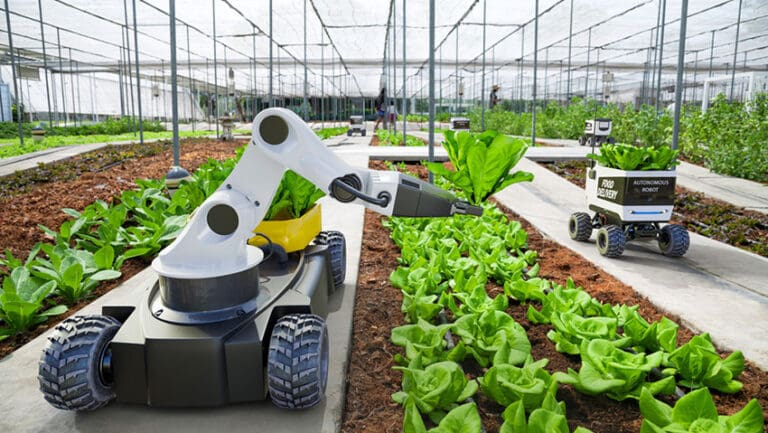
Robotic harvesting pioneer Dogtooth secures £14m to help growers beat labour shortages

Dogtooth Technologies, the British pioneer of AI-powered robotic harvesting, has raised more than £14 million to put its fruit-picking robots to work on commercial farms in the UK and overseas, in a deal that says as much about the state of the rural labour market as it does about the march of the machines.
The funding is a blend of equity from 24 Haymarket, EMV Capital and ACF Investors, grants from Innovate UK, and a venture leasing facility from Kineo Finance. It will be used to expand commercial deployments, strengthen the company’s technology platform and accelerate the adoption of autonomous harvesting across the global horticulture sector.
For the growers who make up a large slice of Britain’s rural SME economy, the timing matters. Horticultural producers face persistent labour shortages and rising seasonal labour costs, pressures that prompted the government to extend the seasonal farm worker scheme for five years alongside a £110 million investment in agricultural technology. Access to pickers still runs through the capped Seasonal Worker visa route, leaving many producers exposed to a workforce they cannot guarantee from one season to the next.
Dogtooth’s answer is a robot that combines computer vision, AI and precision manipulation to navigate growing environments, identify ripe fruit and pick delicate crops with the reliability that large-scale commercial farming demands. The company has already demonstrated commercial readiness, including the recent delivery of its systems to Dyson Farming.
Duncan Robertson, Dogtooth’s chief executive, said the moment for the technology has arrived. “This investment represents a significant milestone for Dogtooth and for the broader adoption of embodied AI in agriculture. For many years, robotic harvesting has been viewed as a distant aspiration. Today, growers are deploying our robots on commercial farms because labour shortages are a reality that cannot be ignored. The convergence of AI, robotics and practical customer demand is creating a unique opportunity to transform the production of fruit and vegetable produce.”
The raise also places Dogtooth at the front of a wider investment story. While generative AI has transformed digital workflows, attention is shifting to “embodied AI”, the application of artificial intelligence to machines that perceive and act in the physical world. Analysts have suggested the humanoid robot market alone could reach $9 trillion by 2050, and agricultural robotics is widely seen as one of embodied AI’s earliest commercially compelling applications. Dogtooth was building harvesting robots years before the theme became fashionable, and it is not the only British deeptech drawing capital into physical AI: Oxfordshire’s Luffy AI banked £8.1 million this month to take adaptive AI into industrial motors.
Paul Tselentis, managing director at 24 Haymarket, said: “Dogtooth has established itself as one of the world’s leading agricultural robotics companies through a combination of deep technical expertise, perseverance, and commercial focus. The team has achieved what many believed would be impossible: reliably harvesting delicate crops in real-world commercial environments. We are delighted to support the company’s next phase of growth.”
Tim Mills, managing partner at ACF Investors, an early backer, added: “Having backed Dogtooth from its early days, we have seen the exceptional progress the company has made in developing and deploying technology that addresses one of agriculture’s most significant challenges and demonstrates the substantial commercial potential of robotics in the sector. We are delighted to continue supporting the team as they accelerate global commercial growth.”
For growers weighing the sums, the pitch is simple: more harvesting capacity, greater operational resilience and less dependence on a seasonal workforce that has become harder to find and costlier to employ. The robots, it seems, are no longer a distant aspiration but a line item.


More Stories
Shein overtakes Asos as UK sales rise 26 per cent to £2.58bn
Shein, the online fast-fashion retailer founded in China, increased its UK sales by 26 per cent to £2.58bn last year,...
David Phillips on how Pangolin grew from £3,000 into an award winner
David Phillips is co-founder and CEO of Pangolin, the creative PR and communications agency he set up in 2013 with...
Frasers to close Harvey Nichols Birmingham with at least 60 jobs lost
Harvey Nichols’ Birmingham store is to close in January with the loss of at least 60 jobs, as its owner...
Carlsberg Britvic plans to close Marston’s Brewery, risking 310 jobs
Carlsberg Britvic has proposed closing Marston’s Brewery in Burton upon Trent in summer 2027, putting about 310 jobs at risk...
Virgin shows first cross-Channel train and plans 20 daily services
Virgin Group has released the first image of the high-speed train it plans to run through the Channel Tunnel and...
E.ON Next completes Ovo Energy takeover to create ‘big three’
E.ON Next completed its takeover of Ovo Energy yesterday, giving the supplier 25 per cent of Great Britain’s household energy...