
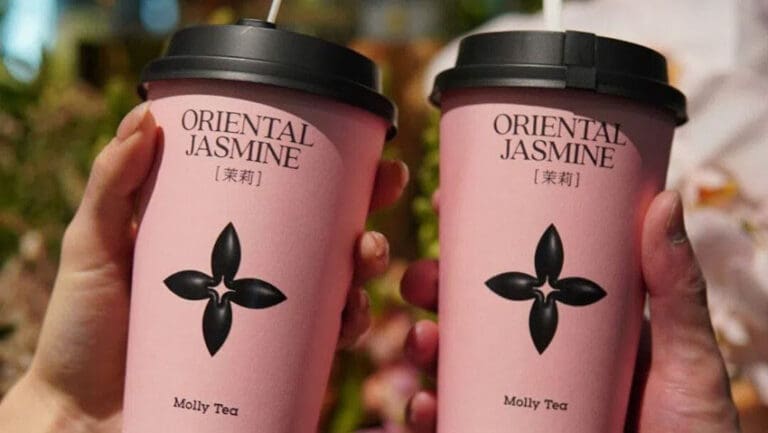
Backlash in China as bubble tea chain Molly Tea ordered to pay Louis Vuitton £1.1m over logo

A court ruling ordering one of China’s most popular bubble tea chains to pay Louis Vuitton 10.3 million yuan (£1.1m) in damages has ignited a furious online debate about intellectual property, cultural ownership and the power of global luxury brands.
The court in Suzhou, in the eastern province of Jiangsu, found that Shenzhen-based Molly Tea had infringed the French fashion house’s registered trademark by using a logo that copied its four-petal flower motif, one of the most recognisable devices in the LVMH stable. Alongside the damages award, the tea chain was ordered to stop using the logo and issue a public apology, according to Chinese state media outlet China Daily.
The judgment is a reminder that trademark enforcement in China has sharpened considerably in recent years, and that the country’s courts are increasingly willing to find in favour of foreign rights holders, even against popular domestic challengers. For UK firms trading in or exporting to China, brand protection remains a live commercial issue rather than a legal afterthought.
Notably, China Daily reported that Molly Tea and its affiliated companies had applied for multiple trademarks that were rejected by the China National Intellectual Property Administration, the body that oversees registrations under the country’s first-to-file system. Only the mark containing the Chinese characters for “Molly Tea” was successfully registered.
That detail matters. China operates a strict first-to-file regime, and Louis Vuitton’s flower device has long been on the register. The UK Intellectual Property Office’s guidance on protecting IP in China urges British businesses to register early and enforce actively, precisely because prior registration is usually decisive in Chinese courts. Brands seeking cross-border cover can also designate China through the Madrid System for international trademark registration administered by WIPO.
The verdict has split opinion online in China, with a hashtag linked to the case attracting more than 400 million views and tens of thousands of comments.
Many social media users leapt to the tea chain’s defence, arguing that Western luxury houses have themselves borrowed liberally from Chinese art and artefacts. One Weibo commenter vowed to “drink a cup of Molly Tea daily” in support, adding: “Give me a break. They’re just taking advantage of the fact that our ancestors didn’t file for patents.”
A user on RedNote, another Chinese platform, made a similar point: “Such basic geometric shapes have been used everywhere throughout history, not just China.”
Others backed the court. One Weibo user suggested Molly Tea’s defenders should “study law first”, noting that Louis Vuitton had registered the logo and that there was therefore no real dispute. Another argued the French house was entitled to defend its intellectual property against imitation from any industry, luxury or otherwise.
For SME owners, the case underlines two hard truths. The first is that registration beats sentiment: however sympathetic the public mood, courts decide on the register, not on cultural history. The second is that trademark disputes are ruinously expensive to fight from a position of weakness, a point made forcefully by entrepreneurs who have faced trademark rows in the UK, where defence costs can run into six or seven figures.
For Louis Vuitton’s parent LVMH, the win comes at a delicate moment in China, where luxury sales remain under sustained pressure as Chinese consumers rein in discretionary spending. A courtroom victory over a much-loved local tea brand may protect the trademark, but the 400 million views suggest the battle for consumer goodwill is another matter entirely.
Molly Tea and Louis Vuitton have been approached for comment.

More Stories
Shein overtakes Asos as UK sales rise 26 per cent to £2.58bn
Shein, the online fast-fashion retailer founded in China, increased its UK sales by 26 per cent to £2.58bn last year,...
David Phillips on how Pangolin grew from £3,000 into an award winner
David Phillips is co-founder and CEO of Pangolin, the creative PR and communications agency he set up in 2013 with...
Frasers to close Harvey Nichols Birmingham with at least 60 jobs lost
Harvey Nichols’ Birmingham store is to close in January with the loss of at least 60 jobs, as its owner...
Carlsberg Britvic plans to close Marston’s Brewery, risking 310 jobs
Carlsberg Britvic has proposed closing Marston’s Brewery in Burton upon Trent in summer 2027, putting about 310 jobs at risk...
Virgin shows first cross-Channel train and plans 20 daily services
Virgin Group has released the first image of the high-speed train it plans to run through the Channel Tunnel and...
E.ON Next completes Ovo Energy takeover to create ‘big three’
E.ON Next completed its takeover of Ovo Energy yesterday, giving the supplier 25 per cent of Great Britain’s household energy...