
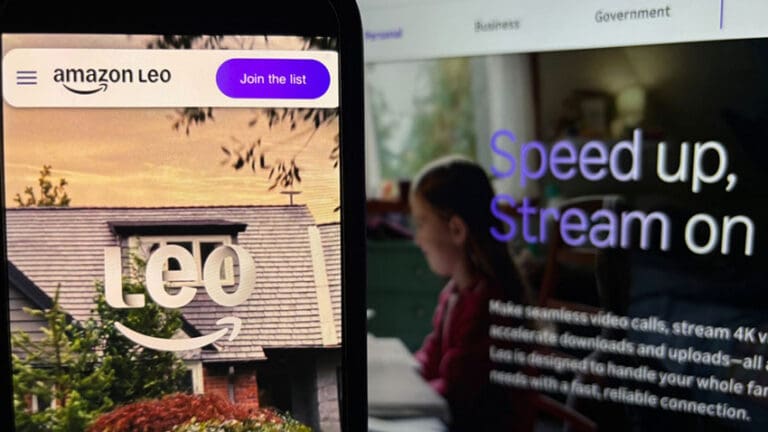
Amazon’s Leo satellite network clears final hurdle for UK launch as Starlink rivalry intensifies

Amazon has passed the milestone it needed to switch on its long-awaited Leo satellite broadband service, deploying enough satellites to begin initial coverage later this year, with the UK confirmed among the first wave of markets.
The breakthrough came in the early hours of 2 July, when a United Launch Alliance Atlas V rocket lifted 29 satellites into orbit from Cape Canaveral, the final Atlas V mission in Amazon’s launch programme. The flight took the constellation to 396 spacecraft, tying the record for the heaviest payload the veteran rocket has ever carried.
Chris Weber, vice president of Amazon’s Leo business, said the constellation was now large enough “to support continuous service across initial latitudes”. He added: “Still lots of work ahead, including raising all these new satellites to their assigned altitude, but we’ve completed enough launches for initial service this year, and future missions just add coverage and capacity.”
For Jeff Bezos’s answer to Elon Musk’s Starlink, the announcement marks the end of a lengthy and at times fraught deployment phase. Amazon, which rebranded the project from Kuiper to Leo last year, holds FCC authorisation for a constellation of around 3,236 satellites and had faced a regulatory deadline to orbit half of them by mid-2026, though the US regulator has since shown flexibility on timing, according to CNBC.
What it means for UK businesses
An enterprise and government preview has been under way since late 2025, but the consumer rollout is targeted for mid-to-late 2026 in priority markets including the UK, US, Canada, France and Germany. Britain’s early place in the queue owes much to Ofcom approval already being in place, though coverage will initially be limited to certain latitudes and broaden as more satellites launch. Full availability could stretch into 2027 depending on the pace of deployment.
The service is designed to deliver speeds from 25Mbps up to 400Mbps and beyond, with gigabit-capable terminals using advanced phased-array antennas, and latency low enough for video calls and streaming. Beyond fixed home broadband, particularly for rural and underserved parts of the UK, Amazon is targeting portable connections, in-flight Wi-Fi through partnerships such as its JetBlue deal, and enterprise and government applications. Customer terminals are in testing, and would-be users can join the waitlist at leo.amazon.com.
An uphill battle against Starlink
Amazon enters the market a long way behind. Starlink has thousands of satellites in orbit, millions of customers worldwide and a growing UK footprint, having recently undercut BT with £35-a-month broadband and secured new Ofcom spectrum licences to expand capacity at its British ground stations.
Even so, the arrival of a deep-pocketed second player should be welcome news for the estimated hundreds of thousands of UK premises still beyond the reach of full-fibre networks. Competition on price, hardware and service quality has been conspicuously absent from the satellite broadband market to date, and Amazon’s entry, backed by its logistics, retail and AWS cloud infrastructure, is the first credible challenge to Starlink’s dominance.
For rural firms weighing up connectivity options, the sensible play is to watch how the initial rollout performs. Timelines in the satellite business have a habit of slipping, but for the first time the UK is months, not years, away from a genuine two-horse race in the sky.


More Stories
Burnham hands EV targets decision to Haigh over wife’s industry links
Andy Burnham has stepped aside from a decision on Britain’s electric car sales targets because of a potential conflict of...
Roobet Philippines Open Pool Championship Kicks Off in Quezon City
The venue is part of what makes this such a special event. Hosted in the atrium of the massive Gateway...
Europe’s Late Effort To Save Its Industry
Openness caused a demand for global supply chains and a shift of production to lower-cost countries as well. Europe wasn’t...
6 Best Sites to Buy LinkedIn Followers, Likes and Connections in UK
Even with valuable content, getting noticed can be difficult when your follower count is low and your posts receive little...
6 Best Sites to Buy YouTube Views, Subscribers and Likes in UK
That is why some creators and businesses choose to buy YouTube views, subscribers and likes. These services increase visible engagement,...
How much development capacity is sitting in your deposit?
New research from property finance platform Brickflow, published in full in its report “The UK’s Most Expensive Mistake”, suggests the...