
Oil Prices Rise After US Announces Blockade on Iranian Ports

By Naveen Athrappully
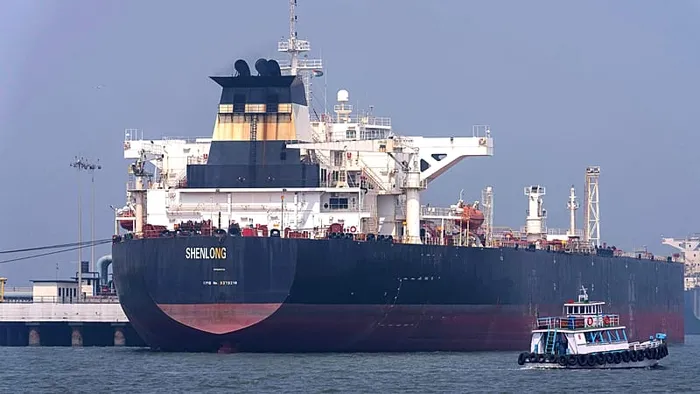
Brent crude oil futures prices surged late Sunday following the United States threatening to block Iranian ports after negotiations to end the conflict failed, with Iran refusing to agree to U.S. terms to give up its nuclear program.
Oil prices hit a high of $103.49 per barrel on Sunday after closing at $95.20 on Friday. As of 9:45 p.m. ET, it was trading at $101.86.
On Sunday, U.S. and Iranian delegations ended their peace talks in Islamabad, Pakistan, without a deal. Vice President JD Vance, who led the U.S. delegation, said his counterparts from Tehran declined to accept Washington’s terms for nuclear disarmament.
President Donald Trump then announced a blockade of the Strait of Hormuz, the critical oil shipping passageway that Iran itself had been blocking since the war began, which has led to surging energy prices globally.
“Effective immediately, the United States Navy, the Finest in the World, will begin the process of blockading any and all Ships trying to enter, or leave, the Strait of Hormuz,” Trump said in an April 12 post on Truth Social.
U.S. Central Command (CENTCOM) later clarified that the blockade, set to begin on April 13 at 10 a.m. ET or 5:30 p.m. local time in Iran, will only apply to maritime traffic “entering and exiting Iranian ports.” American forces will not impede freedom of navigation for vessels traveling the strait “to and from non-Iranian ports.”
Iran allegedly charged some ships $2 million to pass through the strait last week, with five ships reportedly paying the fee.
“I have also instructed our Navy to seek and interdict every vessel in International Waters that has paid a toll to Iran,” Trump wrote. “No one who pays an illegal toll will have safe passage on the high seas.”
US Clearing Iranian Mines
In another April 12 post on Truth Social, Trump criticized Iran for dropping mines in the Strait of Hormuz. “They say they put mines in the water, even though all of their Navy, and most of their ‘mine droppers,’ have been completely blown up. They may have done so, but what ship owner would want to take the chance?”
The president committed to clearing the mines that the Iranian regime laid in the Strait of Hormuz.
Following Trump’s Truth Social post, Iran’s Islamic Revolutionary Guards Corps warned on Sunday that military ships should avoid passing through the Strait of Hormuz. Military Vessels trying to transit the strait will be subject to a “firm response,” it said.
Oil Market
Around 25 percent of global seaborne oil trade transited the Strait of Hormuz in 2025, with options to bypass this critical passageway limited, according to the International Energy Agency.
Only the United Arab Emirates and Saudi Arabia have pipelines that could potentially reroute oil flows to bypass the strait, the agency said. Other oil exporting nations like Iraq, Iran, Bahrain, Qatar, and Kuwait are dependent on the strait to ship their energy exports.
As such, as long as transit through the Strait of Hormuz remains uncertain, oil prices will likely remain higher.
Jim Krane, Energy Research Fellow at Rice University, said the U.S. blockade might be effective as a long-term strategy to impose pain on the Iranian economy, but it isn’t a good short-term negotiating tactic when the oil market is already under strain.
“If the deficit to the oil market takes another jump, it is going to impose pain on every person on Earth that’s subject to market oil prices,” Krane said.
Claudio Galimberti, chief economist of Rystad Energy, said the blockade will raise prices but might move the needle on talks.
“It means the oil markets will be even tighter than before,” Galimberti said. “However, I think this is a negotiation tactic, which eventually resolves into a full opening of Hormuz. So, more pain now, but more gain later.”
But even if passage through the Strait of Hormuz were to normalize, it could still take some time before oil markets calmed down.
“Output has already been reduced at oil and gas fields, while refinery operations have been curtailed or temporarily shut, suggesting that some supply disruptions may take weeks, or longer, to fully reverse,” ING Bank said in an April 10 post.
Trump on April 11 said on Truth Social that large numbers of empty oil tankers were “heading, right now, to the United States to load up with the best and ‘sweetest’ oil (and gas!) anywhere in the World.”
In the United States, the price of regular gasoline averaged $4.12 per gallon on Sunday, up from $3.59 a month back, according to data from the American Automobile Association (AAA).
In California, Hawaii, and Washington, prices exceeded $5 per gallon.
On April 12, Trump predicted that the elevated gasoline prices could rise a bit further or remain the same before the November midterm elections.
The Associated Press contributed to this report.

More Stories
US Military Blockade on Iranian Ports Goes Into Effect, Maritime Group Says
By Jack Phillips A scheduled U.S. naval blockade of the Strait of Hormuz and nearby waters started at 10 a.m....
Who is Jonathan Joly? Age, Marriage, and Net Worth in 2026
If you like to scroll on social media, the chances of you witnessing Jonathan Joly are high. Are you also...
Rory McIlroy Wins Back-to-Back Masters Titles to Join Jack Nicklaus, Nick Faldo, and Tiger Woods
By The Associated Press AUGUSTA, Ga.—Rory McIlroy joined more elite company Sunday at the Masters when he pulled away with...
At Least 30 Dead in Stampede at Haiti’s Historic Laferriere Citadel
By Reuters At least 30 people were killed on Saturday in a stampede in the northern countryside of Haiti, authorities...
Eric Swalwell Ends Bid for California Governor Amid Sexual Misconduct Allegations
By Joseph Lord Rep. Eric Swalwell (D-Calif.) suspended his bid for California governor on Sunday after reports emerged accusing the...
Judge Orders Month-Long Pause on Process for Alberta Separation Referendum Petition
By Olivia Gomm An Alberta judge has granted a one-month stay on the validation process of a petition to trigger...