
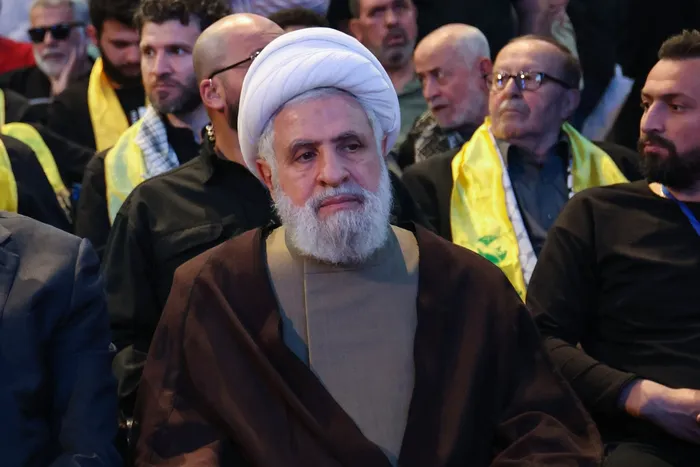
Hezbollah Leader Says Group Would Continue to Fight Israel After Strikes

By Jack Phillips
The leader of Lebanese terrorist organization Hezbollah has said that his group would continue to fight Israel, in the midst of strikes launched by both parties this week, following a U.S. announcement of a two-week ceasefire with Iran.
Hezbollah leader Naim Qassem said in a statement on April 10 through Hezbollah’s Al-Manar TV that the group would not return to the previous status quo and signaled more fighting would occur, saying that “together—as a state, an army, a people, and a resistance—we will protect our country, restore its sovereignty, and expel the occupier.”
“Their threats and weapons will not frighten us. We are the owners of the land; we possess the faith, will, and capability to prevent them from achieving their goals,” he said.
Qassem also suggested to local Lebanese officials not to agree to what he called “gratuitous concessions” with Israel’s government.
This week, the Israeli military said that it had targeted sites affiliated with Hezbollah—a group that is largely based in southern Lebanon—and announced that it had killed an aide to Qassem. Hezbollah retaliated after the heavy strikes by launching missiles into Israel.
The latest war between Israel and Hezbollah erupted after the U.S. and Israeli militaries launched airstrikes against Iran on Feb. 28. Since the ceasefire announced by the United States and Iran earlier this week, a heated debate has ensued over whether it applies to the fighting between Israel and Hezbollah in Lebanon.
Iran said that it does, while the United States and Israel say it doesn’t. European leaders have called on Israel to end the strikes in Lebanon after the ceasefire was initiated.
After the U.S.–Iran ceasefire announcement, the Israel Defense Forces announced it carried out more than 100 strikes in Lebanon in 10 minutes, with officials indicating that fighting would continue.
On March 2, two days after Israeli and U.S. forces launched strikes against Iran, Hezbollah launched missiles toward Israel. It said that the salvo was in retaliation for the killing of Iranian leader Ayatollah Ali Khamenei and for “repeated Israeli aggressions” in Lebanon.
Over the past 40 years or so, Israel and Hezbollah have fought multiple wars since the terrorist group was formed in the 1980s as a guerrilla force opposing Israel.
Hezbollah was widely considered responsible for the suicide bombings at the U.S. Embassy in Lebanon and the U.S. and French military barracks in Beirut in 1983, killing more than 240 U.S. personnel and 58 French soldiers. The group was also linked to a 1996 bombing at a housing complex in Saudi Arabia that left 19 U.S. Air Force personnel dead.
Fighting between Hezbollah—a Lebanese Shia Muslim group that has long been designated as a terrorist organization by the United States—and Israel started again in late 2023 after a Hamas-led attack in Israel on Oct. 7 of that year.
The statement from Hezbollah’s leader comes as U.S. Vice President JD Vance is heading to Pakistan to participate in talks between the United States and Iran over the terms of the ceasefire and reopening of the strategically important Strait of Hormuz.
Ahead of the visit, Vance said, “If the Iranians are willing to negotiate in good faith, we’re certainly willing to extend the open hand.”
But he warned, “If they’re going to try to play us, then they’re going to find that the negotiating team is not that receptive.”
The Associated Press contributed to this report.


More Stories
Treasury, IRS Propose Rules for 1 Percent Remittance Tax on Some Money Sent to Foreign Countries
By Naveen Athrappully The Internal Revenue Service and the Department of the Treasury proposed regulations on Friday regarding the new...
IBM to Pay $17 Million to Settle Allegations of Discrimination
By Jacki Thrapp IBM will pay millions of dollars to resolve allegations that it failed to comply with anti-discrimination requirements...
Trump Says US ‘Loading up the Ships’ Ahead of Iran Talks, Signals Military Option If Diplomacy Fails
By Tom Ozimek President Donald Trump said the United States is preparing military options if negotiations with Iran fail to...
Artemis II Mission Ends With Splashdown Off San Diego
By T.J. Muscaro HOUSTON—Humanity’s first adventure to the moon in more than 50 years is complete. Artemis II, NASA’s 10-day...
Trump Warns Iran Has ‘No Cards’ Except Strait of Hormuz in Peace Talks
By Jack Phillips President Donald Trump on Friday said that the Iranian regime has very few negotiating options ahead of...
State Department Settles Lawsuit Alleging It Censored Conservative Outlets Under Biden
By Jacki Thrapp The Department of Justice (DOJ) settled a lawsuit that accused the Biden administration of censoring speech by...