
US Annual Inflation Shoots Up to 3.3 Percent, Highest Level Since May 2024

By Andrew Moran
A spike in energy prices sent the annual U.S. inflation rate to its highest level since May 2024, according to the Bureau of Labor Statistics.
Last month’s Consumer Price Index report showed that the 12-month inflation rate climbed to 3.3 percent, from 2.4 percent in February, the bureau reported on April 10.
This was in line with economists’ expectations.
Underlying inflation was anemic. The core inflation rate, which strips out the volatile energy and food categories, ticked up to just 2.6 percent from 2.5 percent.
Economists penciled in a reading of 2.7 percent.
On a monthly basis, headline inflation surged by 0.9 percent, and core inflation jumped to 0.2 percent.
The index for energy accounted for virtually all of March’s increase, surging by 10.9 percent.
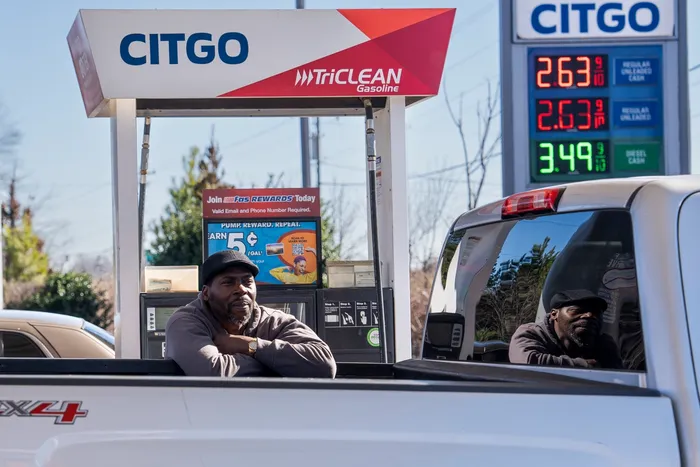
Gasoline was the largest contributor to the index’s spike, rising by 21.2 percent—the biggest monthly increase since the series started in 1967.
Gas prices have rocketed during the war in Iran—soon entering its seventh week—amid soaring global energy markets. With U.S. crude oil hovering around $100 a barrel, the national average for a gallon of gas is firmly above $4.
Fuel oil also advanced by nearly 31 percent in March. Electricity costs rose by 0.8 percent following a back-to-back monthly loss.
The Iranian conflict has shuttered the Strait of Hormuz, a vital waterway located between Iran and the Arabian Peninsula that handles about 20 percent of global crude oil shipments per day.
Earlier this week, the United States and Iran agreed to a two-week ceasefire to iron out an agreement, contingent on the reopening of the global chokepoint. So far, the truce has not returned traffic to pre-war levels, leaving international energy markets on edge and prices elevated.
“As we have been saying for the past month and a half, the duration of the war matters as does the extremely important Strait of Hormuz,” Chris Zaccarelli, chief investment officer at Northlight Asset Management, said in an emailed note to The Epoch Times.
“If the supply shock is temporary, then the economy can weather this storm and the Fed will have an opportunity to lower interest rates by the end of the year, but if the inflation shock is more long-lasting, they will have no choice but to sit on their hands for the entire year.”
The shelter index also climbed last month, rising by 0.3 percent. In the 12 months ending in March, shelter is up by 3 percent.
Food prices, however, held steady in March, with supermarket prices dropping by 0.2 percent.
Most notably, prices for beef and veal, which have soared to record levels over the past couple of years, fell by 0.6 percent. Consumers also enjoyed relief for pork (negative 0.6 percent), fresh whole chicken (negative 0.9 percent), and fish and seafood (negative 0.5 percent).
Eggs continued their collapse, declining by more than 3 percent. On a year-over-year basis, egg prices are down by nearly 45 percent.
Changes for tariff-sensitive items were mostly lower in March.
New-vehicle prices rose by 0.1 percent, but the index for apparel rose by 1 percent. Appliances declined by 1.6 percent, televisions fell by 1 percent, smartphones slipped by 1 percent, and canned fruits and vegetables were unchanged.
The supercore CPI—services excluding housing—climbed to 3.1 percent from 2.8 percent.
A growing concern is that the inflation squeeze is eating almost entirely wage growth right now, says Jamie Cox, managing partner at Harris Financial Group.
In March, the 12-month average hourly wage growth slowed to 3.5 percent—lower than expected—and has been steadily coming down since March 2022.
“March core CPI doesn’t yet reflect the reality of the oil supply shock, where the effect on real wage growth will bear the full brunt in April,” Cox said in a note emailed to The Epoch Times.
“While I’m glad to see the effects to be less than expected in March, the effects in April are now more likely to be worse.”
Market Reaction
Following the CPI report, traders added to bets that the Federal Reserve will follow through on its forecast of policy easing.
Policy expectations have wildly fluctuated over the past month. Futures market data indicate that traders added to bets that the central bank will pull the trigger on a quarter-point reduction later this year.
Still, officials will continue to look through war-driven price pressures and the effects of tariffs on inflation. Various Fed officials, including Chair Jerome Powell, have suggested that the annual inflation rate, excluding these two factors, is likely closer to the institution’s 2 percent target.
The market reaction was tepid, with the leading benchmark averages little changed as investors had already priced in the inflation surge.
U.S. Treasury yields were little changed. The benchmark 10-year yield hovered around 4.3 percent, and the 30-year topped 4.9 percent. The 2-year government bond, which typically tracks Fed policy expectations, was flat at 3.78 percent.
The greenback’s risk premium continued to fade at the end of the trading week.
The U.S. dollar index—a measure of the buck against a weighted basket of currencies—is on track for a weekly loss of more than 1 percent. Year to date, it is up by just 0.4 percent after strengthening as much as 2 percent.


More Stories
Iran Declares Strait of Hormuz Open, but Warns of Risk From Mines
By Chris Summers Iran said on April 9 that the Strait of Hormuz is open to all civilian shipping but...
Remote-Job Postings Rise 20 Percent Sequentially in 1st Quarter: Report
By Mary Prenon Although many American companies, both large and small, have called employees back to the office over the...
Updates on XO, Kitty Season 4 Renewal: Release Date, Cast, and Spoiler
Netflix’s popular romantic comedy drama, XO, Kitty is back with all new connections and a story. The American television drama...
US State Department Issues Travel Advisory for 3 African Nations
By Naveen Athrappully The U.S. Department of State recently issued travel advisories for Nigeria, Ethiopia, and São Tomé and Príncipe,...
US Forces Will Remain in Region Until Iran Complies With Agreement: Trump
By Victoria Friedman U.S. President Donald Trump said on April 8 that warships and personnel will remain in the region...
Homeward Bound: Artemis II Leaves Lunar Space, Reveals ‘Earthset’ Photos
By T.J. Muscaro HOUSTON—The Artemis II astronauts are on their way home from the moon. NASA’s Reid Wiseman, Victor Glover,...