
US State Department Issues Travel Advisory for 3 African Nations

By Naveen Athrappully
The U.S. Department of State recently issued travel advisories for Nigeria, Ethiopia, and São Tomé and Príncipe, with the countries designated as “Level 3: Reconsider Travel.”
The advisory for Nigeria, issued on April 8, was updated to include information on changes to U.S. embassy operations in the country and warnings against traveling to certain locations.
“Reconsider travel to Nigeria due to crime, terrorism, unrest, kidnapping, and inconsistent availability of health care services. Some areas have increased risk,” the department said in the advisory.
The update added Plateau, Jigawa, Kwara, Niger, and Taraba states to the list of places people must not travel to in Nigeria.
“On April 8, 2026, the Department of State authorized non-emergency U.S. government employees and U.S. government employee family members to leave U.S. Embassy Abuja due to the deteriorating security situation,” the U.S. Embassy and Consulate in Nigeria said in a statement.
Violent crime is common throughout the country, including assault, armed robbery, rape, kidnapping, hostage taking, roadside banditry, and carjacking, the U.S. mission warned.
Kidnapping and ransom happen often, with criminals primarily targeting dual national citizens visiting Nigeria. Since Americans are perceived as wealthy, they are often targets of crime. Kidnapping gangs are known to stop drivers at interstate roads to rob and abduct victims, according to the advisory.
“There is risk of terrorist violence, including terrorist attacks and other activity in Nigeria,” the embassy said. “Terrorists collaborate with local gangs to expand their reach. They may attack with little or no warning.”
In the northeast region, terror groups often target humanitarian camps, government buildings, road travelers, entertainment venues, mosques, and churches, the advisory said.
Nigeria has been under the scanner of the Trump administration over attacks on Christians in the country.
On Oct. 31, 2025, U.S. President Donald Trump designated Nigeria as a “Country of Particular Concern.”
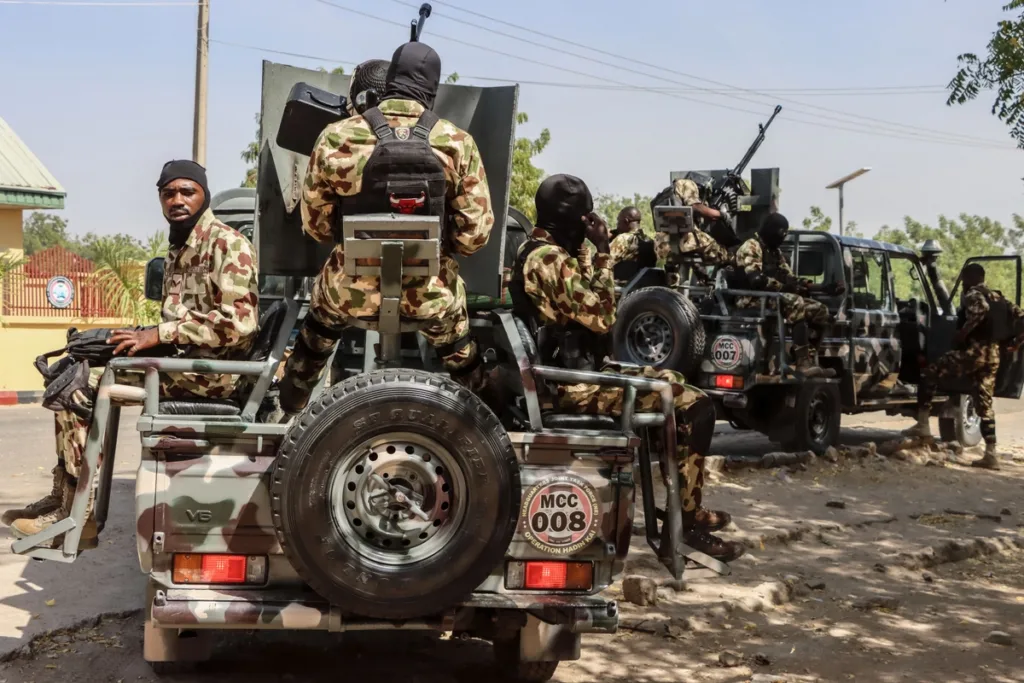
Nigerian soldiers from the Multinational Joint Task Force run at the MNJTF military base in Monguno, Nigeria, on July 5, 2025. Joris Bolomey/AFP via Getty Images
In a post on Truth Social, Trump said, “Christianity is facing an existential threat in Nigeria. Thousands of Christians are being killed. Radical Islamists are responsible for this mass slaughter.”
On Nov. 1, 2025, Trump threatened military action in Nigeria if the country did not do more to halt the killing of Christians.
In December 2025, U.S. Secretary of State Marco Rubio announced that the United States would restrict access to American visas for Nigerians taking part in ongoing atrocities against Christians.
On Dec. 25, 2025, Trump said the United States had conducted a “powerful and deadly strike” in northwest Nigeria that targeted the ISIS terrorist group. A day after the attack, the Nigerian government said the U.S. strikes were part of a broader effort to ensure regional security.
Later, in mid-February, the Nigerian defense ministry said the United States had dispatched around 100 troops to the country to train its military and enhance its ability to deter terrorist threats.
Other terrorist organizations operating in Nigeria include ISIS West Africa and Ansaru, which have attacked government forces as well as civilians, resulting in abductions, injuries, deaths, and the destruction of property.
Ethiopia, São Tomé and Príncipe
The advisory for Ethiopia, updated on April 1, warned about crime, kidnapping, terrorism, unrest, communications disruptions, landmines, and exit bans.
While the security situation in the Ethiopian capital of Addis Ababa is stable, there are “sporadic violent armed conflict and civil unrest” in other parts of the country, the state department said.
“The security situation may worsen without warning,” it said.
Americans will have only limited consular services in the country.
Vehicles crowd a petrol station as drivers refuel during a fuel shortage in Addis Ababa, Ethiopia, on March 27, 2026. Marco Simoncelli/AFP via Getty Images
“U.S. government employees working in Ethiopia need special authorization to travel outside of Addis Ababa due to safety risks,” the State Department said. “Due to travel restrictions, the U.S. embassy has limited access to Americans arrested or detained in Ethiopia and routine consular services are only available at the embassy.”
Ethiopian law does not recognize dual citizenship. When a dual U.S.–Ethiopian national is arrested by local authorities, there are often delays in notifying the U.S. embassy.
Americans with unpaid immigration fines will face exit bans that prevent them from leaving the country, and the government “strictly enforces” these bans, according to the department.
“There have been cases where Americans have been fined more than $100,000 in immigration fines,” it said.
Terrorist groups in Ethiopia are known to have targeted foreigners for kidnapping. These risks are highest in the Gambella and Benishangul Gumuz regions as well as the border regions with Somalia, Sudan, and South Sudan.
Fishing boats sit on the beach in São Tomé city on Jan. 1, 2018. Ruth McDowall/AFP via Getty Images
On April 8, São Tomé and Príncipe’s advisory level was raised from Level 2 to Level 3, with the department warning about unrest and health risks in the country.
Political party conventions are scheduled to begin this month, with the presidential election on July 19 and legislative elections on Sept. 27. The State Department said these events may lead to demonstrations or other political activity.
“The security environment may deteriorate without warning. Unrest related to the local political situation may occur with little notice. Demonstrations may stop or block transportation and other essential services,” the department said.
Medical services in the country are limited, and even minor health issues may require medical evacuation, the department added.

More Stories
Iran Declares Strait of Hormuz Open, but Warns of Risk From Mines
By Chris Summers Iran said on April 9 that the Strait of Hormuz is open to all civilian shipping but...
Remote-Job Postings Rise 20 Percent Sequentially in 1st Quarter: Report
By Mary Prenon Although many American companies, both large and small, have called employees back to the office over the...
Updates on XO, Kitty Season 4 Renewal: Release Date, Cast, and Spoiler
Netflix’s popular romantic comedy drama, XO, Kitty is back with all new connections and a story. The American television drama...
US Forces Will Remain in Region Until Iran Complies With Agreement: Trump
By Victoria Friedman U.S. President Donald Trump said on April 8 that warships and personnel will remain in the region...
Homeward Bound: Artemis II Leaves Lunar Space, Reveals ‘Earthset’ Photos
By T.J. Muscaro HOUSTON—The Artemis II astronauts are on their way home from the moon. NASA’s Reid Wiseman, Victor Glover,...
Who is Zachary Huelsman? Relationship, Age, Social Media, and Controversies
If you also love to scroll through social media accounts like TikTok and Instagram, you must have seen a notorious...