
US Forces Will Remain in Region Until Iran Complies With Agreement: Trump

By Victoria Friedman
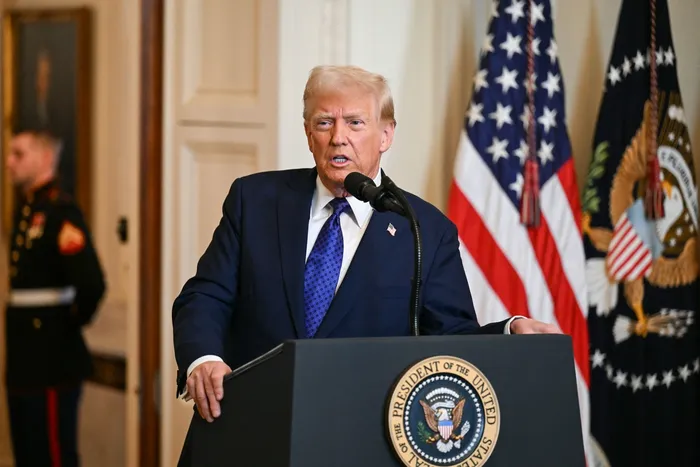
U.S. President Donald Trump said on April 8 that warships and personnel will remain in the region around Iran until a peace deal is reached, vowing a return to military action if Tehran fails to comply.
Trump wrote in a Truth Social post that all U.S. ships, aircraft, personnel, and weaponry “will remain in place in, and around, Iran, until such time as the real agreement reached is fully complied with.”
“If for any reason it is not, which is highly unlikely, then the ‘Shootin’ Starts,’ bigger, and better, and stronger than anyone has ever seen before,” he wrote.
On April 7, Trump announced on Truth Social a ceasefire, saying that the United States would suspend attacks on Iran for two weeks, provided Tehran agreed to the complete and immediate reopening of the Strait of Hormuz.
The Soufan Center, a New York-based think tank, said on April 9 that the ceasefire is “on the verge of collapse,” citing Israel’s large-scale strikes across Lebanon as a key point of contention.
“Even if Lebanon was formally outside the deal, the scale of Israel’s strikes was likely to be viewed as escalatory,” the Soufan Center said.
Both sides of the conflict disagree on whether Lebanon was included in the terms of the ceasefire, with U.S. and Israeli officials saying strikes against Hezbollah in the country are not covered, while Iran and negotiation mediator Pakistan say it was.
Pakistan is scheduled to host officials from Iran and the United States in the capital, Islamabad, on April 11 for talks that could determine whether a broader, permanent peace agreement can be made.
U.S. Vice President JD Vance is set to lead the American delegation, and the speaker of the Iranian parliament, Mohammad Bagher Ghalibaf, will be representing Iran.
‘We’re Not Going Anywhere’
The president’s comments on the United States’ continued presence near Iran follow the Pentagon saying on April 8 that U.S. forces would remain in the region to ensure Tehran complies with the ceasefire.
U.S. War Secretary Pete Hegseth told reporters that the U.S. military had accomplished its objectives in Iran, but would be “hanging around.”
“We’re not going anywhere,” Hegseth said. “We’re going to make sure Iran complies with this ceasefire and then, ultimately, comes to the table and makes a deal.”
An F/A-18F Super Hornet, attached to Strike Fighter Squadron (VFA) 41, is taxied on the flight deck of Nimitz-class aircraft carrier USS Abraham Lincoln (CVN 72) in support of Operation Epic Fury in the Mediterranean Sea, on March 6, 2026. U.S. Navy via Getty Images
Also present at the press briefing was U.S. Gen. Dan Caine, chairman of the Joint Chiefs of Staff, who told reporters that the Pentagon welcomed the ceasefire but that U.S. forces are ready to resume combat missions if necessary.
“Let us be clear: A cease-fire is a pause, and the joint force remains ready—if ordered or called upon—to resume combat operations with the same speed and precision as we’ve demonstrated over the last 38 days,” Caine said.
Dispute Over Lebanon
Since Trump announced the ceasefire, both sides of the conflict have not been able to agree whether Lebanon is covered by its terms.
The office of Israeli Prime Minister Benjamin Netanyahu on April 8 said that the ceasefire “does not include Lebanon.”
Trump similarly said that Lebanon was not included in the deal, telling PBS White House correspondent Liz Landers on April 8 that it was “because of Hezbollah” and that it was a “separate skirmish.”
“They were not included in the deal,” Trump said.
The Israeli offensive against the Iran-backed terror group in Lebanon began days after the start of the war, after Hezbollah fired rockets at Israel to avenge Iranian leader Ayatollah Ali Khamenei’s killing in an airstrike on Feb. 28.
Rescue workers search for people after an Israeli attack hit a residential building in the Corniche al Mazraa neighborhood in Beirut, Lebanon, on April 8, 2026. Daniel Carde/Getty Images
However, Pakistani Prime Minister Shehbaz Sharif, whose government helped broker the deal, said the ceasefire was effective immediately “everywhere including Lebanon and elsewhere.”
Lebanon’s parliament speaker, Nabih Berri, also said that the ceasefire deal included Lebanon.
Ghalibaf said in an April 8 statement posted to X that what had been agreed was “an immediate ceasefire everywhere, including Lebanon and other regions, effective immediately.”
Later on April 8, Vance said that the United States had not agreed to include Lebanon in the terms of the ceasefire.
“I think this comes from a legitimate misunderstanding. I think the Iranians thought that the ceasefire included Lebanon, and it just didn’t. We never made that promise. We never indicated that was going to be the case,” the vice president told reporters while on a state visit to Budapest, Hungary.

More Stories
Iran Declares Strait of Hormuz Open, but Warns of Risk From Mines
By Chris Summers Iran said on April 9 that the Strait of Hormuz is open to all civilian shipping but...
Remote-Job Postings Rise 20 Percent Sequentially in 1st Quarter: Report
By Mary Prenon Although many American companies, both large and small, have called employees back to the office over the...
Updates on XO, Kitty Season 4 Renewal: Release Date, Cast, and Spoiler
Netflix’s popular romantic comedy drama, XO, Kitty is back with all new connections and a story. The American television drama...
US State Department Issues Travel Advisory for 3 African Nations
By Naveen Athrappully The U.S. Department of State recently issued travel advisories for Nigeria, Ethiopia, and São Tomé and Príncipe,...
Homeward Bound: Artemis II Leaves Lunar Space, Reveals ‘Earthset’ Photos
By T.J. Muscaro HOUSTON—The Artemis II astronauts are on their way home from the moon. NASA’s Reid Wiseman, Victor Glover,...
Who is Zachary Huelsman? Relationship, Age, Social Media, and Controversies
If you also love to scroll through social media accounts like TikTok and Instagram, you must have seen a notorious...