
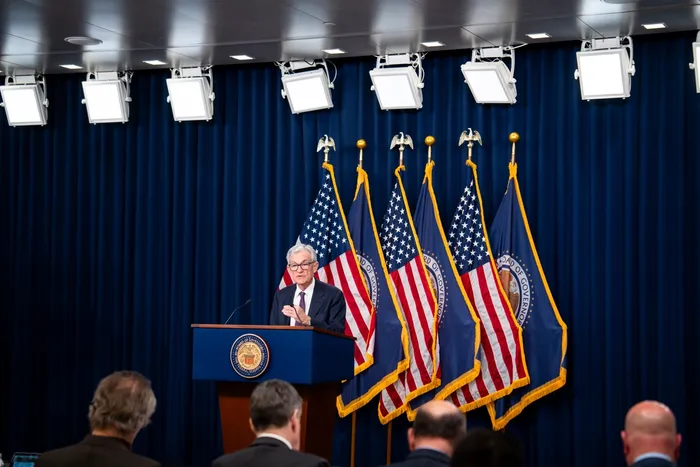
Fed Still Forecasts Lower Interest Rates This Year Despite Iran Conflict

By Andrew Moran
Federal Reserve officials anticipate lower interest rates this year, despite the Iranian conflict clouding the economic outlook, according to minutes from the March policy meeting.
Policymakers left interest rates unchanged at the March 17—18 meeting, keeping the target federal funds rate range between 3.5 percent and 3.75 percent.
The meeting summary, released on April 8, suggested that most participants believed that the war—now in its sixth week—could require rate cuts if higher gasoline prices adversely affect consumer spending or the labor market.
“Most participants raised the concern that a protracted conflict in the Middle East could lead to a further softening in labor market conditions, which could warrant additional rate cuts, as substantially higher oil prices could reduce households’ purchasing power, tighten financial conditions, and reduce growth abroad,” the document said.
The national average for a gallon of gas is more than $4.
Nearly all meeting participants agreed to leave rates unchanged.
They agreed that it was too early to determine the effects of the conflict, adding that it would be “prudent to continue to monitor the situation and assess the implications for the appropriate stance of monetary policy.”
Policy expectations among investors have wildly fluctuated in recent weeks, from pricing in a rate hike to gradually betting on a rate cut this year.
Updates to the Summary of Economic Projections—a quarterly summary of officials’ forecasts for policy and the broader economy—indicated that policymakers were still penciling in a quarter-point rate cut this year.
However, with near-term inflation expectations remaining elevated and the path to conflict resolution unclear, the central bank could bide its time to follow through on a rate action.
The March jobs report may have afforded the Fed some time to assess economic conditions.
Last month, the U.S. economy added a larger-than-expected 178,000 new jobs, and the unemployment rate edged lower, to 4.3 percent.
But officials argued that the labor market was vulnerable to shocks.
“The vast majority of participants judged that risks to the employment side of the mandate were skewed to the downside,” the minutes stated. “In particular, many participants cautioned that, in the current situation of low rates of net job creation, labor market conditions appeared vulnerable to adverse shocks.”
Still, what the Fed does next might depend on upcoming inflation data.
The March and April figures are widely anticipated to come in hot, and the annual consumer inflation rate is forecast to be firmly above 3 percent. Should price pressures persist well into the summer, the Fed might not have an appetite for easing monetary policy.
Even though crude prices plummeted after the U.S.–Iran cease-fire was announced on April 7, the secondary effects of the war-driven oil shock could remain, says Jeffrey Roach, chief economist at LPL Financial.
“We cannot ignore the lingering second-order effects on the global economy, so investors should continue to watch how geopolitical risks may affect wholesale prices, growth, and financing conditions,” Roach said in a note emailed to The Epoch Times.
“We should still expect inflation to run a bit hotter this month, but the outlook has clearly improved with this ceasefire.”
Participants at the Fed meeting agreed that upside risks to inflation and downside risks to employment were elevated.
What They Have Said Since
As in the meeting summary, there have been divergent views among Fed officials during the war.
In an April 7 interview with Bloomberg Television, New York Fed President John Williams stated that although the Iranian conflict will push up headline inflation, he believes that underlying inflation will remain the same.
Williams forecast that headline inflation will finish the year at about 2.75 percent. Core inflation, which strips out volatile energy and food prices, will likely be 2.5 percent.
“Monetary policy today is really well positioned, given where all of those dynamics have been playing out, and well positioned to kind of wait and see on some of the effects of what’s happening today,” Williams said. “I’m not saying we’re just, you know, in some kind of ‘we can’t act’ stance. I think this monetary policy is exactly where it needs to be.”
Fed Vice Chair Philip Jefferson said he is concerned about war-related headwinds for the wider economy.
Speaking at the University of Detroit Mercy on April 7, Jefferson warned about the adverse effects of higher energy prices.
“Should elevated energy prices persist, they can weigh on consumer and business spending,” Jefferson said. “This potential adds considerable uncertainty to the global economic outlook.”
Like some of his colleagues, he said he believes disinflation will resume once the one-time price adjustment from tariffs filters through the U.S. market.
Chicago Fed President Austan Goolsbee, speaking at the Detroit Economic Club on April 7, expressed concern about a stagflation-type shock, driven mainly by high inflation and slowing growth.
“The possibility of a stagflationary outbreak coming from high oil prices before the tariff inflation went away, leading to the main engine of growth—the U.S. consumer—just giving up and saying, ‘We don’t have confidence, we’re going to start hoarding our money,’ and sending us into a stagflationary recession—that’d be the worst outcome,” Goolsbee said.
“I’m cautious—slash nervous—about it in the moment.”
These remarks were made before President Donald Trump announced a two-week cease-fire with Iran hours before his 8 p.m. EDT deadline on April 7. The pause sent global energy prices plummeting to below $100 per barrel.
More Stories
US Property Taxes Grow 3 Percent on Average in 2025, Outpacing Inflation
By Rob Sabo Property taxes are rising across the United States and, on average, have outpaced inflation. Homeowners in 2025...
Shane Lowry Makes Golf History With His 2nd Masters Hole-in-One
By Ross Kelly There are millions of casual golfers around the world who dream some day of recording an ace...
Treasury, IRS Propose Rules for 1 Percent Remittance Tax on Some Money Sent to Foreign Countries
By Naveen Athrappully The Internal Revenue Service and the Department of the Treasury proposed regulations on Friday regarding the new...
Hezbollah Leader Says Group Would Continue to Fight Israel After Strikes
By Jack Phillips The leader of Lebanese terrorist organization Hezbollah has said that his group would continue to fight Israel,...
IBM to Pay $17 Million to Settle Allegations of Discrimination
By Jacki Thrapp IBM will pay millions of dollars to resolve allegations that it failed to comply with anti-discrimination requirements...
Trump Says US ‘Loading up the Ships’ Ahead of Iran Talks, Signals Military Option If Diplomacy Fails
By Tom Ozimek President Donald Trump said the United States is preparing military options if negotiations with Iran fail to...