
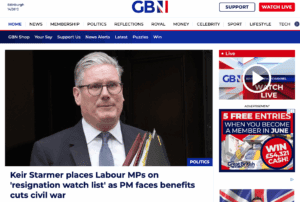
GB News makes its pitch for a slice of public broadcasting funds

GB News has made a bold bid for access to the public purse, arguing that government broadcasting grants should be opened up to competitive tender rather than flowing automatically to the BBC.
The loss-making news channel, backed by hedge fund financier Sir Paul Marshall, set out its case in a submission to the government’s consultation on the BBC’s royal charter. At its heart is a call for “contestable funding”, a mechanism that would allow broadcasters beyond the traditional public service operators to bid for taxpayer-backed support.
The BBC’s World Service is the most obvious target. Once funded entirely by Whitehall, the service now draws primarily on the licence fee but still receives grants from the Foreign, Commonwealth & Development Office worth £137 million last year. GB News believes it should be eligible to compete for a share of that pot, assessed on criteria including quality, audience reach and value for money.
It is a striking proposition from an organisation that has accumulated losses exceeding £100 million since launching in 2021, and one that is unlikely to find a warm reception at Broadcasting House. GB News framed the argument in the language of market competition, contending that opening funding to tender would drive innovation and encourage what it called “diversity of thought and content”.
The channel pointed to precedent. Between 2019 and 2022, two pilot schemes, the Young Audiences Content Fund and the Audio Content Fund, distributed £48 million across a range of broadcasters and independent producers. GB News also drew attention to New Zealand’s NZ On Air model, which allocates public money to a variety of media outlets, suggesting a similar framework could bolster plurality in Britain’s broadcasting landscape.
The submission to the charter review is part of a broader lobbying campaign. In a separate filing with Ofcom, GB News made a parallel case for contestable funding. It is also pressing for prominence rights currently enjoyed only by the established public service broadcasters, the BBC, ITV, Channel 4, Channel 5 and S4C, which guarantee their channels favourable positioning on television sets, albeit in return for strict obligations around regional production and news output.
Whether the government has any appetite for redirecting public funds towards a commercially owned, politically divisive broadcaster remains to be seen. But GB News’s intervention ensures the question of who qualifies as a public service provider, and who should pay for it, will sit squarely at the centre of the charter debate.
Read more:
GB News makes its pitch for a slice of public broadcasting funds


More Stories
Bristol’s new arena sets sights on hosting the Brit Awards
Bristol is about to join the big league of British live entertainment, with the city’s forthcoming Aviva Arena setting its...
Businesses shoulder £200 billion National Insurance bill as payroll tax receipts surge 40% since pandemic
The scale of the tax burden heaped on British businesses since the pandemic has been laid bare by new HMRC...
Budget tax breaks worth £100m come into force for founders and start-ups
Fresh incentives designed to turbocharge Britain’s start-up and scale-up economy have officially taken effect, with the government forecasting that the...
Easter and Eid collision sends British lamb prices to a record high
Supermarket shoppers face paying more than £16 per kilo for a leg as overlapping religious festivals, shrinking flocks and buoyant...
Vince calls on Miliband to halt North Sea oil exports as Iran war rattles supply
One of the Labour Party’s most prominent financial backers has called on Ed Miliband to slam the brakes on North...
Reform UK becomes first British political party to launch its own podcast
Reform UK is venturing into podcasting with a weekly show that will offer listeners behind-the-scenes access to Nigel Farage and...