
Artemis II Day 4: Manual Flight in Deep Space, Lunar Flyby Preparations, Easter Message

By T.J. Muscaro
HOUSTON—NASA astronaut Christina Koch and Canadian Space Agency astronaut Jeremy Hansen have become the first people in more than 50 years to manually fly a spacecraft in deep space.
Hansen took the pilot seat on the Orion spacecraft Integrity just after 9 p.m. ET on April 4. Koch first took the position to her crewmate’s right, and then swapped roles with him more than 10 minutes later.
Flying more than two-thirds of their journey from the Earth to the moon, their job was to test how Integrity behaves when it has only partial freedom of movement.
A spacecraft has six degrees of freedom: three transitional degrees (forward and backward, up and down, left and right) and three rotational degrees (roll, pitch, and yaw).
Koch and Hansen were tasked with intentionally shutting down half of those degrees to see how Integrity handles when it has only half of its maneuverability. They tested it by dipping the spacecraft one direction a few degrees and bringing it back to center, then relaying their observations back to mission control in Houston.
This developmental test was completed successfully within approximately 30 minutes. Hansen also became the first Canadian and non-American to pilot a ship in deep space, and Koch became the first woman to do so.
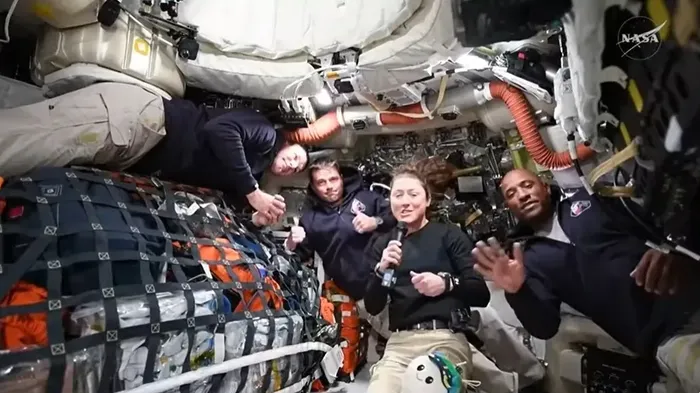
Koch radioed in mid-test that her two other crew members, Reid Wiseman and Victor Glover—whom she referred to jokingly as “the peanut gallery” in her transmissions—were asking her to turn the ship in specific ways beyond what was required for the test to get some pictures.
She obliged, and to the delight of mission control, Koch’s piloting allowed Wiseman and Glover to see the Earth and the moon at the same time.
A view of Earth taken by NASA astronaut and Artemis II commander Reid Wiseman from one of the Orion spacecraft’s four main windows after completing the translunar injection burn on April 2, 2026. (NASA/Reid Wiseman).
On Course for the Moon
This manual test flight was a major highlight of Flight Day 4 of Artemis II’s mission around the moon and back.
Along with the deep space flight firsts, the crew members were the first humans to lay eyes on a major target on the moon’s far side: the Orientale Basin. Despite being tens of thousands of miles away, they were able to see the entire impact zone, and NASA shared a picture of their perspective.
This latest cruising day also featured another opportunity for the crew to talk with their families and doctors and take more pictures. They continue to troubleshoot their faulty toilet, which recently has had issues dispensing its wastewater into space, causing the astronauts to resort to using collapsible contingency urinals.
They have also begun making preparations for the upcoming lunar flyby, which include reviewing their checklists and practicing setting up cameras and other configurations of the capsule. They each also found time to execute their daily 30 minutes of exercise.
The day was also scheduled to feature another course correction burn. But flight controllers determined that Integrity’s initial translunar injection burn was so precise that no course correction was needed. This was the second consecutive course correction burn to be canceled.
The crew additionally continues to send high-resolution photography and other data back to Earth via Artemis II’s Optical Communications System, which uses laser communication for transmission. That system surpassed 100 gigabytes worth of data as of April 4, and NASA officials expressed their eagerness to see more and more imagery and data beam down to them from deep space.
Easter Message
Artemis II will enter the moon’s gravitational influence on Easter Sunday, which further parallels Apollo 8, which flew its mission around the moon during Christmas 1968.
Apollo 8 astronauts felt compelled to read the first 10 verses of the Book of Genesis to their global viewers. Glover, who has been open about his own faith, was asked during a news conference whether he had any statement prepared.
“As we are so far from Earth and looking at, you know, the beauty of creation, I think that for me, one of the really important personal perspectives that I have up here, is I can really see Earth as one thing,” he said.
His message to the people of Earth was also for them to remember that they are special to be living on an oasis of a “spaceship” that is the planet Earth amid the vast emptiness of space.
“I think as we go into Easter Sunday, thinking about, you know, all the cultures all around the world, whether you celebrate it or not, whether you believe in God or not, this is an opportunity for us to remember where we are, who we are, and that we are the same thing, and that we got to get through this together,” he said.

More Stories
Mega Mergers Return to Food Industry in 1st Quarter Amid Pressure for Lower Prices
By Panos Mourdoukoutas The first quarter of 2026 marked a renewed wave of megamergers in the food industry, as companies...
California-Based Family Members of Qasem Soleimani Arrested, Green Cards Revoked
By Jacki Thrapp Two family members of assassinated Islamic Revolutionary Guard Corps Major General Qasem Soleimani were arrested by federal...
‘WE GOT HIM!’: Trump Says US Forces Rescue 2nd Airman Downed in Iran
By Ryan Morgan U.S. forces have successfully rescued a second U.S. airman whose F-15 Strike Eagle fighter jet was shot...
Monthly Payments for Homes Increased 1st Time in 6 Months
By Naveen Athrappully The median monthly mortgage payment in the United States hit $2,742 for the four weeks ending March...
Trump’s 3D Chess: How President Trump Is Checkmating China and Russia by Toppling Their Oil Proxies in Venezuela, Cuba, and Iran
By Stephen Zogopoulos, USNN World News In the rarefied world of grand strategy, true masters don’t play on a flat...
Iran Vows Lasting Grip on Strait of Hormuz After War
By Tom Ozimek Iran has signaled that it intends to exert lasting control over the Strait of Hormuz—the world’s most...