
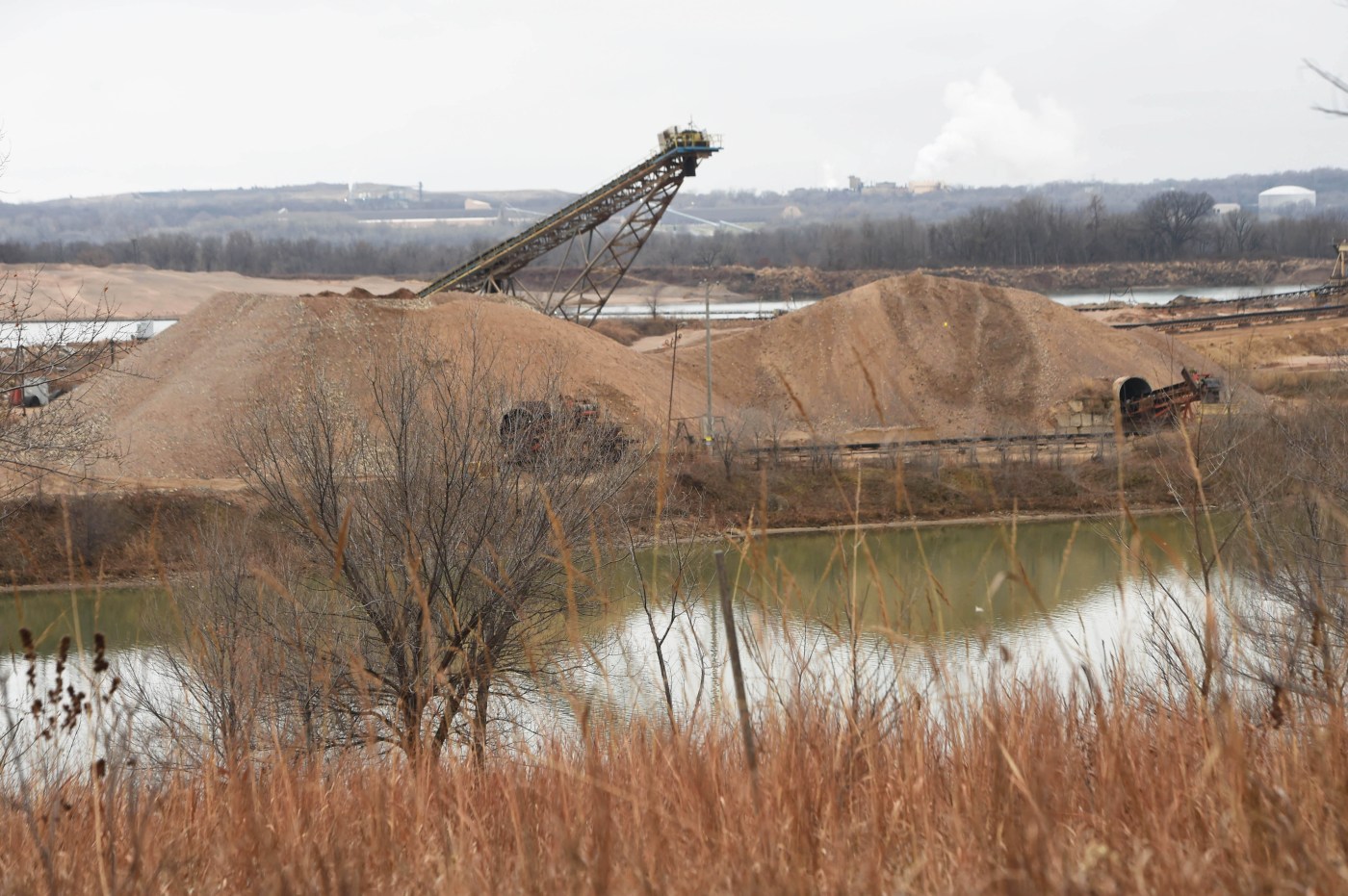
Amrize drops plan for gravel pit expansion in Mississippi River bed

A mining company is dropping a controversial plan to mine the riverbed of the Mississippi River corridor between Cottage Grove and Inver Grove Heights, a decision that environmentalists on Friday hailed as “a win for the river.”
Officials from the mining company, Amrize Midwest Inc., said Friday that the decision to discontinue planning and development of the project was “a business decision made in the best interests of our customers.”
Amrize, which operates the Nelson sand and gravel mine on Lower Grey Cloud Island, wanted to expand and shift operations into the Mississippi River and mine the actual riverbed.
The Cottage Grove City Council, over the objections of numerous agencies and residents, unanimously approved a final environmental review in November for the project proposed by Amrize, formerly known as Aggregate Industries and Holcim-MCR Inc.
Among the agencies that raised concerns about the project: Dakota County, the Metropolitan Council, the Minnesota Department of Natural Resources, the National Park Service, the U.S. Army Corps of Engineers and Prairie Island Indian Community.
“The environmental review was so legally flawed that I’m not surprised they couldn’t figure out how to move forward,” said Colleen O’Connor Toberman, land use and planning program director for the nonprofit Friends of the Mississippi River. “The end of this project is definitely due to a really strong and organized outcry from the community that includes residents, people who love the river and the parks around the river. … Everyone but the city of Cottage Grove knew this was a bad idea, and everyone spoke up until (Amrize) kind of saw the writing on the wall.”
Dakota County sought review
Officials from Dakota County and the Met Council asked the Minnesota Court of Appeals on Dec. 16 to review the project’s environmental impact statement before the project could proceed.
Dakota County officials raised concerns about visual and noise impacts, as well as impacts to wildlife and the river.
The view from the Mississippi River bluffs at Dakota County’s Spring Lake Park Reserve, a 1,100-acre park in Rosemount and Niniger Township, would have been “right at the mining operation,” said Dakota County Planning Manager Kurt Chatfield. The dredge used to mine the river bed would have been 65 feet tall — “That’s the height of a six-story building within the river itself.”
Impacts on wildlife and the river also were a concern. “Many of the visitors that come to a place like a park reserve are there to enjoy the birds and the wildlife,” he said. “This was going to be very impactful, not just for the area, but for the 200 acres that would be mined underwater.”
Because Amrize officials have decided to withdraw, Dakota County officials will dismiss the pending legal appeal, said Dakota County Commissioner Joe Atkins.
Atkins said the proposed project would have “involved noisy crushers, conveyors, and bright lights operating 24/7 for nine months a year — for up to 25 years.”
Mine nearly depleted
Amrize had proposed its mining area to reach additional aggregate reserves on about 400 acres of privately owned land that it leases adjacent to the existing facility in the backwaters area of the Mississippi River.
Related Articles
A ‘ring of fire’ solar eclipse will dazzle people and penguins in Antarctica
As electricity costs rise, everyone wants data centers to pick up their tab. But how?
What can toughen Louisiana coast against worsening storms? 4 years and 30,000 trees
Scientific studies calculate climate change as health danger, while Trump calls it a ‘scam’
EPA ends credits for automatic start-stop vehicle ignition, a feature Zeldin says ‘everyone hates’
There are about five years of life remaining in the existing permitted Nelson Sand & Gravel Mine Facility; the expansion could have extended the life of the mine by another 20 to 25 years, according to Amrize officials.
The Nelson mine site has been in operation since the early 1950s on privately held land on Lower Grey Cloud Island. Approximately 15 union and management employees work on the site, said Michael Lach, general manager.
Materials from the Nelson mine “have helped to build the Twin Cities for more than 70 years,” Lach said. “The materials for roadways, schools, hospitals and homes that have shaped this community came from this site. … Cottage Grove leaders and the larger community have supported us for decades, and we appreciate their partnership.”
Lach said the company will source sand and gravel material from other operations.
Amrize Midwest Senior Vice President Rodrigo Gallardo shared the company’s news in a certified letter sent Feb. 12 to Cottage Grove City Administrator Jennifer Levitt.
“After careful internal review, we have decided to discontinue all planning and development for this project, effective immediately,” Gallardo wrote. “We appreciate the time and effort which has been put forth by the city and their staff relating to this project.”
A spokesman for the city on Friday said that the city considers Amrize’s application withdrawn.
Mayor defends city process
Cottage Grove Mayor Myron Bailey on Friday defended the city’s process and questioned why Dakota County and the Met Council sued the city when officials from both the DNR and the U.S. Army Corps of Engineers “made it clear” the agencies were not going to approve the necessary permits to allow the project to move forward.
“This would have happened without having to waste taxpayers’ money,” he said.
The city had to pay a $50,000 deductible to the League of Minnesota Cities for legal representation, he said, and taxpayers in Dakota County and in the Metropolitan Council region also are footing the bill.
“We weren’t making a decision on the viability of the project, just the environmental pieces,” he said.
Related Articles
Nearly 11 pounds of meth, two guns seized during drug raid at Inver Grove Heights house
Girl Scouts moving cookie sales online in response to ICE actions
Board vacancy, superintendent search: Forest Lake School Board, deadlocked 3-3, faces major issues
Former Hudson strength and conditioning coach pleads guilty to sexually assaulting student athlete in Woodbury
‘This isn’t just about flowers’: Stillwater nonprofit shares bouquets, compassion with widows on Valentine’s Day
He said city officials spent three years working with a team of specialists and experts, including hydrologists, biologists, archaeologists, ecologists, noise specialists, geologists and engineers, to review the adequacy of the 1,000 page environmental impact statement.
“We took our role as the responsible governmental unit to gather potential impacts very seriously,” Bailey said. “We were not approving the project. The council never had that determination or decision to make on the project. We were asked to do a particular job, and we did it. We followed the law to make sure that everything was done correctly.”
But Dakota County’s Chatfield said the final environmental impact statement did not address mitigation to offset the visual impacts, noise impacts and impacts to wildlife and the river.


More Stories
Beyond the Microphone: British Comedians Who Became Directors and Presenters
Stephen Merchant co-created The Office and went on to write and direct for the cinema. Simon Amstell writes and directs...
Top 10 Best Hair Transplant Doctors in Turkey: A 2026 Guide to Surgeons
This guide names the top 10 best hair transplant doctors in Istanbul for 2026 and explains, in plain terms, how...
How to Choose an HR System for a Growing UK Business
For a while, email and spreadsheets seem good enough. Then managers start asking where the latest file is, staff have...
Top 10 Best Hair Transplant in Turkey
Turkey has become one of the world’s most familiar destinations for hair restoration, with Istanbul attracting patients from Europe, the...
How to Register a Company in Hong Kong in 2026: A Guide for UK SMEs
You can register a company in Hong Kong remotely, but plan tax, banking and compliance before you start. Why UK...
Timur Turlov Takes Freedom SuperApp Beyond Kazakhstan as Digital Expansion Accelerates
The application combines banking, investments and everyday services in one digital environment. Having built its customer base in Kazakhstan, the...