
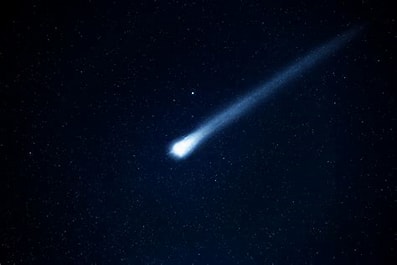
Skywatch: Jumpin’ Geminids

Next weekend you can catch one of the best meteor showers of the year. It’s the annual Geminid meteor shower, and if the clouds stay away it should be a good one this year because the moon will be mostly out of the sky.
Meteor showers occur when the Earth runs into a debris trail of dust and small pebbles as it orbits around the sun. For most meteor showers, the debris is left behind by a passing comet, but the Geminids are unusual because the debris trail was left behind by an asteroid dubbed by astronomers as 3200 Phaethon. This asteroid was discovered in 1983 and is thought to have a diameter of around three miles. It has a highly elliptical orbit that swings it by our part of the solar system every year and a half. Each time it passes it refreshes the debris trail. It’s a real cosmic litterbug.
(Mike Lynch)
By the way, 3200 Phaethon is not one of those killer asteroids that’s expected to bash into the Earth someday, at least not for now. Eventually, though, a large asteroid will hit the Earth, maybe in 10 years, 100 years, or several million years from now. Who knows? An asteroid or comet that hit the Earth 65 million years ago wiped the dinosaurs out and cleaned the slate for life forms on Earth.
Enough destruction talk. Getting back to the Geminid meteor shower, it will peak next Saturday night into Sunday, Dec. 13-14, but you’ll also see some Geminids this coming week and a few days after the peak next weekend. The best time to look for the meteors is between midnight to just before morning twilight begins. If you’re lucky enough to already be in the countryside or able to jump into the car to the darker skies, you may see well over 50 meteors an hour and maybe even 100. Even if you’re challenged with suburban light pollution you’ll see enough of them to make losing a little sleep worth it. Some of these meteors are slamming into our atmosphere at over 40 miles a second. These bits of dust and pebbles get incinerated at altitudes anywhere from 40 to 60 miles up. Most of the light you see from meteors though, is not because of combustion but from how they temporarily destabilize or excite the small column of air they’re charging through. That’s why you see meteors as streaks in the heavens, and some of the streaks stay visible for a second or two after they pass, as the column of air they came through stabilizes. Meteor streaks can also be different colors depending on their chemical composition and how fast they’re moving. In general, the reddish-tinged meteors tend to be slower meteors, and faster meteors are more bluish.
A meteor. (Mike Lynch)
This shower is called the Geminid meteor shower because all of the meteors from our vantage on Earth appear to be coming from the general direction of the constellation Gemini the Twins, which starts out the evening in the eastern sky and by morning twilight it’s stretched across to the low western heavens. By no means though should you restrict your viewing to the immediate part of the sky around Gemini because the meteors will be all over the heavens. The best thing to do is to be well layered in clothes, coats and blankets and lay back on a fully reclining lawn chair, rolling your eyes all around the sky and keeping count of how many meteors you see. Meteor shower watching is especially fun with a group of people because the more sets of eyes you have patrolling the sky, the more meteors you’ll see. Dress warm and enjoy the show.
Mike Lynch is an amateur astronomer and retired broadcast meteorologist for WCCO Radio in Minneapolis/St. Paul. He is the author of “Stars: a Month by Month Tour of the Constellations,” published by Adventure Publications and available at bookstores and adventurepublications.net. Mike is available for private star parties. You can contact him at mikewlynch@comcast.net.
Related Articles
Skywatch: Holiday celestial lights
Skywatch: No turkeys, but many other birds in night sky
Skywatch: The Seven Little Sisters will lead you to Planet George this week
Skywatch: Holiday telescope shopping guide
Skywatch: Long starry nights are back


More Stories
Explosion Proof PTZ Cameras — Full 360° Intelligence in Explosive Zones
In a standard office building, a blind spot in your surveillance coverage is an inconvenience. In an oil refinery, a...
The nightmare oil price nobody’s talking about
Real world oil prices are far higher than the figures seen on TV news reports When the first US and...
EU nations forced to pay for von der Leyen’s Covid deal
A Belgian court has ordered Poland and Romania to buy $2.2 billion worth of Covid-19 vaccines from Pfizer and BioNTech...
Europeans must pay more for medicine – German pharma giant
Profits have fallen since US President Donald Trump pushed to lower prices for Americans German pharma giant Bayer has warned...
Panic buying drains French gas stations
Hundreds of sites have run dry across the country after price caps triggered a surge in demand amid Middle East...
Ratcliffe backs tory plan to scrap carbon taxes amid industry pressure
Jim Ratcliffe has thrown his support behind Conservative proposals to scrap carbon taxes, intensifying the debate over the cost of...