
St. Paul: Inside Obama Montessori, Bruce Vento Elementary school renovations

There are 37 construction projects happening in the St. Paul Public Schools district this year, but at least two major ones celebrated ribbon-cuttings this fall.
A remodeled Barack and Michelle Obama Montessori and Middle School and the new Bruce Vento Elementary School welcomed students this year, adding shared learning spaces and an environmental magnet to the district.
Obama Montessori and Middle School houses both the pre-kindergarten through fifth grade Montessori program that had been located at J.J. Hill Montessori, and a new middle school. The middle school currently teaches only sixth grade and will add a grade for the next two years.
Nora Lor, 7, listens to garden coordinator Kristen Saylor in the Garden Room at Bruce Vento Elementary School in St. Paul on Tuesday, Oct. 14, 2025. Nora was learning how to transfer seedlings to a net pot for placement in tower Gardens. (John Autey / Pioneer Press)
The Bruce Vento construction marks the district’s first new building since 2018 and is an environmental magnet program.
Bruce Vento, named after the late U.S. congressman who grew up in St. Paul, continues to house pre-kindergarten to fifth-grade students and now an Early Childhood and Community Hub, which includes childhood programming and community services. The previous building, on the same property as the current building, is being torn down, with an environmentally focused schoolyard to come next.
Bruce Vento Elementary: Sustainable features
Officials at Bruce Vento Elementary held the school’s ribbon-cutting ceremony Oct. 2, with guests including Vento’s widow, Sue Vento, and Dr. William Schrankler, the first principal of the original Bruce Vento Elementary, which opened in 1971 as the East Consolidated School.
Kids play in the gymnasium at Bruce Vento Elementary School in St. Paul on Tuesday, Oct. 14, 2025. (John Autey / Pioneer Press)
Construction of the new, approximately 160,000-square-foot building began in 2023 with an $89.9 million budget. It is designed by the firm Cuningham and the work contracted with RJM Construction. The schoolyard is expected to be completed in August 2026.
Facilities project manager Pam Bookhout recently led tours around the new building, which includes sustainable features such as a geothermal system using groundwater heat exchange and a high-performance building envelope to preserve energy. There also are plans to install solar panels and screens to show data on energy use in the school to students and staff. The building also features secure entryways.
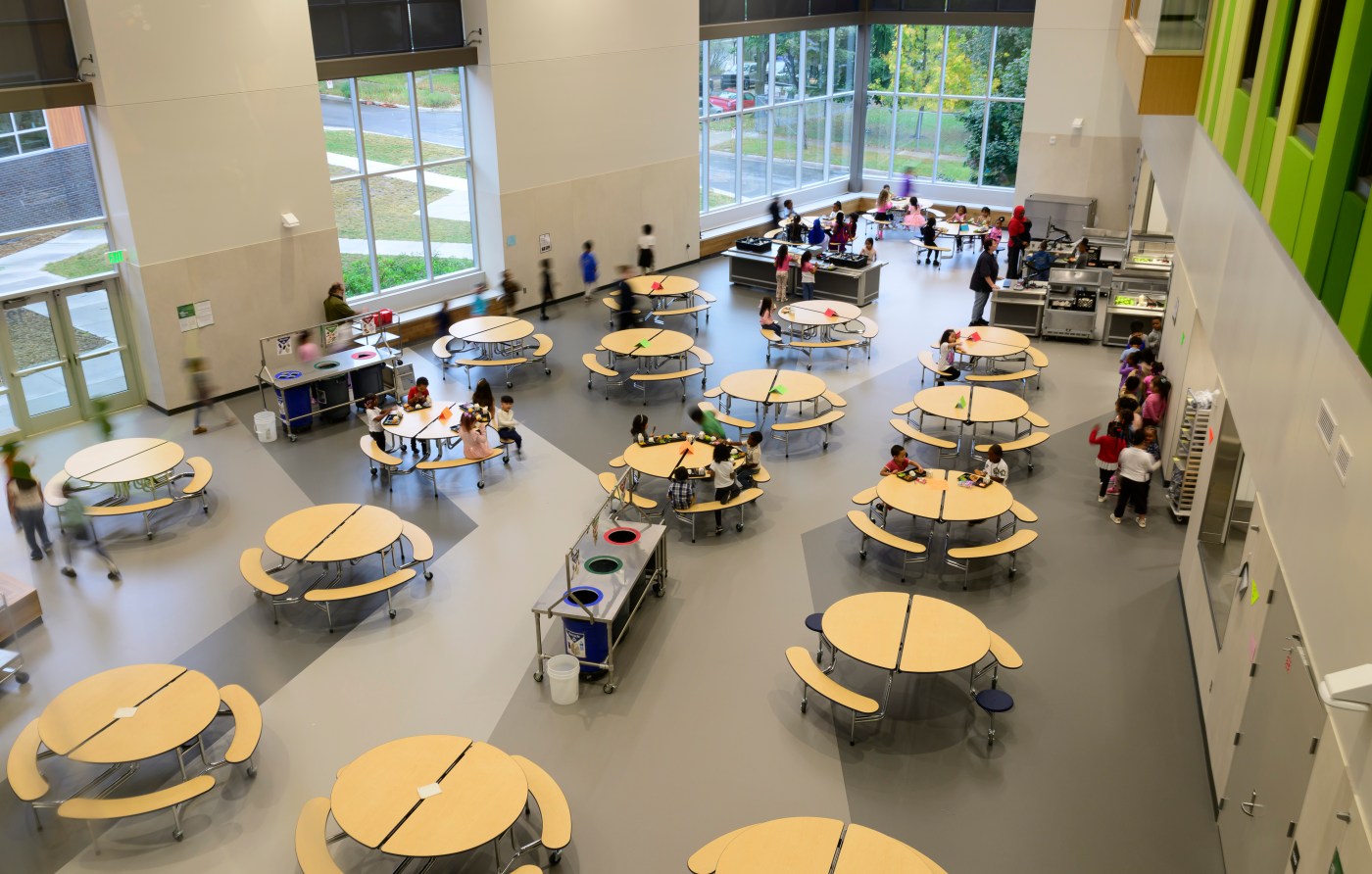
“The other building, it was very, very limited in windows,” said Bruce Vento Principal Nicky Napierala. “And so it was a very, very dark space that was heavy on the concrete. But in this space, the shape is a little different, other than like a typical, what a school would look like. We kind of say that it looks like the letter W because there’s a courtyard where there’s open space, the cafeteria has high ceilings, like a little lookout, like the eagle’s nest that we have. Our school mascot is Baldwin the eagle, so we call it the eagle’s nest.”
‘As much daylight as possible’
Community feedback on the school’s design and focus came from surveys, family nights and one-on-one meetings with staff. The design process included imagining the indoors and outdoors coming together, Bookhout said.
“I guess one thing about the building, some people have looked at it and said, ‘Why isn’t it square, or why isn’t it rectangular?’” Bookhout said. “And it does have a little bit of an odd shape, but the main purpose for that was to allow as much daylight in as possible.”
Alicia Thor, an environmental science specialist at Bruce Vento Elementary School in St. Paul, ties a kindergartner’s shoe during an outing outside the school on Tuesday, Oct. 14, 2025. (John Autey / Pioneer Press)
Families showed a strong interest in movement, play, sustainability and nature, Bookhout said, which helped officials decide to make the school an environmental magnet.
“The old Bruce Vento was built in the 1970s, so it was a long time coming for a brand-new building. And a lot of the feedback that we got from families and the community was centered around play and environment and our garden, as well as infusing restorative practices in what we do on a daily basis,” Napierala said.
Because many designs in the 1970s focused on open-concept designs, noise in the previous building could be distracting for classes, and teachers had made makeshift walls using bookshelves in an attempt to keep noise out, Bookhout said. The new building design moves away from that.
Students walk back to class from the front lobby of Bruce Vento Elementary School in St. Paul on Tuesday, Oct. 14, 2025. (John Autey / Pioneer Press)
“You know, our old building, we did the best that we could, but this new building, you walk in, and it’s just incredible,” said Gretchen Ray-Jensen, the restorative practice program coordinator at Bruce Vento Elementary. “I know a number of our families have said, it almost brings you to tears to see how valued families feel and important, coming into a space that is this incredible and really centers ourselves in the environment, building community and providing spaces for community to be present.”
In the three years that the new building was being constructed on school grounds, and now that the old school is being torn down, students at Bruce Vento have been without a playground. During that time, they’ve had a “playground day” every Friday, traveling by school bus to the John A. Johnson Elementary playground before their Friday field trip.
Allison Fang, 5, a kindergartner at Bruce Vento Elementary School in St. Paul, holds a matching game during an environmental class on Tuesday, Oct. 14, 2025. (John Autey / Pioneer Press)
When the schoolyard is completed, it will feature raised plant beds made from wooden beams from the previous building and a “dry creek bed,” Bookhout said. The building is on a dramatic grade change, she said, which meant the design team had to get creative in order to make the building feel like it was just two levels rather than multiple levels up and down. Renovations on the previous building had been paused by the district in 2019 due to the cost related to its many levels and slopes.
Outside educational feature
Outside, however, the design team was able to take some advantage of the grade change for an educational feature.
“I think about this sort of, the grade change that happens on the building from north to, or on the site from north to south, and that there will be sort of a rocky area where, if you’re having a rain event, the rain is going to go down that small rocky creek, and you’re just going to see it flowing, and it goes from north to south,” Bookhout said. “But it also feeds into the grasses and then into the storm system. And then when it stops raining and the sun comes out and dries everything, there won’t be standing water in there.”
The creek is integrated into the school design, with a “creek” weaving across the building floors and keeping nature at the forefront, Bookhout said.
While the schoolyard is in progress, the school’s environmental specialist and garden coordinator are getting students outside, growing plants and on field trips, while organizing curriculum with an environmental focus.
By bringing the indoors and outdoors together, the focus isn’t just on the students being in the building and then outside, Bookhout said, but doing things like gardening in the raised beds, walking along the learning trail, learning about storm water collecting in a cistern to water plants and seeing the building’s energy use on screens inside.
Chain link fencing keeps kids safe as construction continues at Bruce Vento Elementary School in St. Paul on Tuesday, Oct. 14, 2025. (John Autey / Pioneer Press)
Obama Montessori and Middle School
The renovated Obama school brings together a Montessori elementary school and its new middle school and celebrated its ribbon-cutting late last month. Montessori schools are child-centered educational approaches focusing on independence, hands-on learning and self-direction in mixed-age classrooms
Gianni Swingler, 4, focuses as he builds with blocks during open time in the Children’s House Pre K-1st grade class at the Barack and Michelle Obama Montessori and Middle School in St. Paul on Tuesday, Oct. 14, 2025. (John Autey / Pioneer Press)
The $55.3 million project was designed by Snow Kreilich Architects and contracted with H+U Construction.
The remodeled building includes shared spaces, such as a main office, cafeteria, library and some meeting spaces, as well as shared duties. Amanda Herrera-Gundale took on the role of principal of the middle school this year, joining Elizabeth Diemer, who is principal of the Montessori side of the school. The two have offices just a few doors down from each other.
“So we have our same staff, we have the same families, same children, we’re just a different home,” Diemer said. “And so we’ve kind of really been trying to build and bank on those existing relationships that we have with one another to kind of come together to work through some of the challenges and successes that come with moving into a new space.”
The old gymnasium has been repurposed as a commons area at the Barack and Michelle Obama Montessori and Middle School in St. Paul on Tuesday, Oct. 14, 2025. (John Autey / Pioneer Press)
Remodeled areas include a general learning space, gym, cafeteria, media center, art room and administration office. The middle and elementary schools are connected by shared spaces, such as the cafeteria and media center.
On the Montessori side of the school, school officials worked to meet the needs of their style of teaching. That includes lower wooden shelves so students can independently take or put away items they want and more flexible workspaces and adjustable furniture with more space for students to spread out and work with Montessori materials.
On the middle school side, spaces also are tailored to the content they teach, Herrera-Gundale said, such as the music room which is carpeted and set further away from other classrooms or the gym which features more natural lighting. Some spaces also feature reused pieces – a multipurpose learning space has original gym flooring from a previous building and some exposed brick in the walls of newly added classrooms comes from the former exterior of the building.
Librarian Rebekah Orensten talks to a group of middle-schoolers in the library at the Barack and Michelle Obama Montessori and Middle School in St. Paul on Tuesday, Oct. 14, 2025. (John Autey / Pioneer Press)
While the middle school and Montessori sides don’t have a lot of crossover, Diemer and Herrera-Gundale have seen interactions between students and staff across the two sides of the building, such as staff sharing lunch or students walking their younger siblings to class.
“Middle schoolers, they have all these things going on and relationships, and there’s so much going on in their brains,” Diemer said. “But then seeing these little kids, I think we see a side of them come out of, like, they’re helpful and they want to be leaders for the kids, and they want to show them around and be the big kids.”
Middle-schoolers browse the shelves for books to read in the library at the Barack and Michelle Obama Montessori and Middle School in St. Paul on Tuesday, Oct. 14, 2025. (John Autey / Pioneer Press)
Related Articles
New MN tool highlights school financial impact of federal shutdown
St. Paul Public Schools board sets levy at 2% less than last year
What do the MCA test scores mean and how should parents interpret them?
St. Paul: Early voting opens as mayor’s race, school levy overshadowed by high taxes, ‘stagnation’
Boys brought replica guns to St. Paul school, police say


More Stories
From Scotland Yard Commander to Global Security Entrepreneur: Dr Ali Dizaei’s Leadership Story
There are career journeys that follow a straight line, predictable, uniform, and comfortable. And then there are journeys shaped by...
The Naughty AI President: A New Age of Governance
In the race to build better systems of governance, humanity has always chased an impossible ideal: the perfect ruler. Rational,...
Sends shares Q1 2026 business update and product progress
Sends reported Q1 2026 updates sharing news on digital cards, app redesign, ClearBank integration, and fintech industry recognition. Sends, a...
Government doubles down on gaming with £30m funding package as sector eyes global growth
The government has fired the starting gun on a £30 million funding offensive aimed at Britain’s video games sector, urging...
Rising energy costs from Middle East conflict set to leave UK households £480 worse off this year
Rising energy costs triggered by the escalating Middle East conflict are on course to strip nearly £500 from the finances...
UK firms risk being left behind as AI adoption gap widens, warns PwC
British businesses are in danger of being left stranded in the middle of the pack on artificial intelligence, with a...