
MN GOP push school safety measures over gun control. Are SROs an option?

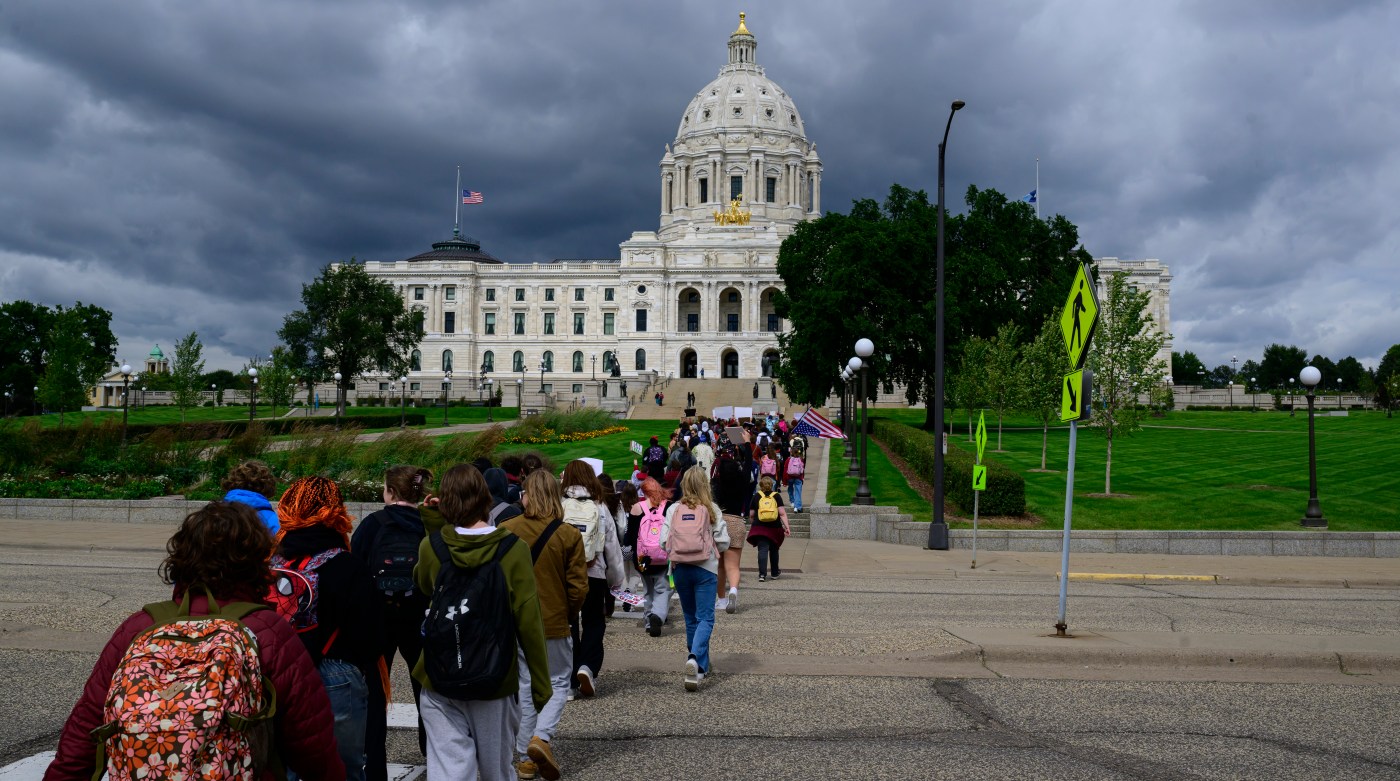
One approach Minnesota lawmakers have been pitching in response to the Annunciation Catholic Church shooting is funding for school safety measures — specifically, school resource officers.
SRO funding has been brought forward by House Republicans as part of a school safety package and by Sen. Andrew Mathews, R-Princeton, during the Senate Gun Violence Prevention Working Group earlier this month.
Minneapolis Police Chief Brian O’Hara said an Annunciation parishioner told him the first time they felt any sense of safety was when the first officer arrived at 8:31 that morning, four minutes after the shooting started.
“We all know four minutes is still a long time for someone that’s inflicting evil on our kids to keep doing damage. And so I’ve kept trying to think through my mind, what’s the thing that we could do that could be the most immediate help? And this is what I keep coming back to.” Mathews said.
Gov. Tim Walz has said he wants to call a special session of the Legislature on gun control following the school shooting in Minneapolis. However, the DFL and GOP haven’t been able to agree to a framework.
Making funds available
Meanwhile, Mathews said he wouldn’t go as far as to mandate officers in schools, but rather is pitching making state funds available for schools to help pay for them.
Mathews said he knows Republicans aren’t considered the “big spending party,” but that he thinks society is at a “time and place” where a conversation should be had about funding this security measure, for public and private schools.
Some Republican lawmakers toured Lakeville Area Schools after the Annunciation shooting. The district has enhanced security measures like 3D Response Systems. Mathews said a tour guide told them during the visit that “in his many long years of law enforcement experience, he had never heard of a bank being robbed that had a squad car at the parking lot.”
“Sometimes just a visual like that will help,” Mathews said.
Not all lawmakers are completely on board with adding such measures.
Sen. Bonnie Westlin, DFL-Plymouth, said that with all the “talk about hardening schools,” she’s seen research that shows it hasn’t been “especially effective.”
“It has a negative impact on our kids,” she said. “Our kids need to go to schools that are safe, but they should not be walking into a building that looks like a prison or a fortress. They should be going into an environment where they can learn. It is our responsibility to reduce the risk of shootings, and one of the ways we do that is to remove the availability of these particular weapons.”
SROs were a topic of debate in the years following George Floyd and the legislative response that followed in 2023, when the state changed language on SROs and use of force. Though several schools pulled officers, some have since returned and some districts never stopped using them.
St. Paul Public Schools pulled their SROs in 2020 and, in their place, have used school support liaisons and community support liaisons. The liaisons are instructed to build relationships with students and head off conflicts before they escalate.
What schools are saying
Duluth Public Schools has four SROs, one at each high school and one at each of the middle schools. Communications Officer Adelle Wellens said the district has had a contract with the Duluth Police Department for SROs since the 1970s.
Wellens said that while there was some community pushback in 2021, Duluth police never intended to pull the officers out of the schools in 2023 after the law change on use of force. The officers are still in place.
“Our SROs don’t use force unless there is a clear and immediate threat,” she said. “And they’re great officers. They want to be there to not be someone that our students are afraid of, but someone that our students can come to if they have a problem.”
Wellens said Duluth has focused more on “community policing” and less on discipline, adding that it’s the administration’s job to handle discipline. She said there were 22 student citations in the 2024-2025 school year, compared to 115 in 2021-2022.
The school district also has started an annual survey asking students and parents how they feel about the law enforcement presence. The 2024 survey found that 81% of the students who responded found their interactions with the SRO positive, and that 74% of non-white students found their interactions to be positive. The survey showed 89% of students said they feel the SRO deters school shootings from occurring.
After pulling them for the 2024-2025 school year, Moorhead Area Public Schools welcomed back two SROs this school year, one at Horizon Middle School and one at Moorhead High School.
Steve Moore, executive director of operations and emergency management for Moorhead Area Public Schools, said the decision to pull the SROs was based “purely” on staffing at the Moorhead Police Department.
The feedback from the community about the officers’ return was more positive than negative, Moore said. He said the SRO presence has been beneficial for two reasons: one, community building; and two, in the event of an emergency.
“I like having them there from an emergency management perspective, because they help diffuse fights and those kinds of things,” he said. “If there’s anything that starts to escalate that could be even a higher threat, then they’re already there to take action quicker.”
Safety and security
Regardless of whether state funding would be made available to support additional SROs, Wellens said she’s not sure the Duluth Police Department has the staffing for it.
“From what I’ve heard currently, right now, the city, the Duluth Police Department, just doesn’t and wouldn’t have the bodies to be able to cover the seven of our nine elementaries that are within their jurisdiction,” she said.
Moore said he would “love” to have two more officers in Moorhead schools, but that any support from the state for safety measures would be appreciated.
He said he’d like the Legislature to expand how long-term facility maintenance funding can be used.
Related Articles
Government shutdown’s effect on Minnesota will depend on how long it lasts
DFL, GOP deadlocked in talks for special session on gun violence
Joe Soucheray: Trump had nothing to do with fraud in Minnesota. That’s on the governor.
Gov. Walz: GOP won’t budge on gun control; House speaker calls it ‘mischaracterization’
Former DFL lawmaker Nicole Mitchell sentenced to 6 months in jail for burglary
“Right now, we can use long-term facility maintenance for indoor air quality, we can use it for roofs, but there is a big need, particularly, to have access to that funding for safety, for safety and security,” he said. “For example, you can write camera upgrades, potentially weapons detection systems and those kinds of things that we simply would have to use capital for.”
Wellens echoed Moore, saying she would ask lawmakers not to “pigeonhole” any money allocated for school safety measures. She said Duluth schools have a lot of old cameras that could use upgrading.
“A lot of people don’t realize that technology also is part of school safety, and if we don’t have the funds for technology, we can’t make those safety updates,” she said, adding that Duluth has tried for a technology referendum three times and it has failed each time.
“There are more things that go into school safety than just having school resource officers,” Wellens said. “And I think that each school should be able to determine how they use those fundings, because there may be schools, more rural schools, that the police department can’t even find someone to be an SRO.”

More Stories
Middle East war triggering global energy ‘shock’ – IMF
Disruptions to oil and gas supplies will leave lasting “scars” on the world economy, managing director Kristalina Georgieva has said...
What is fueling unrest across the EU?
The bloc is facing an energy crisis due to the Strait of Hormuz disruption, with soaring diesel prices triggering protests...
OECD urges reeves to overhaul ‘inefficient’ UK tax system
Rachel Reeves has been told by one of the world’s most influential economic bodies that Britain’s tax system is holding...
Easter lifts footfall but retailers brace for April cost squeeze
Britain’s high streets enjoyed a welcome lift last month as an early Easter drew shoppers back through the doors, but...
Google takes on Opentable with AI that books your dinner in seconds
Google has fired the opening shot in a battle for Britain’s restaurant booking market, rolling out an artificial intelligence tool...
Retail backers of SEIT face wiping out half their money as green trust raises the white flag
Thousands of small investors who piled into one of London’s best-known green investment vehicles are staring down the barrel of...