
Move over white sharks: Another shark species off Massachusetts was spotted attacking seals

Great white sharks have some competition.
Another shark species was spotted attacking seals off Massachusetts for the first time, according to local shark researchers.
Dusky sharks were seen preying on gray seals off Nantucket, the researchers found in a new study.
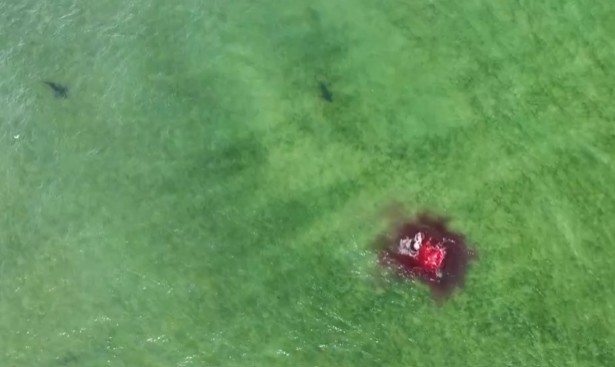
The scientists from the Atlantic White Shark Conservancy, the New England Aquarium, and the Massachusetts Division of Marine Fisheries recorded the first-ever aerial footage of dusky sharks killing and eating a seal in Massachusetts waters.
“Though the observations we’re reporting are preliminary, they have changed our understanding of the feeding ecology of dusky sharks, which are considered endangered on a global scale, as well as predatory interactions between sharks and seals in the waters off Massachusetts,” said Megan Winton, senior scientist at the Atlantic White Shark Conservancy and lead author of the study.
“This footage provides us valuable insight into understanding the behavior of a shark species that experienced steep population declines in the mid-20th century but now seems to be recovering and reassuming an important ecological role,” Winton added.
We are thrilled to announce the publication of a new research paper! The paper, Novel Observations of Dusky Sharks Preying on Gray Seals off Nantucket, MA, documents the first known aerial footage of dusky sharks preying on gray seals in Massachusetts waters. pic.twitter.com/ETMclYJAR9
— Atlantic White Shark Conservancy (@A_WhiteShark) August 28, 2025
Multiple shark attacks on seals were reported off the Nantucket coast of Great Point Coskata-Coatue Wildlife Refuge by beachgoers and boaters in July of 2023.
Initially, people thought it was great white sharks attacking the seals, as the local white shark population has jumped during the last decade. However, researchers looking at photos and video footage of the attacks confirmed that they were dusky sharks.
Following these reports, the team of researchers launched a drone and captured unprecedented footage of a large dusky shark killing and consuming a gray seal in shallow water.
Dusky sharks were not known to prey on seals, but researchers say it’s likely they’re “resuming a historically important ecological role” as populations of sharks and seals along the East Coast rebound in response to protective legislation.
Cape Cod is considered the northern extent of the dusky shark’s range in the summer in the western North Atlantic, but little is known about its distribution and habitat use in the region.
“This work opens a new chapter in our understanding of how recovering shark populations in the U.S. Atlantic may influence the ecological structure of coastal ecosystems,” said co-author Greg Skomal, senior fisheries biologist at the Massachusetts Division of Marine Fisheries and director of the Massachusetts Shark Research Program.
“These incredible observations, a first for this species, raise important questions about how these predators may impact both wildlife management and public safety as they return to their historic habitats,” Skomal added.
Related Articles
Legendary killer whale ‘Old Thom’ spotted, shark researchers deploy first-ever camera tag in Cape Cod Bay
Manatee spotted off Cape Cod: ‘It’s rare to have manatees this far north’
Fisherman catches tiger shark off Cape Cod: ‘We’ve been seeing more and more’
White shark spotted 40 feet off Cape Cod beach: ‘Busy afternoon’
Hammerhead sharks spotted off Massachusetts, bull sharks could be next to migrate north
The study also highlights the increasing importance of drone technology and public engagement in advancing marine science.
Based on the initial footage obtained by eyewitnesses that led to the Nantucket beach closure, at least three other gray seals were consumed by dusky sharks off Great Point in July of 2023.
“This discovery illustrates the important roll the public can play as citizen scientists in documenting and reporting shark behavior,” said John Chisholm, adjunct scientist at the New England Aquarium and a co-author of the study. “Eyewitness reports, paired with new monitoring tools, made it possible to capture rare predator-prey interactions that would otherwise go undocumented.”
The Atlantic White Shark Conservancy Sharktivity’s app helps raise awareness of the presence of white sharks off the coast. The app sightings are fed by researchers, safety officials, and users who upload photos for confirmation.


More Stories
Quick Fix: Chicken Hungarian Goulash with Caraway Pappardelle
By Linda Gassenheimer, Tribune News Service Chicken simmered in a tomato sauce infused with onion, green pepper, and paprika forms...
Quick Fix: Chicken Hungarian Goulash with Caraway Pappardelle
By Linda Gassenheimer, Tribune News Service Chicken simmered in a tomato sauce infused with onion, green pepper, and paprika forms...
How Elvis Presley roars back to life in Baz Luhrmann’s ‘EPiC’ concert film
As filmmaker Baz Luhrmann was deep into his work on “Elvis,” his 2022 biopic of Elvis Presley, an idea struck...
How Elvis Presley roars back to life in Baz Luhrmann’s ‘EPiC’ concert film
As filmmaker Baz Luhrmann was deep into his work on “Elvis,” his 2022 biopic of Elvis Presley, an idea struck...
Netflix se retira de acuerdo con Warner Bros y despeja el camino para Paramount
Por WYATTE GRANTHAM-PHILIPS NUEVA YORK (AP) — Netflix retiró de su oferta para comprar el negocio de estudio y streaming...
El despido de Ruben Amorim podría costarle a Man United 21 millones de dólares
MANCHESTER, Inglaterra (AP) — El costo para el Manchester United por despedir a Ruben Amorim podría alcanzar las 15,9 millones...