
University of St. Thomas hosts ‘upskilling’ training for machinists

There’s a need to replace workers in the manufacturing industry and the University of St. Thomas School of Engineering is holding an “upskilling” event this week to improve attendee efficiencies in the field.
Held over two-day sessions this week, the free training sessions are led by John Wentz, director of the university’s Center for Advanced Manufacturing and a professor of mechanical engineering, along with two machinists.
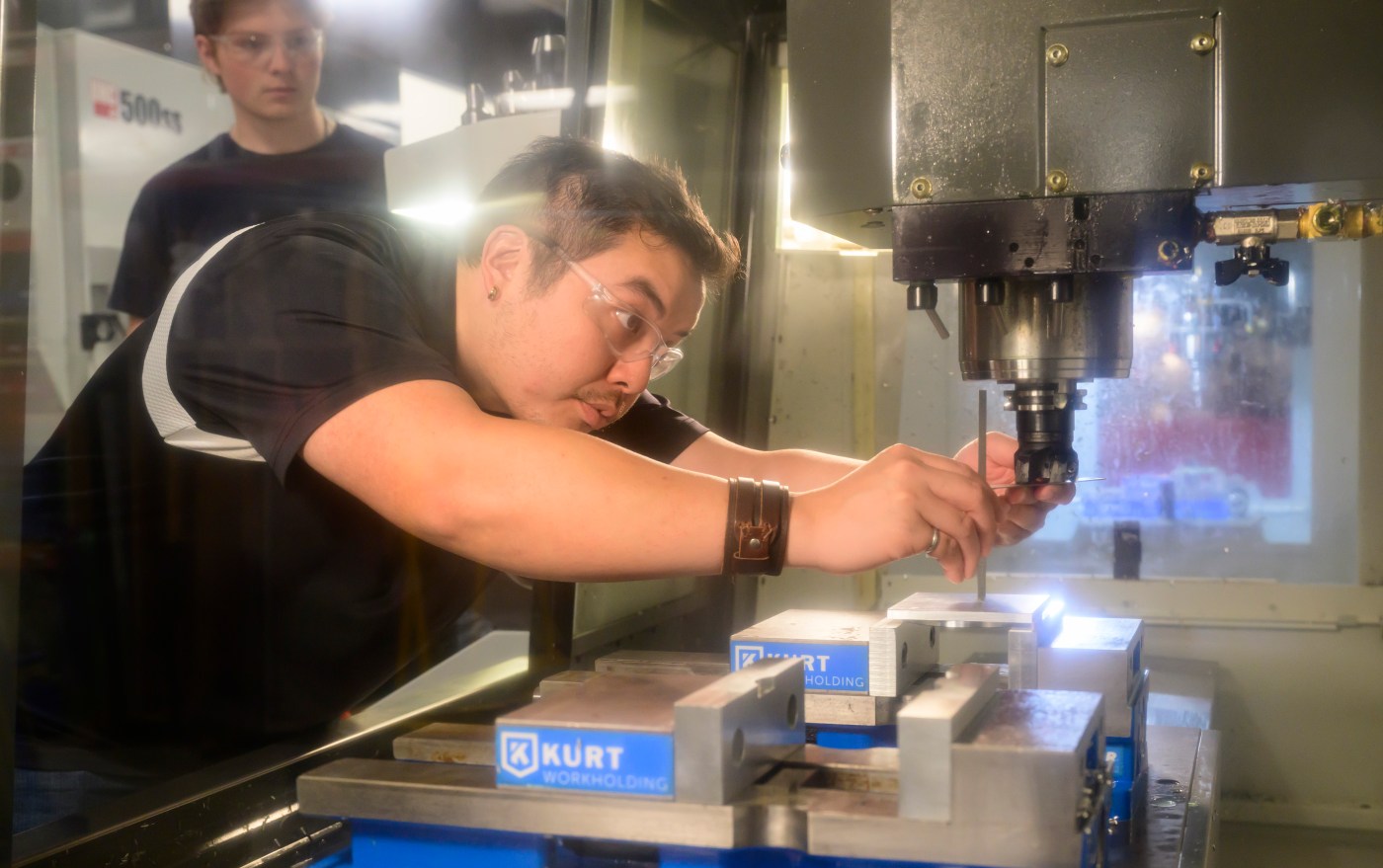
Professor John Wentz leads a class on machining and CNC optimization training through the Center for Advanced Manufacturing at the University of St. Thomas in St. Paul on Tuesday, Aug. 26, 2025. (John Autey / Pioneer Press)
The manufacturing industry involves highly skilled workers and it’s rapidly advancing with technology. But each year thousands are departing the industry for retirement or other reasons. That’s left a demand for new, and more highly-trained, workers.
“Our manufacturing workforce is just aging out, and we’re not replacing them,” Wentz said. “So we’re running at a deficit of manufacturing workforce. That’s where our outreaches to high schools and the ACE program comes in. But if we don’t have enough people, the people we do have have to be more efficient, and that’s where the upskilling comes in.”
The university also hosts other training programs for those interested in manufacturing. However, this week’s training focuses on “upskilling,” or working with those who have existing skills in machining. Wentz said he doesn’t know of any other upskilling training like it in the U.S.
University of St. Thomas sophomore Blake Lelm watches as a CNC machine carries out his program during a class on machining and CNC optimization training at the school in St. Paul on Tuesday, Aug. 26, 2025. (John Autey / Pioneer Press)
“We’re seeing college students who are interested in machining and they want to … already have been trained into some of the best software. We even have high school students who have gone through our other ACE training and they’re very interested in this, so they want to get as much as they can,” Wentz said.
‘Everything is pre-programmed’
Partnering with Air Force Research Laboratory and Third Wave Systems, the university hosts a 12-member group over two sessions to learn about CNC machining, or Computer Numerical Control, which Wentz said is like robotic machining.
“Instead of an operator turning a crank to move material, everything is pre-programmed,” Wentz said. “So the computer program that’s developed tells it when to run and how to run. So it’s essentially the operator is developing the computer program, making sure everything’s in the right spots, and then letting it run.”
It’s about “how do we make that program the best,” he said. “There’s many ways to make a shape. What is the fastest way to make it? How do we remove the material the most quickly and keep our tools from breaking or keep our tools from wearing out too quickly? Simulation tools allow us to see before we break, before the cut, what the cut will look like.”
Those attending leave the training with two items they’ve made themselves, such as a table coaster, as well as a training certification. They can also choose to do an 8-hour online class on software tools as part of the training. On campus, they receive hands-on training and can compare machining with traditional methods versus optimized computer-generated instructions.
University of St. Thomas graduate student Michael Thinh retrieves his freshly-created aluminum coaster during a class on machining and CNC optimization training at the school in St. Paul on Tuesday, Aug. 26, 2025. (John Autey / Pioneer Press)
Participants
Participants range from machinists to engineers and high school or college students.
Wentz said he expects another training session to be held in the winter and another next summer. He wants to see more groups hosted throughout the year.
University of St. Thomas sophomore Blake Lelm, who is studying mechanical engineering, said the training gives him a better understanding of topics that he can use in future career opportunities.
If he goes to work somewhere that doesn’t use the software, he may be able to introduce it, Lelm said, being able to start a “new idea and create a better work environment and more optimal working conditions.”
Related Articles
St. Paul’s 10th annual Backpacks and Barbers event excites kids for back to school
St. Paul company redeveloping Lakeside Club in Mahtomedi fined for asbestos violations
Nagasaki group’s St. Paul visit marks 70th year of sister city bond
Review: Mixed Precipitation’s zany production fuses Mozart’s classic opera with doo-wop music
Letters: Don’t mock Mississippi, Minnesota, learn from it


More Stories
Europe to face fuel shortage – Shell CEO
The Iran war is set to hit diesel and gasoline supplies starting next month, Wael Sawan has warned European countries...
Russian oil at premium over Middle East war – Bloomberg
Indian refiners have reportedly payed above benchmark prices for about 60 million barrels for April delivery Indian refiners have sharply...
ScottishPower secures £600m backing for major UK subsea power link
ScottishPower has secured £600 million in financing from the National Wealth Fund to support the development of a major subsea...
Revolut posts record £1.7bn profit as it eyes UK credit card launch
Revolut has reported record pre-tax profits of £1.7 billion for 2025, up 57 per cent year-on-year, as the fast-growing fintech...
UK factory costs surge at fastest rate since black wednesday amid energy shock
UK factory costs have surged at their fastest rate since the aftermath of the Black Wednesday, as rising energy prices...
Blackrock chief warns $150 oil could trigger global recession
The head of the world’s largest asset manager has warned that a sustained surge in oil prices to $150 a...