
Minnesota State Fair Space Tower arrived 60 years ago via Duluth

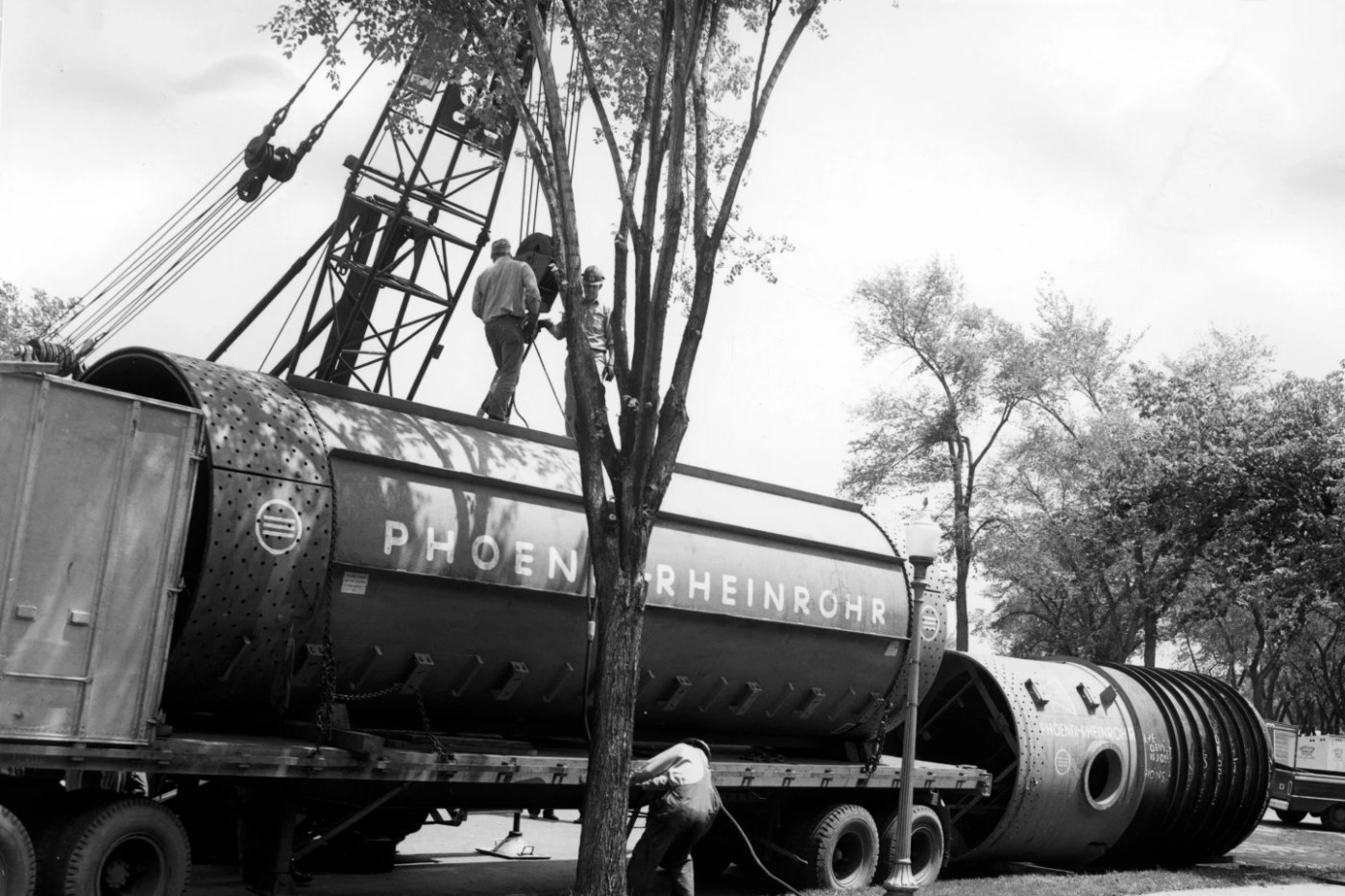
DULUTH — The Space Tower has been a well known Minnesota State Fair landmark for 60 years now. Less well known is that the components of the 330-foot tower made a stop in Duluth en route to the Fairgrounds.
The attraction’s website mentions that “the parts were manufactured in Germany and shipped to the U.S. … arriving in Duluth.”
The Space Tower was erected in 1965, at the height of the world’s space craze.
“The space age influence will be noticeable elsewhere on the grounds also,” reported the Fargo Forum in August 1965. “A 103-foot Titan II missile will be on display, and there will be color motion pictures of astronaut Ed White’s historic ‘walk in space.’”
A group of investors — “essentially the same group” that built the fair’s Skyride in 1964, reported The Globe of Worthington, Minnesota — brought the Space Tower to Minnesota. It was purchased from a subsidiary of the same Swiss company that built the Skyride.
The cost was variously reported at $345,000-$400,000, or about $3.5 million-$4 million in today’s dollars. At the time, only a handful of buildings in the Twin Cities were taller, and the State Fair bragged it was building “the tallest cylindrical tube mast in the region.”
Ben Kantor, whose family has owned and operated the Space Tower since 1982, said he never knew much about the attraction’s Duluth history.
“I’ve only heard that they came through Duluth, and we have a couple of pictures of it being built, but that’s about it,” Kantor told the Duluth News Tribune in a July 2025 interview.
Kantor pointed out that an identical tower, the Space Spiral at Cedar Point amusement park in Ohio, was demolished in 2012. “The bottom of ours says ‘Cedar Point,’ and theirs said ‘Minnesota State Fair,’” said Kantor. “We got theirs; they got ours. I don’t know why.”
International cargo
State Fair archivist Keri Huber did not have much more information about the tower’s transit through Duluth, but she pointed to a contemporary newspaper account that corroborated the story.
“The tower was built in Germany, shipped by boat from Rotterdam, The Netherlands, to Duluth, Minn., and then transported to St. Paul on 20 semi-trailer trucks,” reported the Minneapolis Tribune on Aug. 6, 1965.
The Space Tower under construction in 1965 at the Minnesota State Fair in Falcon Heights. (Courtesy of the Minnesota State Fair)
Jayson Hron, director of communication and marketing for the the Duluth Seaway Port Authority, provided more information from the September 1965 issue of the Port Authority’s magazine.
A headline read: “330-foot State Fair Space Tower travels from Switzerland via Duluth.”
“The tower was shipped to the Port of Duluth, and assembled at the fair grounds,” the magazine reported.
Hron also found a mention of the unusual cargo in the Duluth News Tribune’s “Port Beams” column on July 4, 1965. There was no photograph, but there was a ship name, the Francisca Sartori.
“The space needle was part of more than 3.6 million tons of international cargo that passed through the Port of Duluth-Superior in 1965 — then a record high in what was Year 7 of the St. Lawrence Seaway Era,” Hron wrote in an email to the Duluth News Tribune. “Nearly 200,000 tons of ‘general cargo’ moved through the Clure Terminal in 1965 — also a record high at that time.”
Another Duluth connection
One more connection among the St. Lawrence Seaway, Duluth and the Space Tower:
Fairgrounds regulars are familiar with the pioneer woman statue that now stands near the Ramberg Center. That statue was built in 1958 to celebrate the state’s centennial, and originally stood on the piece of land that is today occupied by the Space Tower.
The pioneer woman was not moved to make way for the Space Tower, though. She was moved in 1959 to make way for a new statue by the same sculptor, Norman Anderson. The Fair had decided to commission a new sculpture each year to recognize “a significant current event or dramatic phase of state history.”
What constituted a “significant current event” in 1959? It was the opening of the St. Lawrence Seaway. “A delegation of Duluthians” traveled to the Fairgrounds, the News Tribune reported, for the dedication of a Neptune statue celebrating the debut of Duluth as Minnesota’s world port.
A 1959 map of the Minnesota State Fairgrounds in Falcon Heights highlights a statue of King Neptune, lower right, on the site that would later become home to the Space Tower. (Courtesy of the Minnesota State Fair)
Related Articles
Review: Minnesota State Fairgrounds hosts a high-energy hip-hop fest once again
So much fruit, so little beer-flavored beer. The Minnesota State Fair’s 2025 new beverages, reviewed
State Fair Grandstand review: Meghan Trainor hosts an enjoyable dance party sans band
Minnesota State Fair weather forecast: ‘Sunny and perfect’
The good, the bad and the questionable: The 2025 new Minnesota State Fair foods, ranked
Unlike with the pioneer woman, though, the State Fair did not keep Neptune: He was donated to Duluth, where he stood on the north side of the Duluth Ship Canal until 1963. That year, city crews attempting to repair the weather-beaten statue — sheathed in fiberglass, plastic and papier-mache — accidentally set it ablaze.
Conventional wisdom about the conflagration has it that the statue was flimsy, its demise inevitable. Perhaps so, but Anderson’s pioneer woman continues to stand on the State Fairgrounds, and a Smokey Bear sculpture by the same artist remains on display in International Falls. Maybe the Lake Superior shore, ironically, just wasn’t the right spot for Neptune.
Regardless, the trident-bearing figure was long gone by the time the Francisca Sartori arrived from Europe, bearing the Space Tower that would be erected in Neptune’s former kingdom at the corner where Cooper meets Cosgrove.


More Stories
US court rules against Pentagon in killer AI dispute
The Department of War had ordered contractors to drop Anthropic after it refused to allow military use of its technology...
Which Interior Flooring is Best?
Where do you start when choosing new flooring? When shopping for new flooring a good place to start is to...
Petrol set to top £1.50 a litre as Iran war drives fuel price surge
UK drivers are bracing for a sharp rise in fuel costs, with petrol prices expected to exceed £1.50 per litre...
Dyson hit by £440m sales drop as Trump tariffs bite
Dyson has reported a £440 million drop in annual sales after being hit by US trade tariffs, although the group...
Octopus Investments to cut 20% of staff as AI reshapes asset management
Octopus Investments is set to cut around a fifth of its workforce as it accelerates the adoption of artificial intelligence,...
Next to invest £300m in UK logistics as new warehouse set to deliver £2.5bn boost
Next has unveiled a major expansion of its UK logistics network, committing more than £300 million to new warehouse infrastructure...