
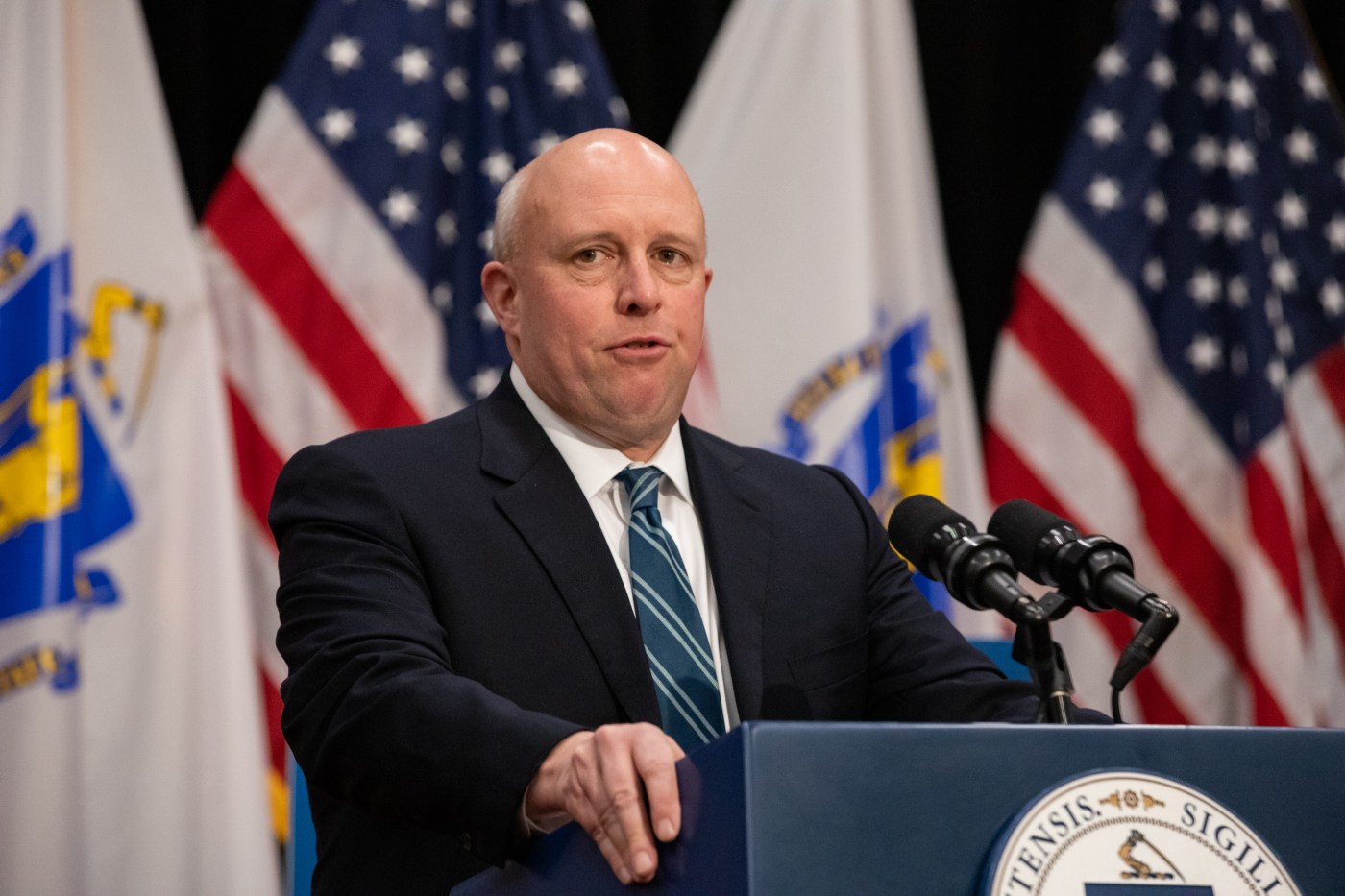
Mass. Republicans, Democrats slam Mike Kennealy for his oversight of state-run shelters

Mike Kennealy, a Republican running for governor, drew criticism Wednesday from Massachusetts conservatives and Democrats for his oversight of state-funded emergency family shelters during his time as a cabinet secretary under former Gov. Charlie Baker.
Kennealy’s Republican primary opponent and the Massachusetts Democratic Party slammed Kennealy for not recommending any major reforms to the state-run shelter system in a transition document he handed Gov. Maura Healey in 2022 shortly before she assumed office.
Democratic Party Chair Steve Kerrigan said Kennealy, who served as housing and economic development secretary for four years under Baker, “admits that he saw the number of shelter residents start to increase in June of his final year, but did nothing to change the system.”
“His only solution was to increase spending by millions of dollars and send people into costly hotels,” Kerrigan said in a statement. “Now that his candidacy is sinking, Mike Kennealy says the only time he recommended making changes to the right-to-shelter law was in a private meeting (with Healey). That’s a lie.”
Brian Shortsleeve, Kennealy’s rival for the GOP nomination for governor said through a spokesperson that Kennealy did “not urge reforms” in the transition document and instead requested more money to pay for housing and benefits.
“It was Kennealy’s playbook that Maura Healey picked up and ran with, ultimately costing taxpayers billions of dollars and counting,” said Holly Robichaud, Shortsleeve’s political strategist.
Kennealy offered a written warning to Healey about a surge of migrants to Massachusetts and dwindling shelter capacity in the November 2022 transition document. The heads-up largely focused on the need to expand shelter capacity and provide more funding to the system.
The Lexington native and one of his top lieutenants did not offer any recommendations to further prepare Massachusetts for the sharp spike in demand for emergency assistance shelter that would follow months later in Healey’s first year as governor.
But the document did provide a clear signal to Healey that the program set up under the state’s 1980s-era right-to-shelter law was under strain.
“More recently, starting in June 2022, there was a significant surge in new asylum-seekers, refugees, and immigrants seeking (emergency assistance) shelter, many of whom have presented as in need of assistance at Boston Medical Center,” the document said, according to a copy obtained by the Herald.
In a Nov. 9, 2022 memo included in the transition document, former Housing and Community Development Undersecretary Jennifer Maddox said the increase in demand might require “additional funding” to expand the system.
Responding to the criticism Tuesday, Kennealy said Healey is “scrambling to deflect blame for her disastrous handling of the migrant crisis,” while Brian Shortlseeve, a venture capitalist and former MBTA official who is also running for governor as a Republican, made a “bizarre decision to echo the governor’s deflection.”
“Brian Shortsleeve is now parroting Healey’s talking points in a desperate attempt to cling to relevance. The simple truth is that Gov. Healey was warned by me, and others of a growing migrant crisis — she ignored the warnings and Massachusetts families paid the price,” Kennealy said in a statement to the Herald.
Kennealy previously claimed that he personally warned Healey about the increase in migrant arrivals and recommended that the incoming Healey administration address the right-to-shelter law during a private, in-person meeting in November 2022.
Kerrigan said voters know that claim is “a lie because he had four years to change — or even propose changes to — the right to shelter law, and he didn’t do a thing.”
“He’s a failing candidate covering up a failed record,” Kerrigan said.
A source familiar with Healey’s transition discussions previously told the Herald in May that Kennealy’s advice to Healey focused only on increased funding to support expanded shelter capacity and the state’s right-to-shelter law “were never mentioned.”

More Stories
Middle East war triggering global energy ‘shock’ – IMF
Disruptions to oil and gas supplies will leave lasting “scars” on the world economy, managing director Kristalina Georgieva has said...
What is fueling unrest across the EU?
The bloc is facing an energy crisis due to the Strait of Hormuz disruption, with soaring diesel prices triggering protests...
OECD urges reeves to overhaul ‘inefficient’ UK tax system
Rachel Reeves has been told by one of the world’s most influential economic bodies that Britain’s tax system is holding...
Easter lifts footfall but retailers brace for April cost squeeze
Britain’s high streets enjoyed a welcome lift last month as an early Easter drew shoppers back through the doors, but...
Google takes on Opentable with AI that books your dinner in seconds
Google has fired the opening shot in a battle for Britain’s restaurant booking market, rolling out an artificial intelligence tool...
Retail backers of SEIT face wiping out half their money as green trust raises the white flag
Thousands of small investors who piled into one of London’s best-known green investment vehicles are staring down the barrel of...