
Party pooper: Voter enrollment of Democrats, Republicans decline in Massachusetts as independents rise

The Bay State has always had an independent streak, and the numbers back it up.
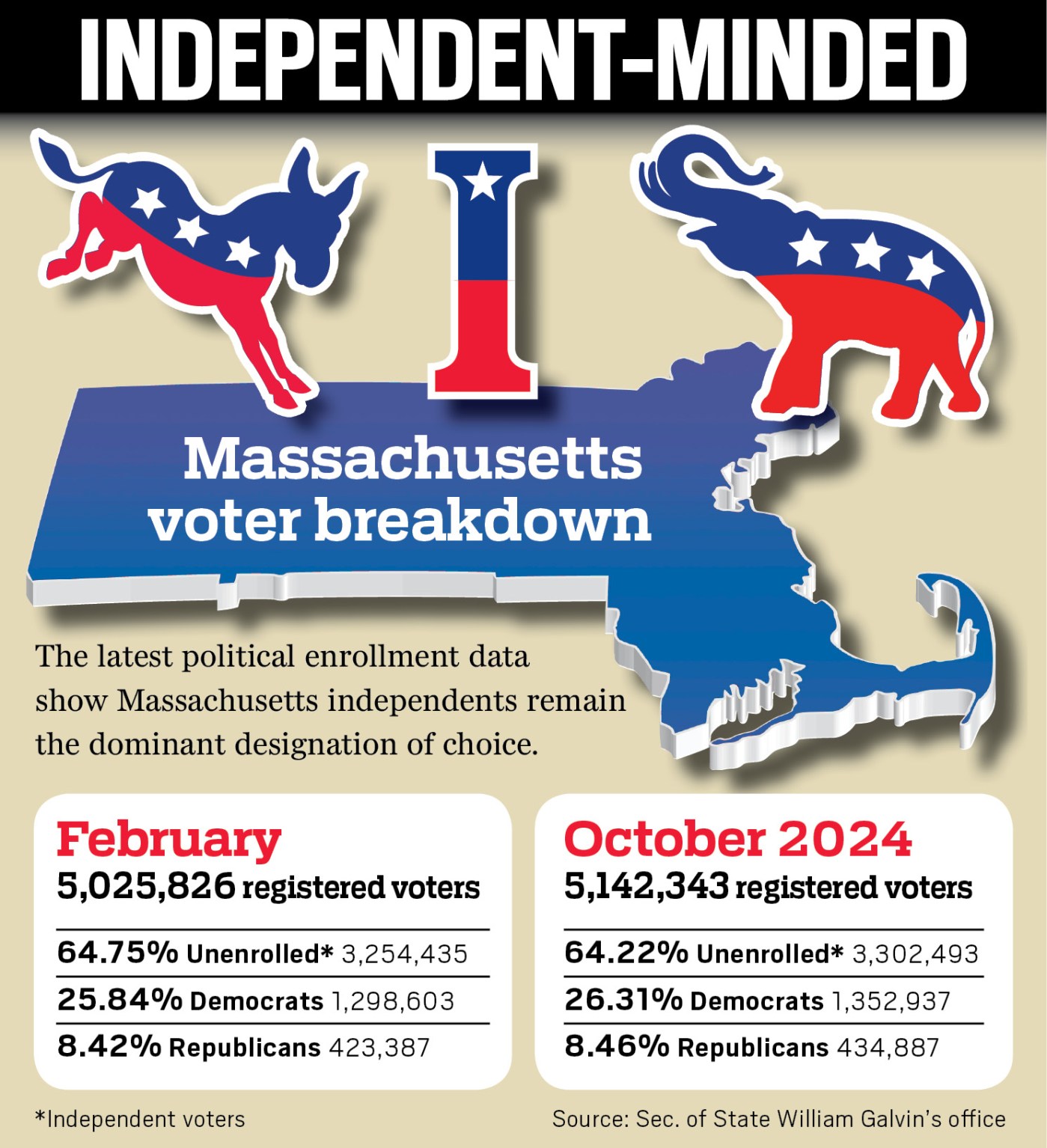
Voter registration in Massachusetts is down by about 2.2% since the 2024 presidential election, with both major political parties taking hits to their rolls, according to registration data released by the Secretary of State’s office.
However, the “unenrolled ” — or independents — now make up an even larger portion of the electorate, at 64.75%.
As of this month, registered Democrats accounted for 25.84% of the electorate, or 1,298,603 registered party members, a drop of 54,334 voters.
Republicans counted 8.42% of the state’s registered voters on their rolls, or 423,287 party members, a drop of 11,600 voters.
The state’s unenrolled voters — a total of 3,254,435 — slipped from October by 48,058 non-party affiliated voters.
Back on October 26, a little bit more than a week before November’s election, there were 5,142,343 registered voters in the Bay State, according to Secretary of State Bill Galvin’s office. As of February, that number has dropped by 116,517 to 5,025,826 registered voters.
It’s not unusual for the voter rolls to shrink after an election, Galvin’s spokesperson told the Herald, and similar declines in registration were seen each February in “2015, 2017, 2019, 2021, and 2023.”
“Federal law requires us to keep inactive voters on the rolls for a period spanning two federal elections. Inactive voters who haven’t voted in that three to four year period, or confirmed their residence in any other way during that time, will be removed from the rolls. Most of these removed voters have likely moved but haven’t registered at their new address,” Deb O’Malley, Galvin’s communications director, said in an email.
Voters who leave the state and register to vote in another, according to O’Malley, would also come off the Bay State’s rolls at some point after the election.
Still, there is no denying the fact that both the Republican and Democratic share of the electorate has declined, while the block made up of unenrolled voters has grown.
In October, unenrolled voters, sometimes referred to as independents, made up the majority of the electorate at 64.22% or 3,302,493 registered voters. Democrats accounted for 26.31% of registered voters, with 1,352,937 party members, while Republicans accounted for just 8.46%, with 434,887 party members.
Those who list their registration as one of the state’s many authorized “political designations” — among which you’ll find Green-Rainbow, Pirate, Pizza Party, and Socialist designations — made up 0.69% of the electorate in October, with 35,559 voters registered in this fashion, while Libertarians accounted for 0.32%, or 16,467 voters.
According to Galvin’s office, the Libertarian Party did not field enough registered voters to maintain party status through February.
“Party status is maintained by either registering 1% of voters in the party (which has only ever happened for the Democrats and Republicans) or by running a statewide candidate who gets at least 3% of the vote. This is why you see the Libertarian and Green-Rainbow Parties get added and removed from statistics over the years,” O’Malley explained.
All voters previously registered as Libertarians are still registered to vote, O’Malley said, but their registrations were changed to “political designation.” As of February, about 0.98% of voters, or 49,401, fall under that category.
MassDems Chair Steve Kerrigan said that he’s never happy to hear that the number of registered Democrats has declined, but that the real proof of how well the party is doing is found in election outcomes. By that measure, he said, the party is doing as well as ever.
“What we look at in Massachusetts is, not necessarily how people register, but how they vote,” Kerrigan told the Herald. “Just in the last couple of cycles: in 2022, we took back the governor’s office, in ‘24 Sen. Warren bulldozed over her Republican opponent with an impressive victory. We returned our entire Congressional delegation to Washington and maintained our super majorities in both the House and the Senate on Beacon Hill.”
That’s not to say Democrats are resting on their laurels, the party chair said. Registration efforts are ongoing and continuous. The party is “always concerned” when voters choose not to sign up and remain unenrolled, he said, but politics is not scored by the number of registered party members.
“It’s how they vote on election day and in particular elections. That really is what we’re charting, and I think the Democratic Party in Massachusetts has shown, time and again, that they’re able to win elections because we have the right values and the right candidates,” he said.
A spokesperson for the MassGOP did not return a request for comment by press time.
MassGOP Chair Amy Carnevale, commenting Wednesday on lawmakers thwarting a voter-approved audit of the state Legislature, said “the Massachusetts Democratic supermajority has a long history of backroom deals and unchecked power.”
Secretary of State William Galvin (Photo By Matt Stone/Boston Herald, File)
More Stories
Massachusetts bill would give workers a heads up before ICE audits
A bill is making its way through the Massachusetts State House that would require employers to notify workers ahead of...
Bruins will be missing Tanner Jeannot against Sabres
The Bruins’ five-game road trip did not get off to the smoothest start. The team flight was delayed leaving Boston...
Coming storm could bring 5 to 8 inches of snow, high winds and ice
Another snowstorm is on its way. The Twin Cities are expected to see rain early Sunday morning turn to a...
Gophers expected to hire Stanford assistant Bobby April as rush ends coach
The Gophers football program is expected to hire Stanford defensive coordinator Bobby April III to be the U’s new rush...
Charley Walters: Craig Leipold could be a controlling owner Twins fans love
Don’t underestimate the chance that Wild owner Craig Leipold and his family, once Major League Baseball settles on a new...
Working Strategies: Resolve to create an efficient job search for new year
Amy Lindgren The new year is here, with all its excitement and hoopla. And possibly dread if you’re engaged in...