
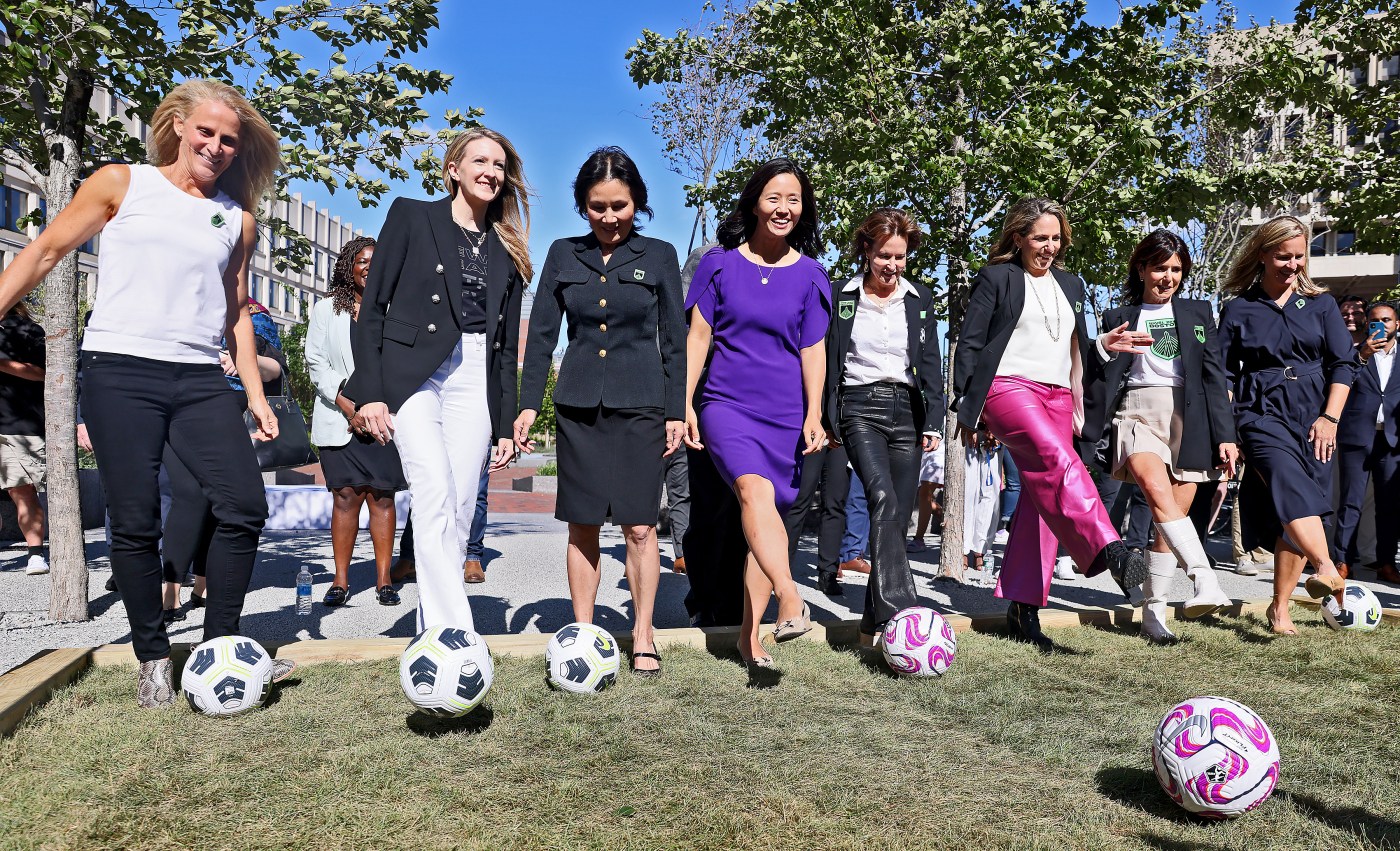
Big-money soccer investors, including Boston Globe’s Linda Henry, bank on $100M from city taxpayers

Opponents of Boston’s public-private plan to rehab Franklin Park’s White Stadium for a new professional women’s soccer team have often knocked the project as a giveaway to “millionaire investors” on the backs of city taxpayers.
Boston taxpayers are already on the hook for “roughly $100 million” for the city’s half of a more than $200 million plan that’s doubled in cost in recent weeks. The issue has crept into the mayoral race, with declared candidate Josh Kraft calling for a pause on the project that’s been championed by Mayor Michelle Wu.
The hefty price tag, along with the Wu administration’s admissions that the city taxpayer tab may climb even higher with further cost overruns, has raised questions about who stands to benefit most from the project.
Who benefits?
Whether it’s a group of wealthy investors at Boston Unity Soccer Partners, the ownership group behind the push to bring in a new National Women’s Soccer League team, or Boston Public School student-athletes, who will share use of the renovated White Stadium with the new pro team, depends on who you ask.
“Boston taxpayers are being asked to write a blank check for the benefit of BOS Nation’s millionaire investors, with no limit to how much this bloated project could ultimately cost us,” Dorchester resident Jessica Spruill said in a December statement. “It’s becoming clearer every day that this deal is a massive giveaway to wealthy private investors, and Boston residents are paying the price.”
Mayor Wu, on the other hand, has pointed to what she sees as the need for a private investment to help the city fund long-needed renovations for the dilapidated 75-year-old White Stadium in Franklin Park.
“The renovation of White Stadium is the largest investment in BPS athletics since the stadium first opened in 1949, one that will transform the facilities and opportunities for Boston Public School students, Franklin Park lovers, and all community members,” Wu wrote in a letter to the City Council after it deadlocked last month on a vote to halt demolition work at the stadium.
“The new White Stadium complex will anchor youth sports in Boston with students making daily use of state-of-the-art facilities for multiple sports,” Wu said.
Who are the private investors?
Much of the opposition has been buoyed by the healthy financial standing, and in at least one case, billionaire status, of the investors behind the new pro women’s team.
Here’s a look at some of the investors behind the White Stadium plan.
Boston Unity Soccer Partners initially consisted of four core investors, Jennifer Epstein, Stephanie Connaughton, Ami Kuan Danoff, and Anna Palmer.
Other investors who later bought into the team include Aly Raisman, a U.S. Olympic champion gymnast; Elizabeth Banks, a Hollywood actress, director and producer; Brad Stevens, general manager of the Boston Celtics, and his wife Tracy; and Linda Pizzuti Henry, CEO of the Boston Globe and wife of the billionaire Red Sox owner John Henry, who also owns the Globe.
Epstein, controlling manager of the new pro women’s team, is the daughter of Boston Celtics co-owner Robert Epstein.
She is also the founder of Juno Equity, a fund backing women-led companies, the co-founder of Wildlife Hospitality, and a trustee for the Institute of Contemporary Art, according to her biography on Boston Unity’s website.
Connaughton is a “strategic marketer, innovator and brand builder,” having led the creation of more than seven brands, including Gillette Venus. Her biography on the site also states that she invented a yoga mat and that her family is part of the investor/founder group of the Boston Celtics.
Her husband is John Connaughton, a member of the Celtics investor group and board member, and co-managing partner of Bain Capital, a global private investment firm.
Danoff is a “philanthropic innovator and tech investor” who co-founded the Women’s Foundation of Boston. She is also the lead funder of Raxia, an AI-powered platform for revenue cycle management, and a former Putnam portfolio manager and Fidelity equity analyst, according to her BUSP bio.
Palmer is an entrepreneur who invested in early-stage companies as a general partner at Flybridge Capital and co-founded XFactor Ventures, “one of the most active seed funds backing female entrepreneurs,” her biography states.
The investment group includes at least one billionaire by marriage, Linda Pizzuti Henry, co-owner and CEO of the Boston Globe and a partner at Fenway Sports Group, which is owned by her husband.
Her husband John Henry’s net worth is listed by Forbes at $6 billion. John Henry owns the Boston Globe, Boston Red Sox, Liverpool Football Club, Pittsburgh Penguins and is a co-owner of RFK Racing.
While declining to provide a complete list of investors, a spokesperson for Boston Unity confirmed the names of those nine investors and also directed the Herald to a July 2024 Boston Globe op-ed written by four other investors, Herby Duverné, Juan Fernando Lopera, Frederick Lowery and Linda Whitlock.
Battle lines
The project is the subject of a lawsuit filed by neighbors and a conservancy group that contends the proposed use would illegally privatize public trust land.
The mayor has denied the privatization claim, saying the city and BPS would maintain ownership of the facility through a lease agreement and that use would be shared between the new pro team and BPS student-athletes.
Also at issue is that taxpayers in Boston are being asked to fund half of a new professional stadium while a larger pro soccer stadium for the New England Revolution would be 100% privately funded by the Kraft Group in nearby Everett.
Proponents say, however, that there’s a difference between the two projects. The Kraft Group pitched its privately-funded plan to redevelop blighted land, while White Stadium is a City of Boston-led project that included a public bid process.
Critics have pushed for White Stadium to be renovated as a high-school-only facility and for the new pro team to share use of the future Everett stadium, saying that the pro women’s soccer schedule would largely displace BPS football teams.
Boston Unity, when asked why taxpayers should be burdened given the wealth of its investors, said it’s covering its fair share of the more than $200 million renovation, arguing that it’s pitching in more than half the costs for the least amount of stadium usage.
“Our investment to revitalize White Stadium is a commitment to Franklin Park’s future, bringing long-overdue support to uplift communities that have experienced years of underinvestment,” a Boston Unity spokesperson said in a statement.
“We are covering more than half the costs to restore this city and BPS-owned facility while reserving the vast majority of White Stadium’s use for BPS students and community programs, with our team’s activities accounting for less than 5% of total stadium usage.”
“Through our partnership,” the statement continued, “the city will see nearly a quarter of a billion dollars in projected investment in these historically underserved neighborhoods — driven by BUSP’s construction funding, operational and maintenance support, community contributions, rent, and millions of dollars directed to minority- and women-owned businesses through supplier-diversity commitments.”
Demolition work began last month at White Stadium, and the new pro women’s team is expected to take the pitch in March 2026. A trial for the pending lawsuit that seeks to stop the project is set for March 18.
Related Articles
Boston hits ‘major milestone’ in controversial White Stadium rehab, with $25M escrow construction deposit
‘Huge win’: Opponents of Boston’s White Stadium plan protest demolition, buoyed by deadlocked City Council vote
Boston City Council deadlocks on call to halt White Stadium demolition
Boston taxpayer tab for controversial White Stadium rehab grows again to $100M
Rehabilitation work has started on Franklin Park’s White Stadium. (Matt Stone/Boston Herald)
LOS ANGELES, CA – OCTOBER 28: Red Sox ownership Tom Werner, John Henery and Linda Pizzuti Henry during the eighth inning of Game 5 of the World Series against the LA Dodgers at Dodger Stadium on October 28, 2018 in Los Angeles, California. (Staff Photo By Matt Stone/ Boston Herald)
Activists hold a rally protesting ongoing demolition of White Stadium and the plans to build a professional soccer stadium on the site.(Nancy Lane/Boston Herald)
White Stadium destruction, as seen on Saturday, Feb. 15, has started. (Stuart Cahill/Boston Herald)
White Stadium project trailer. (Stuart Cahill/Boston Herald)
White Stadium is undergoing a makeover as an appeal is still in the courts. (Stuart Cahill/Boston Herald)


More Stories
Golden Pharaoh Casino UK Review: Bonuses, Games & Safety
Golden Pharaoh leans hard into the “ancient treasure vault” vibe — but under the gold plating it’s basically a modern...
Humanoid robot market tipped to reach $9tn as China leads global adoption
The global market for humanoid robots could be worth as much as $9 trillion by 2050, with China expected to...
Dua Lipa and Shania Twain help Glastonbury lift profits and boost charity funding
Glastonbury Festival has reported a rise in profits after a strong year that featured performances from global stars including Dua...
Dear Abby: Party host spills the boozy beans to kids
Dear Abby: While attending a friend’s family barbecue, “Willa,” a young mother of four, drank too much and became ill....
F.D. Flam: The microplastics problem isn’t necessarily in your brain
In the realm of horror, it was hard to beat the headlines last February that you were carrying around the...
Robert Cropf: America’s unnamed crisis
I first encountered Leszek Kołakowski, the Polish political thinker, as an undergraduate. It was he who warned of “an all-encompassing...