
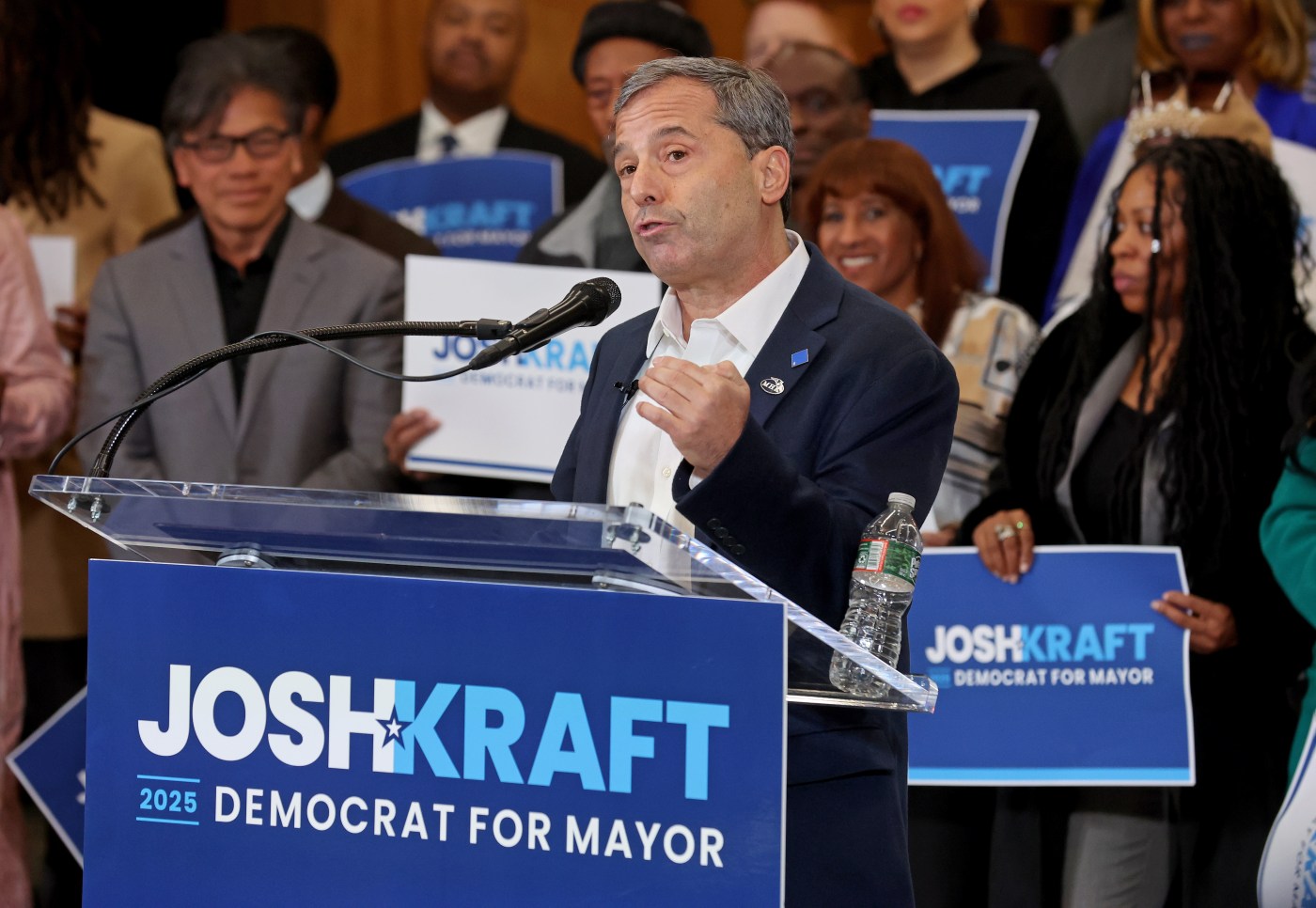
Boston mayoral candidate Josh Kraft unveils plan to increase housing affordability, outlines optional rent control proposal

Boston mayoral candidate Josh Kraft unveiled a plan today that he says would improve housing access and affordability for more residents by jumpstarting stalled construction, and incentivizing landlords to opt into a rent control program.
In releasing his plan, Kraft took aim at his opponent Mayor Michelle Wu’s “housing failures” and policies that he says have hindered the production of new units that would be considered affordable to middle-class residents and families.
“On the number one challenge facing our residents — access to housing that regular people can afford — production under Mayor Wu has ground to a halt,” Kraft, 57, said in a statement. “Having so many permitted projects continue to sit on the shelf generates no new housing, no new jobs, and no new tax revenue.
“My plan will change that,” he vowed on Wednesday.
Kraft also said he would implement what his campaign is calling an “achievable version of rent relief,” by way of an opt-in rent control program that he says would not require approval by state lawmakers on Beacon Hill.
“Mayor Wu promised us rent control three years ago, but quickly abandoned the effort,” Kraft said. “I won’t do that. My plan is completely voluntary, would benefit both tenants and building owners, and would not require approval from the state Legislature.
“Renters deserve to be protected from massive year-over-year increases and my plan will do that,” he said.
Kraft, a son of the billionaire New England Patriots owner Robert Kraft and president of the family’s philanthropic arm, the New England Patriots Foundation, formally announced his bid for mayor of Boston last week.
In his announcement speech, Kraft said that housing would be a top priority for him if he were to be elected mayor and briefly spoke on his intention to pursue a rent control program, but didn’t offer up many specifics until Wednesday.
According to Kraft’s campaign, there are more than 26,000 housing units that have been permitted through the community and city process and ready for construction, but are not financially viable under the Wu administration’s mandates.
In addition to creating jobs and housing units, Kraft’s campaign said that completing that construction would generate an estimated $100 million to $125 million in new tax revenue annually.
Kraft’s plan to jumpstart production of those units involves reverting back to the inclusionary development policy that was in place under the former Mayor Marty Walsh administration, and nix the updates that have been added by the Wu administration.
As of October 2024, the city’s inclusionary zoning policy requires market-rate housing developments with at least seven units to set aside 17% to 20% of those units as income-restricted, the city website states.
Kraft is seeking to revert back to the prior policy, which triggers the inclusionary requirement for buildings with 10 or more units, and includes a lower percentage of required income-restricted units, at 13%, his campaign said.
He is also looking to increase the number of residents who would qualify for income-restricted units, “to include working-class residents,” by requiring one-third of units apiece at 60%, 90% and 120% of area median income.
Kraft envisions that approach would give middle-class residents more access to affordable housing options, and jumpstart the production of stalled units.
Robert Nichols, founder of MIG, a Boston-based real estate firm that specializes in the urban market, said he’s reviewed Kraft’s housing plan and favors the changes the candidate is seeking to make to the city’s inclusionary development policy.
“I’m a lender and a developer, and the inclusionary zoning that was implemented this past October has made it really hard for not only developers to justify projects in the city of more than six units,” Nichols said, “but more importantly, it’s robbing people of generational wealth — and I think it’s an unintended effect of the policy, but it’s a real effect that I’ve seen it firsthand.”
Kraft’s plan also involves the first particulars he’s offered up about his intention to implement an opt-in rent control program, if elected mayor.
He said keeping the program optional would eliminate the need for approval on Beacon Hill, where Wu’s mandatory rent control legislation has stalled.
Under his plan, the city would offer landlords the opportunity to cap their rents at the Consumer Price Index plus 5%, not to exceed 10% per year.
In exchange for a 10-year commitment to cap rents, the city would offer landlords a 20% return on their real estate taxes, Kraft’s campaign said.
The proposal, his campaign said, would target workforce housing and middle-class renters. Only renters earning below 200% of the area median income would be allowed to participate in a rent control program.
Kraft would also create a city registry of all the units participating in such a program, “so that prospective tenants can contact owners directly and avoid costly broker fees,” his campaign said.
After a tenant moves out of a rent-controlled unit, the landlord would be allowed to adjust rents to match market-rate value.
The program would be available to new developments and buildings under six units, including triple deckers.
A portion of the $100 million to $120 million in annual tax revenue from jumpstarting the construction of 26,000 permitted but stalled units would be used to fund the 20% reduction in property taxes for building owners.
Another portion of that unrealized tax revenue would be dedicated to an affordable housing fund available to Boston residents to assist with buying their first home, Kraft’s campaign said.
Chris Lehman, co-founder of and a policy architect at Groma, a tech-enabled operator of small multifamily residential real estate in the Boston area, said he opposed Wu’s “chilling” mandatory rent control proposal but his company would likely opt the majority of its properties into Kraft’s more landlord-friendly plan.
His company has done modeling that has found it would break even financially with Kraft’s rent control plan, and favors the positive impacts he sees it as having on renters and the city broadly.
Related Articles
Indicted Boston City Councilor Tania Fernandes Anderson scrambles to avoid state campaign finance law violation
Boston hits ‘major milestone’ in controversial White Stadium rehab, with $25M escrow construction deposit
Round 3: Boston City Council set to vote on Mayor Wu’s tax shift legislation Wednesday
Ex-city councilor Michael Flaherty to receive $253K severance after dismissal from Boston Water and Sewer
Pols & Politics: Michelle Wu, Josh Kraft make moves as race for Boston mayor kicks off
Lehman described Wu’s plan, on the other hand, as a “totally misguided way to approach the problem of housing affordability.”
“The fundamental driver of the high cost of housing is the lack of supply of housing,” Lehman said. “We’re not building enough housing to meet the demand, which is extremely high … Because mandatory rent control kills the appetite for investment in Boston, it actually harms affordability in the long run, by further suppressing supply even relative to the status quo.”
Speaking specifically to Kraft’s criticism over her policies hindering housing affordability and production, Wu, 40, said last week that during her first term as mayor, “We have seen more affordable housing created than in a generation.”
“We’ve been pushing everything possible to make sure that the cost of housing comes down in Boston and that we’re focusing on affordability,” Wu said, adding that her rent control plan has been met with “roadblocks” at the state level.


More Stories
Japan’s Cabinet OKs record defense budget that aims to deter China
By MARI YAMAGUCHI, Associated Press TOKYO (AP) — Japan’s Cabinet on Friday approved a record defense budget plan exceeding 9...
Japan’s Cabinet OKs record defense budget that aims to deter China
By MARI YAMAGUCHI, Associated Press TOKYO (AP) — Japan’s Cabinet on Friday approved a record defense budget plan exceeding 9...
St. Thomas men’s basketball: Nonconference scheduling isn’t easy for DI mid-majors
As of Friday, St. Thomas was the 116th-ranked program in all of Division-I men’s basketball, per the NCAA’s NET Rankings....
Britons getting poorer – report
The UK’s growth in GDP per capita is set to trail most G7 nations, a think tank’s analysis shows High...
More thrifting and fewer returns, the early trends that defined shopping this holiday
By ANNE D’INNOCENZIO, Associated Press Retail Writer NEW YORK (AP) — The shopping rush leading up to Christmas is over...
More thrifting and fewer returns, the early trends that defined shopping this holiday
By ANNE D’INNOCENZIO, Associated Press Retail Writer NEW YORK (AP) — The shopping rush leading up to Christmas is over...