
Pioneer Press readers explore gorgeous, opulent French Riviera

I always thought there were two types of overseas vacations: An adventure, or a beach vacation.
In the former, which I prefer, you get to know a place and its history, preferably on foot. In the latter, you relax on a beach, drink vacation drinks and float in the ocean.
I’m here to tell you that it’s possible to have both — which I discovered recently on a trip to the French Riviera with more than 30 Pioneer Press readers.
Our tour group stayed in Nice, France, for the entirety of the trip, with short motorcoach trips to other places in the region. There was plenty of history, culinary adventures and walking — but also a gorgeous beach on the impossibly blue Mediterranean Sea (the region is known as Côte d’Azur, or blue coast, in French) and lots of free time to enjoy it.
Here’s what we did during the tour, which took place in mid-October.
Arrival
Place Massena in Nice, France. (Courtesy of Mick Richards)
After a long flight that was delayed slightly, we had just a few minutes to freshen up in our rooms in the pretty and conveniently located Hotel Massena before walking to dinner.
We first passed through Place Massena, a gorgeous, black-and-white tiled plaza, peppered with human-figure statues on tall poles designed by the Spanish artist Jaume Plensa. Those statues light up at night, which is not only whimsical but helpful to a tired traveler trying to find their way in the busy city.
During our walk to the restaurant in Vieux Nice, the old part of the city, our lively, knowledgeable tour manager Petra Oomen explained that it’s hard to get lost in this part of the city, despite the narrow, winding streets, because it’s not that large, and you’ll eventually run into either the ocean, the very steep hill going up to Castle Hill (more on that later) or Promenade du Paillon, the park built over the Paillon River, which still flows beneath it. We tested her theory repeatedly, and though we sometimes took a wrong turn, we always found our way keeping those tips in mind.
After a tasty dinner of Nicoise salad and tender beef in a creamy sauce (and bread — so much delicious, crusty bread everywhere in France), it was off to bed.
Vieux Nice
We split into two groups in the morning to take a walking tour of the old city. We wandered through the famous flower market, which also includes handcrafted soaps, lots of vegetables, cheeses, cured meats and more. As we wandered, we tasted some local delicacies, including brightly flavored, melt-in-your-mouth macarons; some gelato that wasn’t quite as good as I’ve had in neighboring Italy; and socca, which is a fried flatbread of sorts, made from chickpea flour. We also tried the local onion, anchovy and olive tart, pissaladière.
Aperol Spritzes on the Mediterranean Sea in Nice, France. (Jess Fleming / Pioneer Press)
After so much talk of Castle Hill, the medieval fortress built on the highest point in the area, we decided to make the climb during our free time. We took a roundabout way to get there, but after asking some locals which way to go, we found the entrance and climbed and climbed — about 300 stairs worth of uphill. It was a hot, humid day, but the workout turned out to be worth every drop of sweat. The first wonder we happened across was a giant, artificial waterfall, built at the end of the 19th century. A further climb led us to the top of the hill, which affords magnificent views of the coastline below. The entire area has been turned into a popular park, with several cafes, a playground and multiple places to view the promenade, the harbor side of the hill and the entire city. Though the castle itself was destroyed in 1706, ruins are being excavated by archaeologists in the middle of the park.
There is allegedly an elevator that takes visitors to the top, but we never found it. Later, we heard it was out of service anyway.
After our descent, we walked the promenade along the beach and wandered down to one of the beachside restaurants for an Aperol Spritz. The beach was crawling with people sunning themselves and swimming in the sea, which never drops below 55 Fahrenheit.
Monaco and an unforgettable dinner
Before this trip, I knew very little about the country of Monaco, but I was instantly fascinated by its story, as told by Petra, who gave us the history, but also the “gossip” about the very wealthy royal family.
Monaco is less than a square mile in area, making it the second-smallest country in the world, behind Vatican City. It’s also considered the wealthiest country in the world, with a GDP per capita of $234,317. With no personal income taxes for residents and low business taxes, it’s well-known as a tax haven for the uber-rich. In fact, 30% of its residents are millionaires.
Related Articles
Don’t pre-tip on delivery? Don’t expect your food quickly, DoorDash warns
Lettuce introduce you to this controversial style of burrito beloved in Chicago
Recipe: Make this seafood chowder with fingerling potatoes
As kitchen store and school Cooks | Bellecour celebrates 50 years, owners reflect on how they ‘have to change to stay the same’
Gretchen’s table: Mummy baked brie with homemade cranberry jam
With all that money comes opulent buildings, high-end shopping and almost constant construction. With no way to build out — there is some land reclamation going on, but not enough to meet demand — the only way to go is up.
We took a little open-air train around the country, marveling at the shops, gorgeous architecture and perfectly manicured gardens, before ending up near the palace, where we would catch the daily changing of the guard ceremony. After, we took an optional tour of the palace, which predictably contains priceless artifacts and artworks, including an entire exhibit of Picassos.
And no visit to Monaco is complete without a stop at the Monte Carlo casino. There are two — the historic building and a newer, more modern facility. We chose the old one, and my travel companion took home about 70 Euro from the slot machines, which look exactly like the ones here. Turns out, gambling looks just about the same everywhere.
Jacques Cousteau is one of Monaco’s many famous former residents. He was director of the Oceanographic Museum of Monaco, which is worth a visit if you enjoy aquariums.
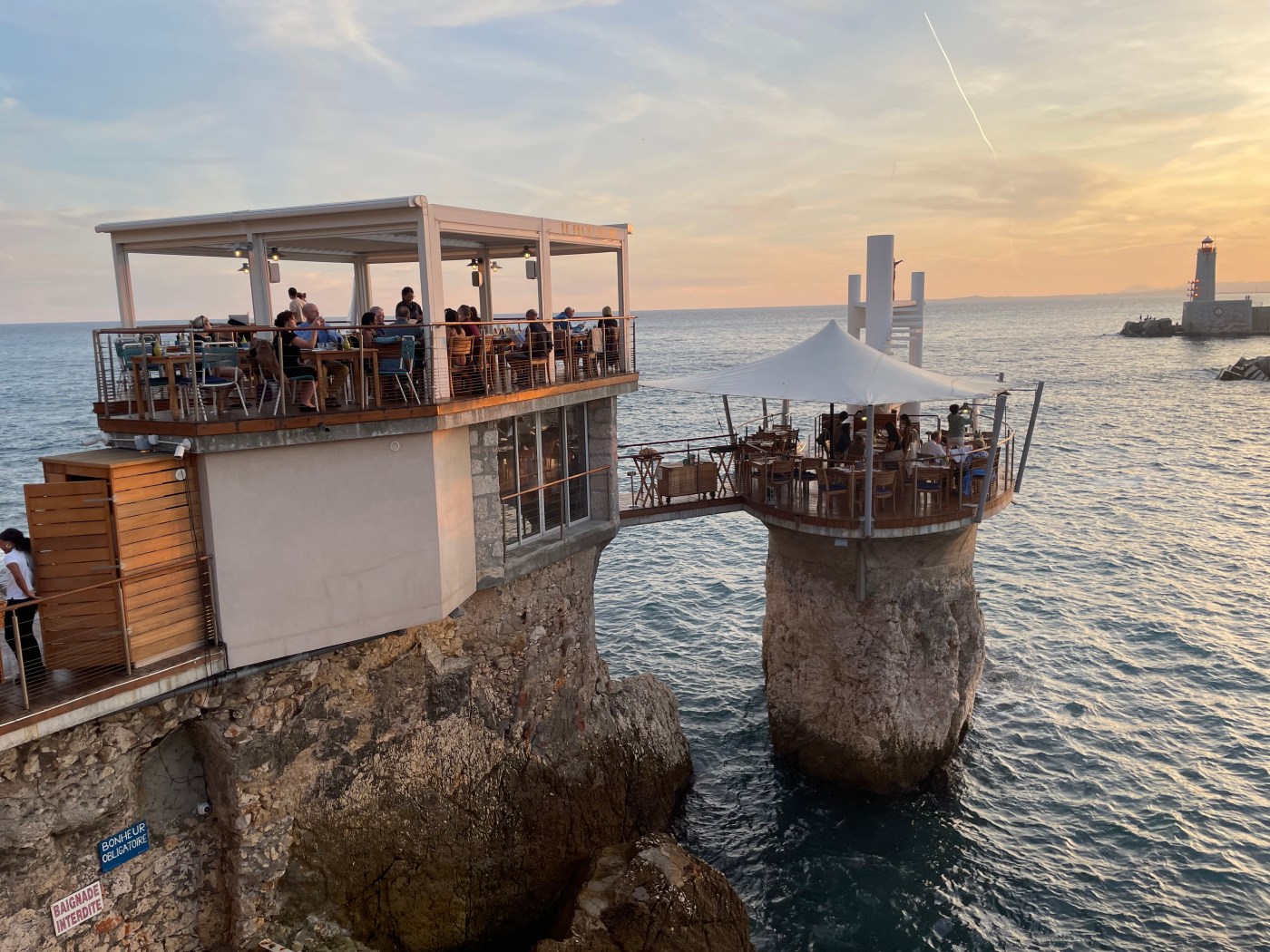
The view from Le Plongeoir restaurant in Nice, France. (Jess Fleming / Pioneer Press)
In the evening, we had reservations at a restaurant I had seen on Instagram (that app really has my number) called Le Plongeoir. The eatery is situated upon a rocky outcropping, giving guests the feeling of dining on the actual sea. We watched the sun plunge into the skyline, providing a splash of pink and orange on its way out. Our meal — steak for my friend and a creamy shrimp risotto for me — was delicious, but honestly, it wouldn’t have mattered what we ate. I’ll never forget our meal on the sea, watching the bright blue waves crash against the rocks as the sun set.
Grasse
Pink umbrellas in Grasse, France. (Courtesy of Mick Richards)
I was honestly not really sure how I would feel about this day, during which we were to make our own perfume at one of the city’s many perfumeries. My nose tends to get overwhelmed easily.
But after a quick tour of Fragonard, which has been making perfume since 1782, I was eager to try my hand at creating a signature scent. It turns out, it’s quite difficult — just a few drops of one of the blends we were given to play with can make a huge difference. In the end, I liked what I created, but also found that French perfume in general has brighter, fresher notes to it than anything I’ve experienced before. I bought some scents that I didn’t make for me and my daughter, but also got to take home the perfume I created. Unsurprisingly, I preferred the ones produced by experts. Those experts, referred to as noses, study intensely to learn how to distinguish scents and combine them to create a symphony of wonderful smells. There are just a few handfuls of great noses in the world at one time, and they are highly revered in France, and especially Grasse.
After our workshop, we were set loose in the streets of Grasse, which are charmingly covered by a canopy of pink umbrellas, hung for Expo Rose, an annual celebration roses in which the streets are decorated with rose bushes, bouquets and exhibitions. We popped into the many charming shops and made a stop for a delicious quiche lunch at a corner cafe.
Cannes and St. Honorat
Spices at the outdoor market in Cannes, France. (Jess Fleming / Pioneer Press)
I knew about the film festival before arriving in Cannes, but that was about all I knew.
Upon arrival, we went straight to the festival hall, which was gigantic, modern and mobbed with television workers and producers there for a conference.
I snapped a quick picture of the stairs with the red carpet before we headed toward the city center and its gorgeous open-air market.
The produce was fresh and vibrant, and vendors offered street foods, pungent cheeses, olives, flowers and more. But the vendor that sucked us in was selling spices out of colorful sacks. He dropped pinch after pinch of fragrant, bold spices into the palms of our hands to try, and it was difficult not to buy some of each. In the end, I walked away with some bright espelette pepper and a lemon-salt-pepper mix that will be incredible on fish.
A chapel on St. Honorat Island in France. (Jess Fleming / Pioneer Press)
We took a short walk from the city center to the harbor, where we caught a short ferry ride to St. Honorat Island. The island is inhabited by 22 monks, who grow olives and grapes from which they make wonderful organic wine. After tasting a few varieties, we walked the tiny island and saw the vineyards, plentiful olive trees and even a few monks, who pray many times a day, between the hand-harvesting of grapes and olives.
Even though the French Riviera is known for its gorgeous weather — boasting 300 days of sunshine a year — it was drizzling while we walked, which only seemed to enhance the smell of the Aleppo pines that litter the island.
In the evening, it was back to old Nice for a dinner of traditional stuffed vegetables, sea bass (or lamb, beef or vegetable dishes for others) and a French entremet (layered mousse) dessert, paired with plenty of wine, of course! It’s worth noting that the rosé wine in Provence (the geographical region the French Riviera is in) is famous for a reason — it is light and crisp with a hint of floral richness that makes it irresistible. And because the French are purists and don’t add sugar or other additives to their wines, we never suffered a hangover, despite imbibing frequently.
Villa Ephrussi de Rothschild
Monaco isn’t the only playground to the rich and famous in the French Riviera — the commune of Saint-John-Cap-Ferrat, where this sprawling villa is located, is the second most expensive place in the world to own real estate, after Monaco.
It’s a peninsula, surrounded on three sides by the bright blue sea, and the Villa Ephrussi, now a museum, occupies a large portion of the northern part of the land mass.
Commissioned by Baronness Béatrice Ephrussi de Rothschild and built in the early 1900s, the palace itself is gorgeous, opulent and filled with impressive artwork, porcelain collections and period furniture.
Views out the windows of the sea are breathtaking, too. But the real attraction here is the sprawling gardens, which the baronness ordered to be built in the shape of a ship so she could be reminded of a cruise she had taken.
Each portion of the garden has a different theme — French, Spanish, Japanese, Provencal, rose and even just one called “exotic.”
The wall in St. Paul de Vence, France. (Jess Fleming / Pioneer Press)
The lush plants and fragrant blooms are dotted by sculptures and fountains. The central pools feature fountains that shoot streams of water into the air, coordinated with classical music pieces. It’s a must-visit spot for gardening enthusiasts or photographers.
St. Paul de Vence
Petra’s description of this medieval walled city as “artsy fartsy” made us laugh — but it was also very true.
Chagall, Matisse, Picasso and more were inspired by its beauty and spent time within its walls. Chagall lived in St. Paul de Vence for 19 years and is buried in its cemetery.
Salmon at Les Sens in Nice, France. (Jess Fleming / Pioneer Press)
Artists and their numerous galleries are still the main draw here, and styles range from pop art to modern art to classical. Boutiques and cafes are also in the mix, and we all enjoyed wandering, sampling and photographing every gorgeous inch.
Upon returning to Nice, we did some last-minute shopping before walking a few blocks to Les Sens, a very French restaurant, for our farewell dinner. This was hands-down the most delicious meal we had during our stay — I love ending on a high note! A spinach tart with a perfectly poached egg and meaty jus started things off, followed by silky salmon in a creamy, herbaceous sauce paired with mashed potatoes studded with tons of black olives (sounds weird, tastes amazing) and ending with a rich, very seasonally appropriate apple tart. The restaurant is no secret — locals and tourists alike were waiting outside for it to open and it was packed to the brim as we were leaving — but it will definitely be a must-visit for me when I return to this beautiful city.
Related Articles
More travelers are using buy now, pay later for holiday trips
This off-grid hot springs spot in Oregon is the perfect autumn getaway
Amtrak aims to double ridership within 20 years
A hot travel trend – the ‘hush’ getaway: Expert tips ahead of holiday season
3 tips for saving money on your next vacation, according to a frequent flyer


More Stories
High school roundup/scores: Two hat tricks lift Medfield to 10-4 win over Grafton
In nonleague boys hockey action, Jason Drake and Michael Cortis each netted hat tricks as Medfield cruised over Grafton 10-4....
Massachusetts animal rights advocates alarmed after local PD kills ‘disoriented’ raccoon
Massachusetts animal rights advocates are sounding the alarm after a local police department in Worcester County euthanized a raccoon described...
Boston Fleet lose to Ottawa Charge after lengthy shootout, 3-2
OTTAWA, Ontario (AP) — Brianne Jenner scored in the eighth round of the shootout as the Ottawa Charge defeated the...
Patel says FBI headquarters to ‘permanently close’ with move
FBI Director Kash Patel said the agency’s historic-but-aging headquarters in Washington would be “shut down permanently” as he shifts personnel...
Google is letting users swap out embarrassing Gmail addresses without losing their data
Google has finally answered users’ cries, allowing Gmail users to swap out embarrassing teenage email addresses. Gmail account holders can...
How Gophers football plans to attack transfer portal next week
PHOENIX — Leaders of the Gophers football program discussed one of the biggest hot-button topics over dinner last week at...